

Mika Godts scored 17 and assisted 12 goals in the Eredivisie this season. He was then not chosen for Belgium’s World Cup squad, even while he [James] garnered interest from sides like Arsenal, Chelsea (anyone surprised?), and Bayern Munich.
So why, then, did Belgium leave him behind? Is it because of a major weakness? If so, can he fix it? And if that weakness is so significant, how did he manage to put up such good numbers?
Let’s find out.
📚 Contents
Note for email readers: This email may be truncated. To read the full article, please click on this link or the link to the right of [Message clipped] note at the bottom of this email.
The Overarching Issue
A lot of Mika Godts’ issues boil down to one fundamental fault: he struggles to reliably, and consistently, find separation. The issue with that is, well, that’s a pretty major problem to have when your MO is that you’re a dribble-y winger who’s looking to scale up from the Eredivisie.
Avoidant Dribbling
Given that Godts can’t really find separation, he often resorts to dribbling ‘around’ his man, as opposed to driving at him. While this sounds logical (why dribble at your man and risk losing the ball when you can avoid him entirely and still get past him?), it does limit the solutions he can create in closed spaces.
This is, in part, down to the fact that dribbling as an evasive manoeuvre (as opposed to one that’s to increase the threat your side can create on the flanks by going direct), depends on the opposing full-backs’ willingness to “jump” at your dribbles, therefore leaving space to run in behind.
In other words, the space Godts tends to exploit doesn’t exist if the full-back stays jockeying, instead waiting for him to engage, because he simply… won’t?
Of course, he would still try to dribble around his marker, but I think it’s fairly easy to just force him out wide (towards the touchline), from where the space he has to work with — therefore his effectiveness — further diminishes.
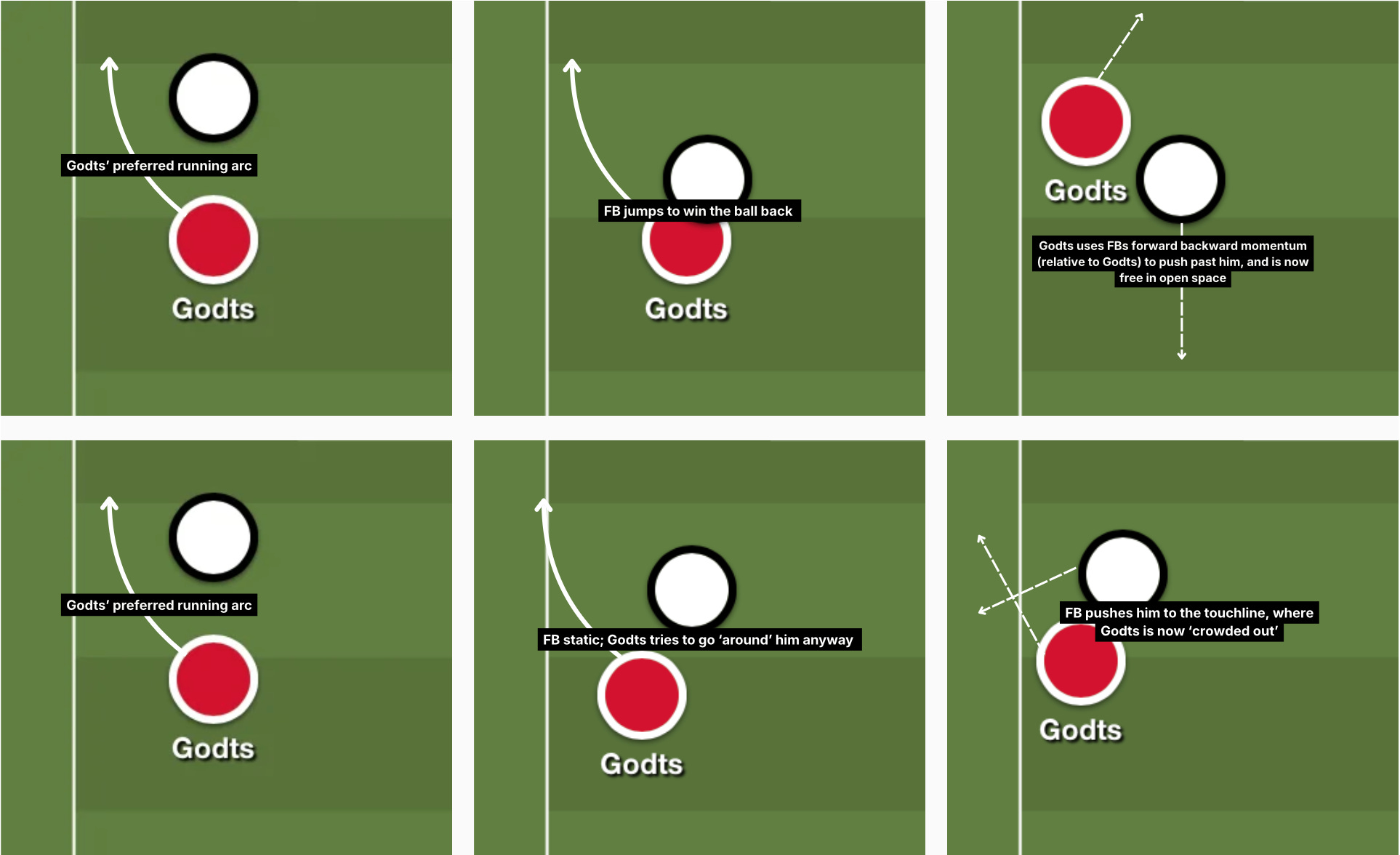
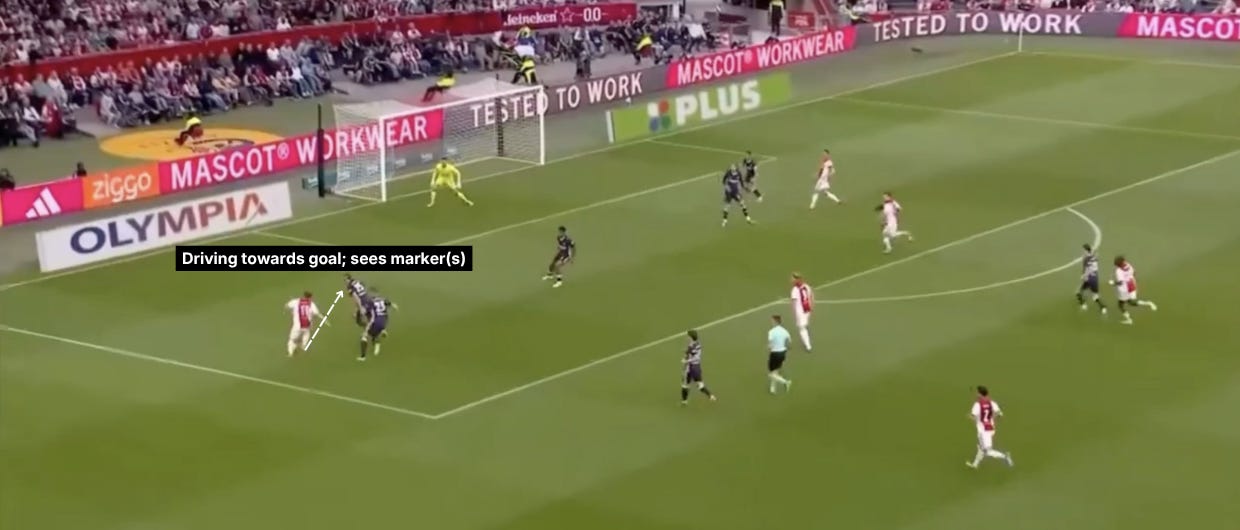
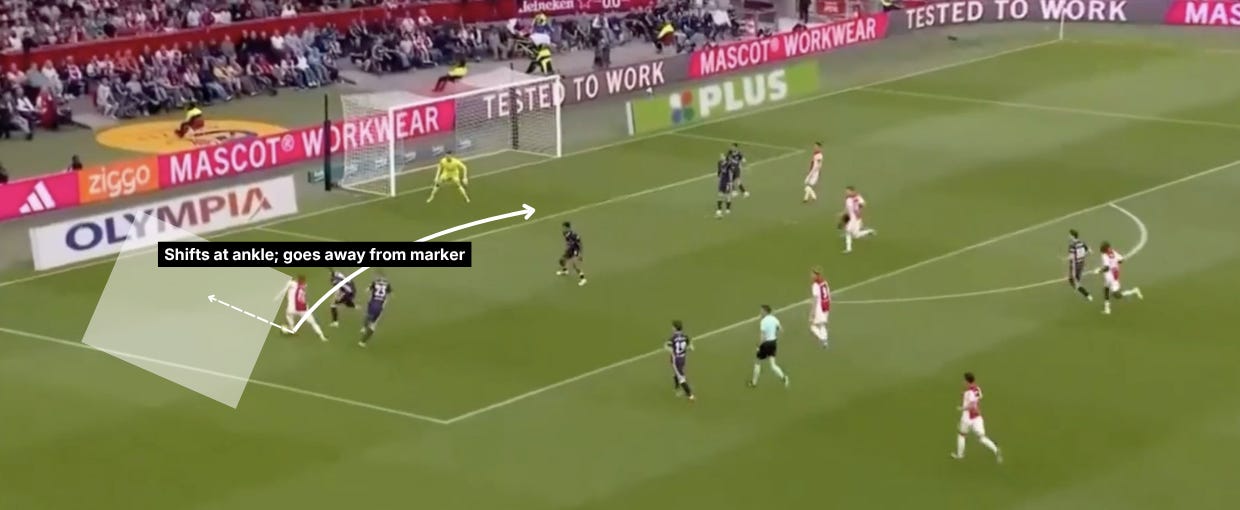
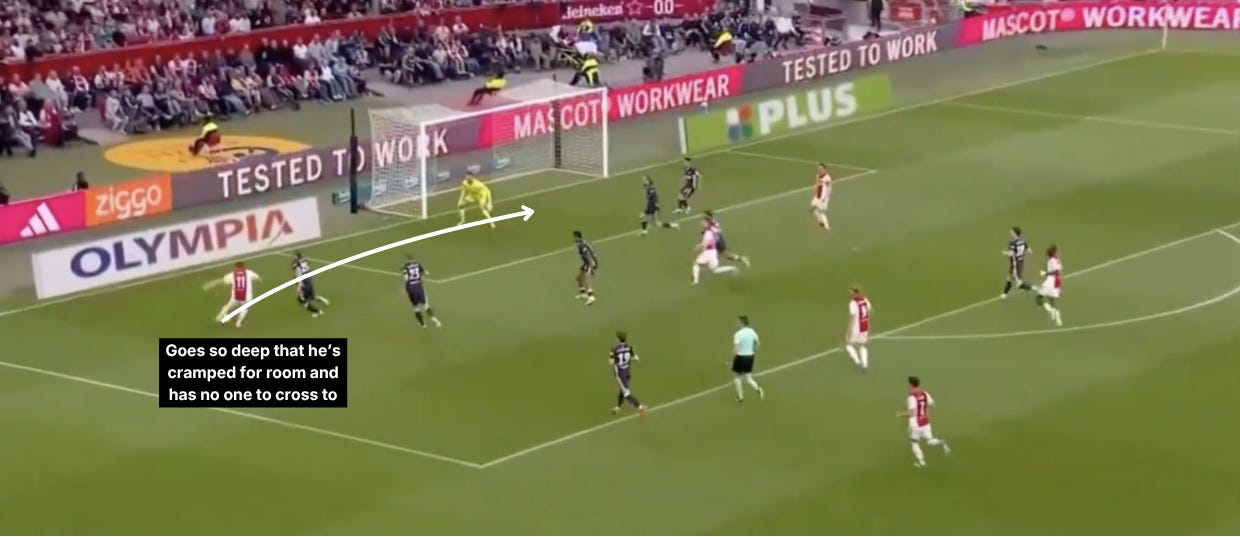
Let’s say, even whilst knowing this, the full-back jumps anyway. Well, Godts can get past him then. But in doing so, he is still going around him. What this means is that he’s actually going away from goal in order to then get closer to goal.
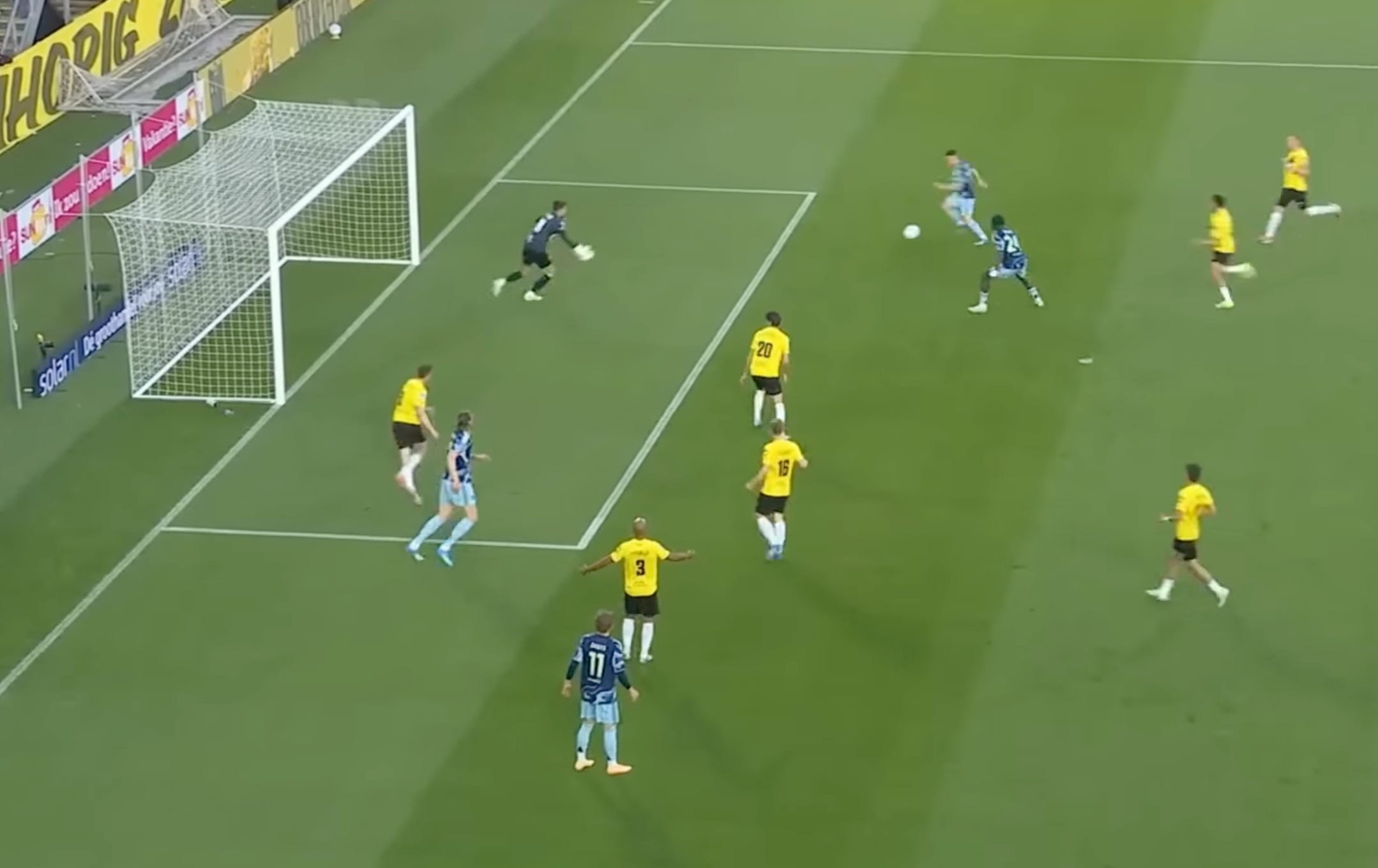
This is fine if this entire sequence happens farther from goal, giving Godts space to run back into before getting a shot off, but if it happens close to goal, he runs the risk of running too deep, to the point that he’s closing a crossing channel on himself:
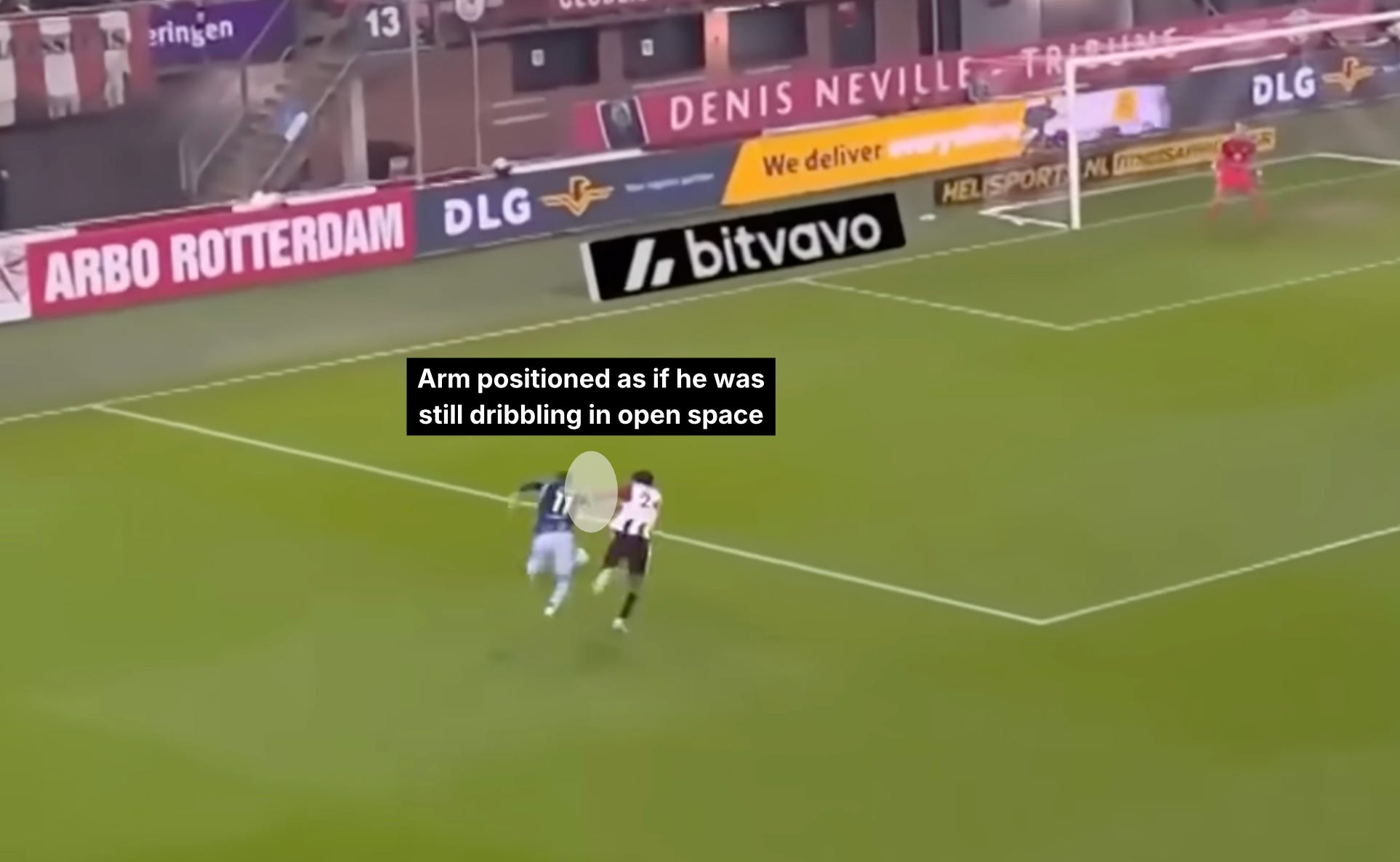
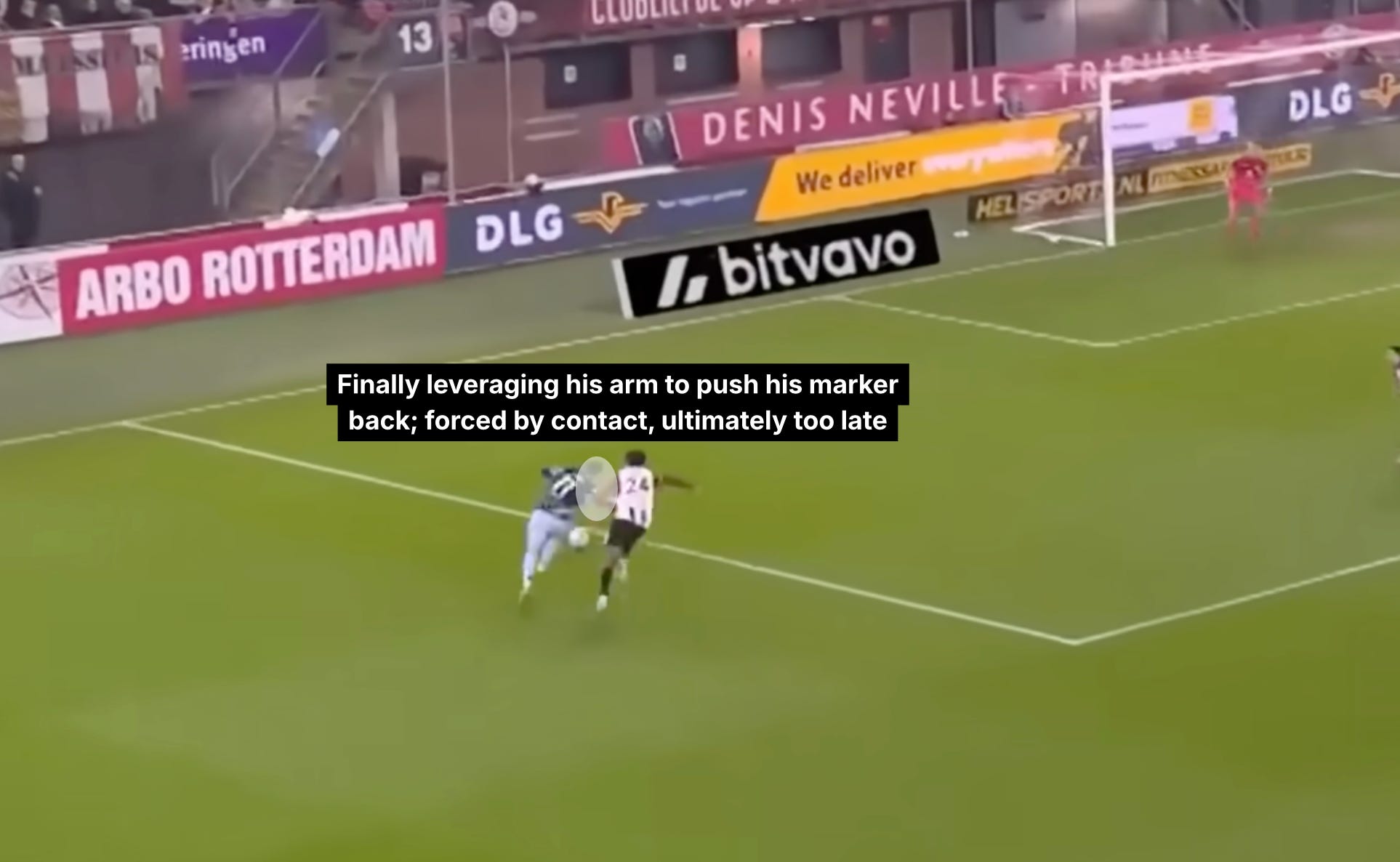
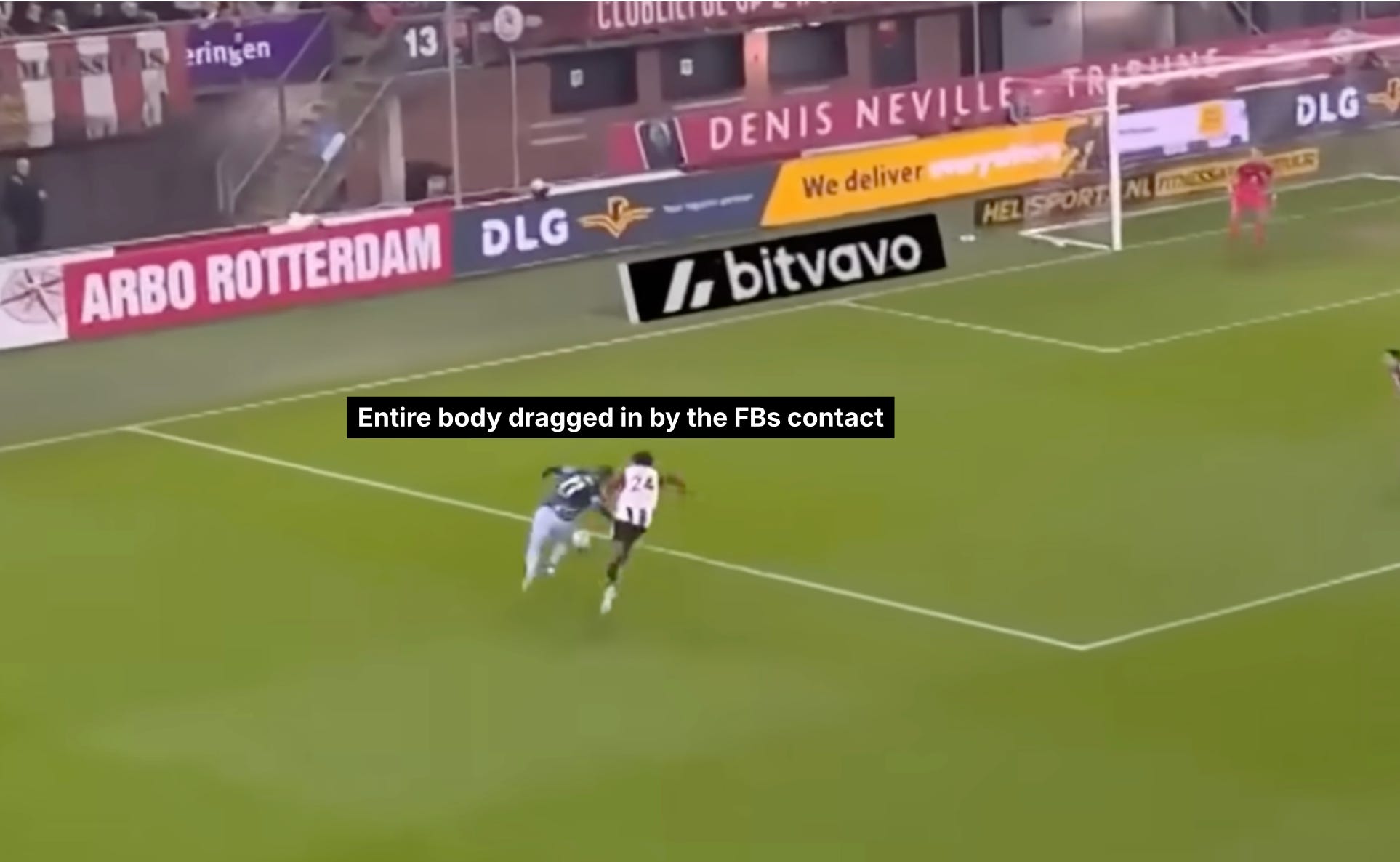
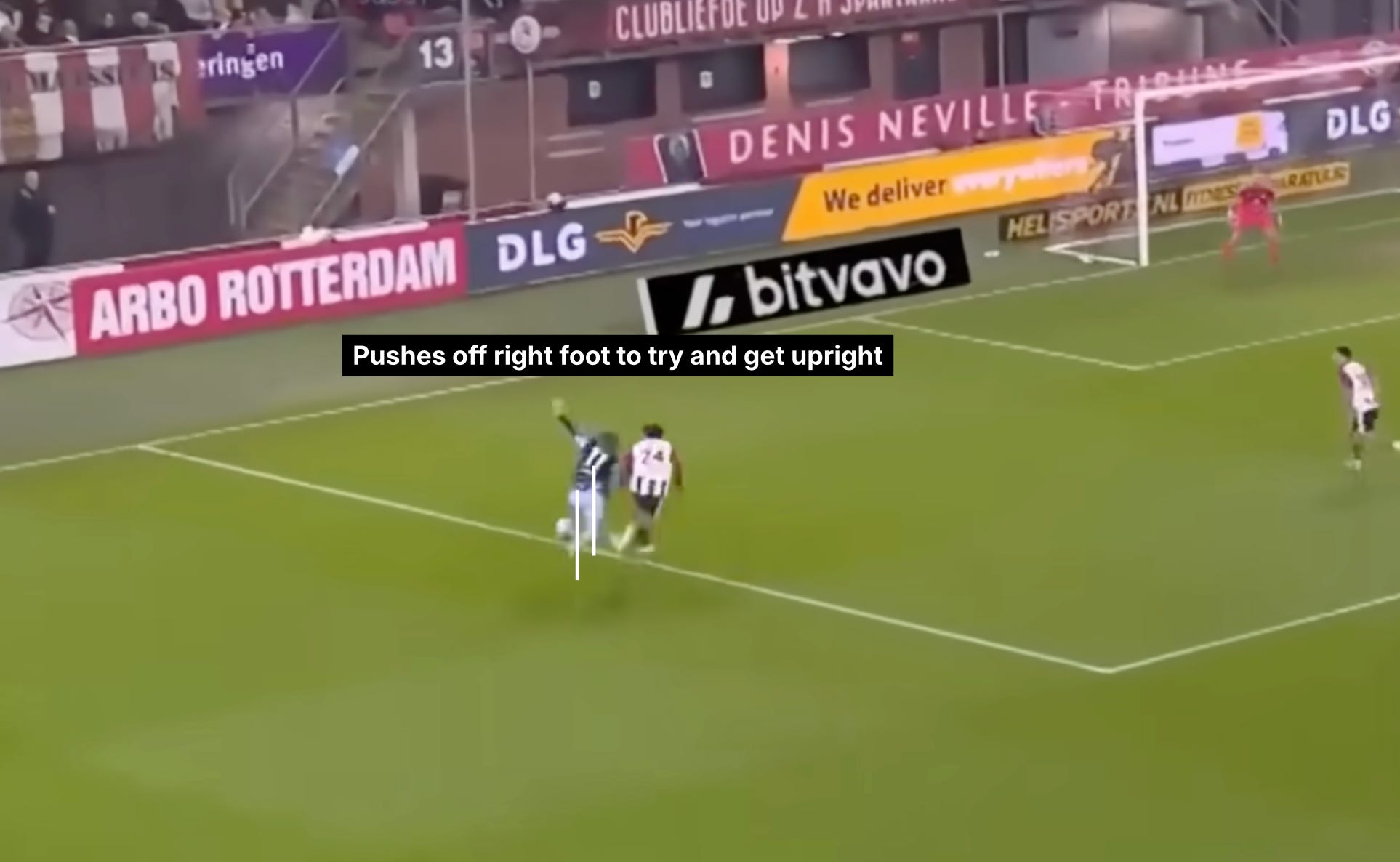
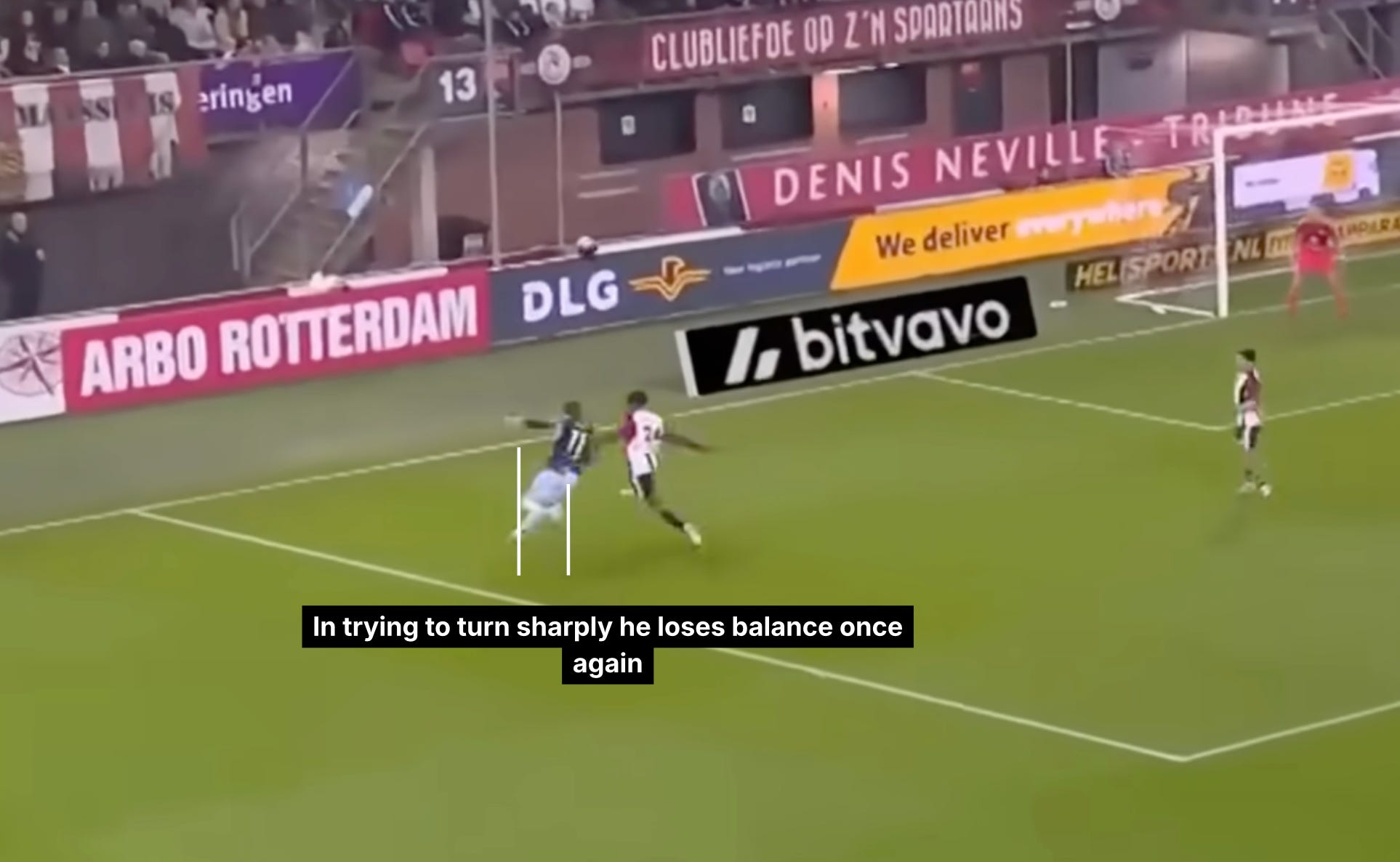
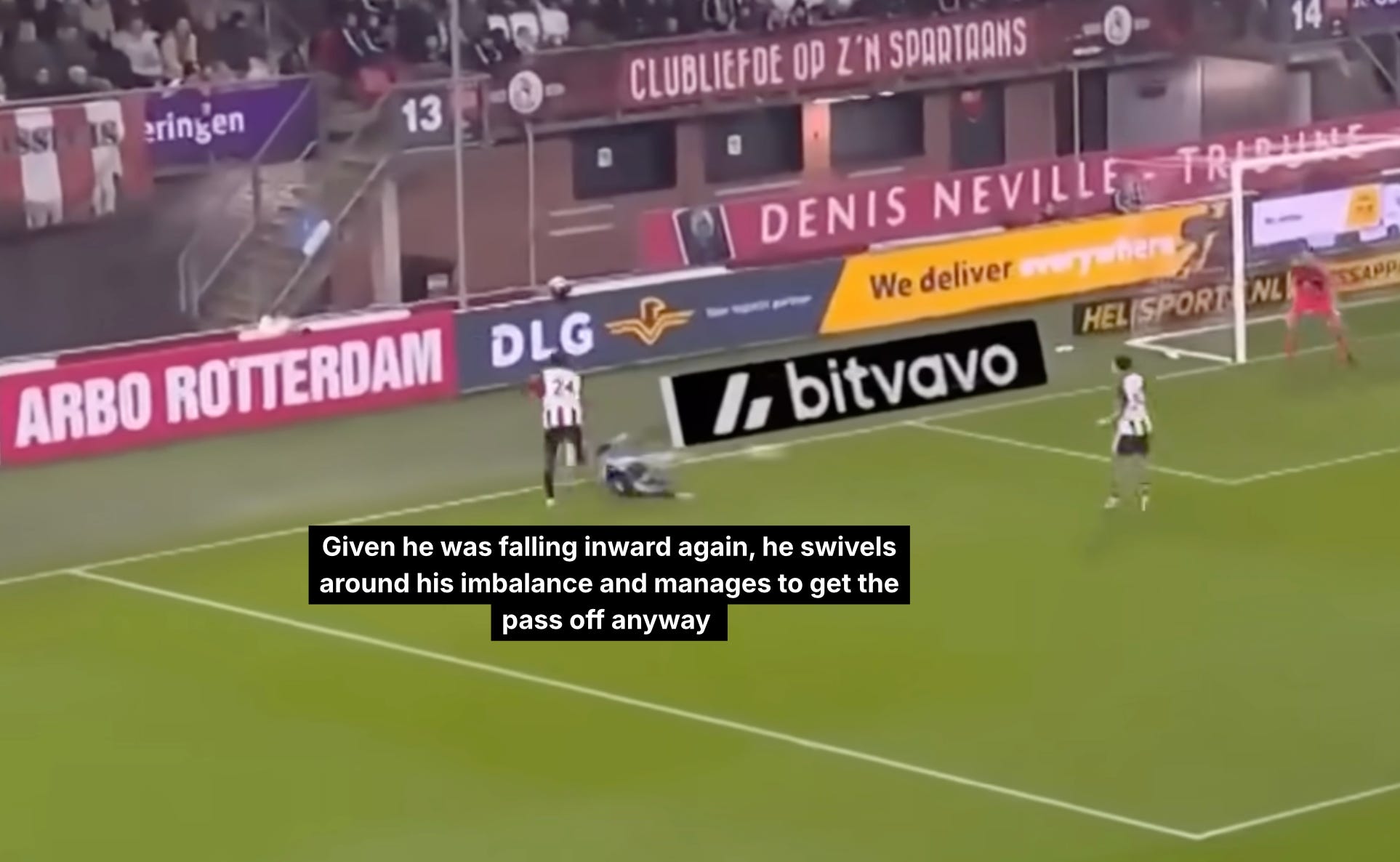
When Godts does engage, however, I find his [stiff] arm is often not stiff enough to actually hold his marker back (worrying). Consequently, any contact makes him fall inward as he’s pulled towards the challenge.
That said, he’s oddly spring-y on his toes when falling, meaning he’s able to semi-stabilise his centre of gravity and keep himself from fully falling over, which works until he’s trying to change direction again, at which point his shoulders are in a different stratosphere to his toes and he likely falls down:
Inefficiency and Scalability
Godts’ running is built on being step-heavy, meaning he takes ages to gather momentum. Not only does this mean that his burst of pace on the ball is lacking, but it also gives defenders an opportunity to whisk the ball away from him, given how long he takes to get going:
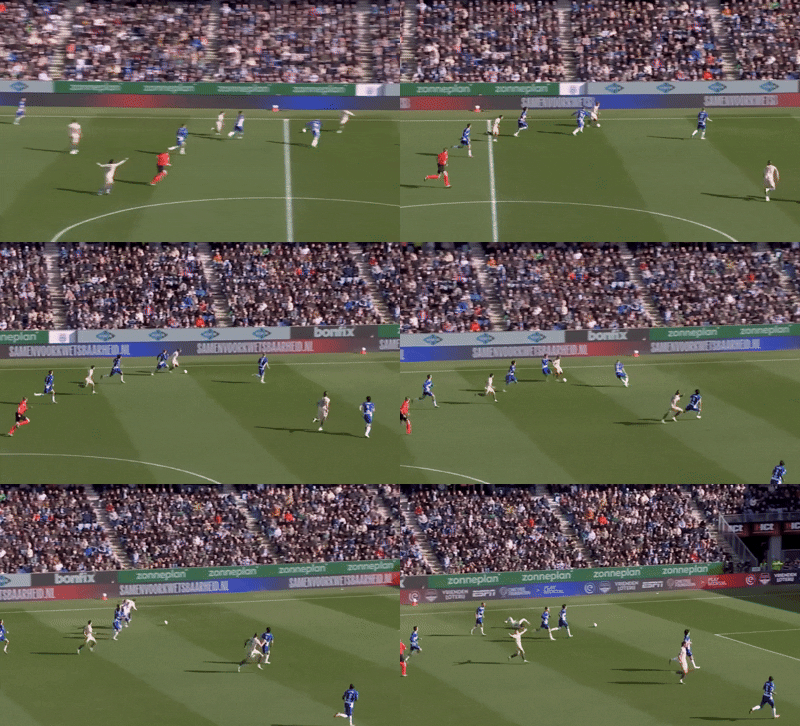
That inefficiency also tires him out more than needed (wasted steps = wasted efficiency across every match he plays), while giving defenders more time to anticipate where he’s going, therefore making it easier for them to do the whole close-off-running-arc plan routine detailed above.
This need to carry momentum (by running into space) likely worsens his unwillingness to take his man on [directly], given that if you can’t accelerate instantaneously, you’re more likely to be a step behind a defender who has less ground to cover than you do.
Consequently, I think Mika Godts isn’t ready to play for a side that expects to face low blocks on a regular basis. Actually, let me rephrase that. I don’t think Mika Godts is ready to face low blocks on a regular basis.
His whole dribbling principle is based on time and space, and this isn’t time or space he creates (meaning he lacks self-sufficiency), but the time and space that situations afford him. He can’t do that vs low blocks. So without that burst from a standing start, or more confidence/strength to run at his man, can he keep up his current level of chance creation? (No)
Predictability in Solutions
As I alluded to earlier, Godts’ inability to create separation [for himself] means he’s rather limited in the solutions he can create on the pitch. If he tries to run into clamped spaces, he either turns the ball over, or realises halfway through that that just isn’t something he can [currently] do, so he goes backwards and recycles play.
While that’s fine, I don’t think it’s something you’d want your winger to repeatedly do, especially to the point of predictability. Furthermore, it’s not like his first move (running around his man) is perfectly refined either.
His left foot is also distinctly… average. It’s not bad, per se, but if you’re a player who’s limited by solutions (and not by ideas for solutions), then being two-footed would go a long way towards making [unpredictable] things happen on the pitch.
So, all in all, what I’m getting at here is that Godts currently really, really limited by the solutions he has when it comes to playing the ball forward (and in general team-scale ball progression), and he doesn’t have one solution that he’s world-class at.
Finishing
What Godts IS good at, however, is shooting the ball. He frequently hits the corners, and is able to get a shot off from more or less any position imaginable.
He’s especially good at playing across himself, though, so if he does find himself running at the keeper when isolated from the left, he’s equally comfortable aiming for the near or far post, making it doubly hard to guess where he’s going.
Aggressively shifting at the ankle:
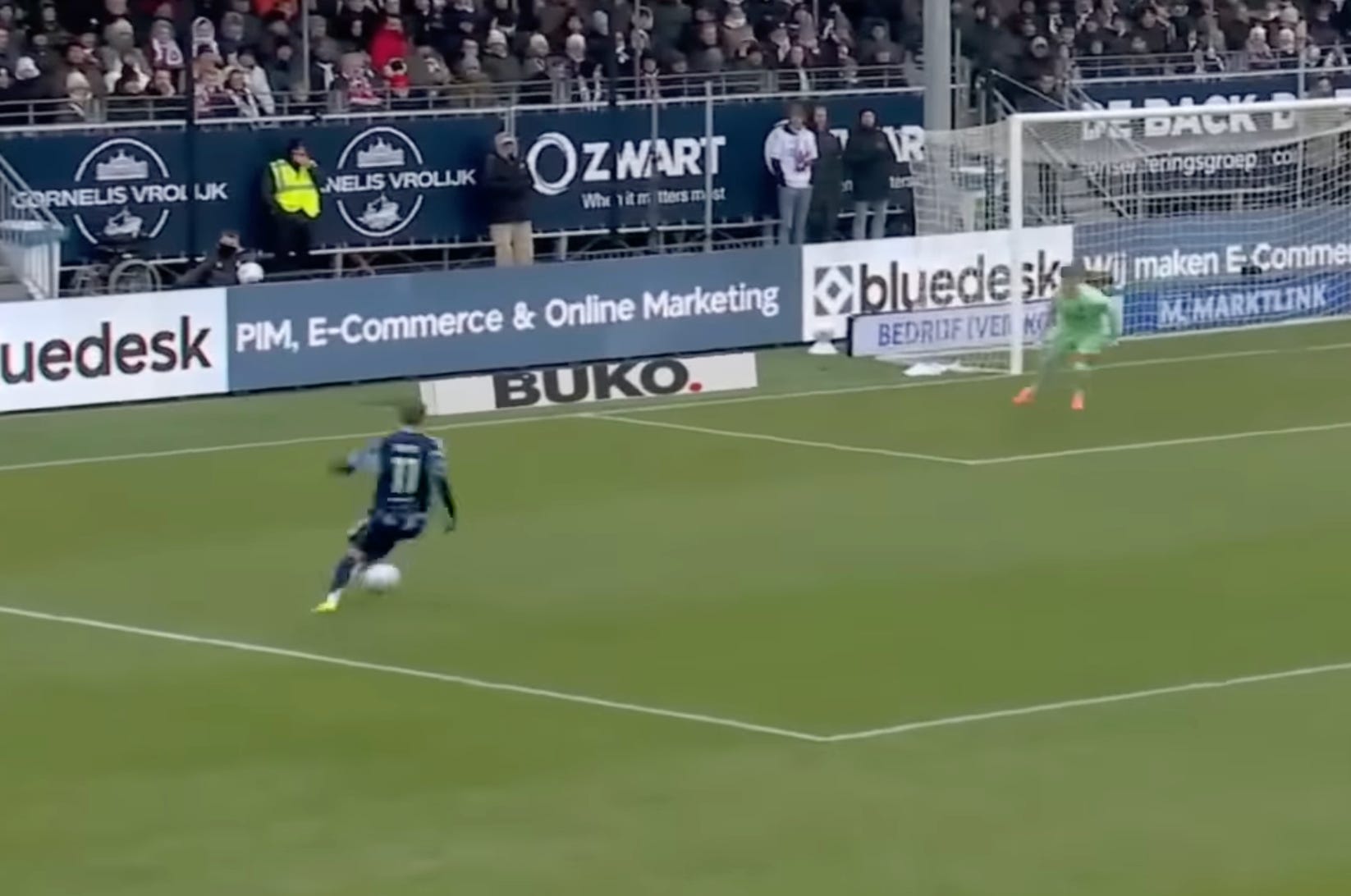
To then gauging a shift in the keeper’s weight distribution:
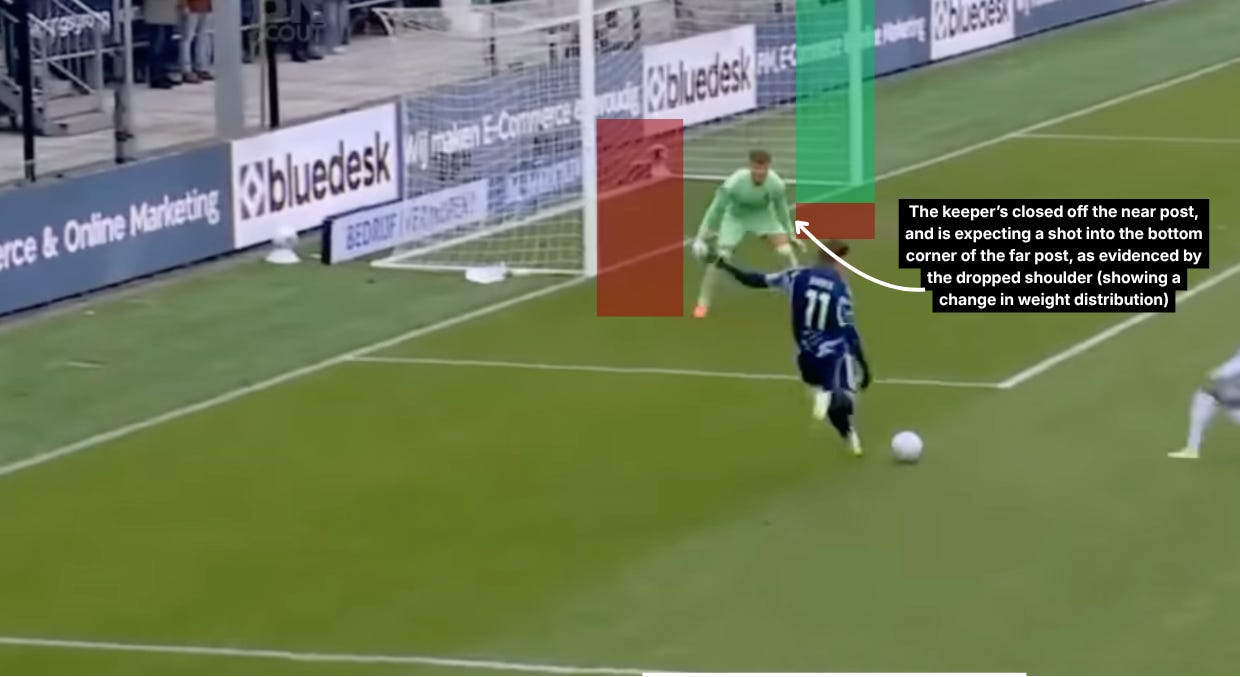
And swivelling to deceive; using the keeper’s angles against him
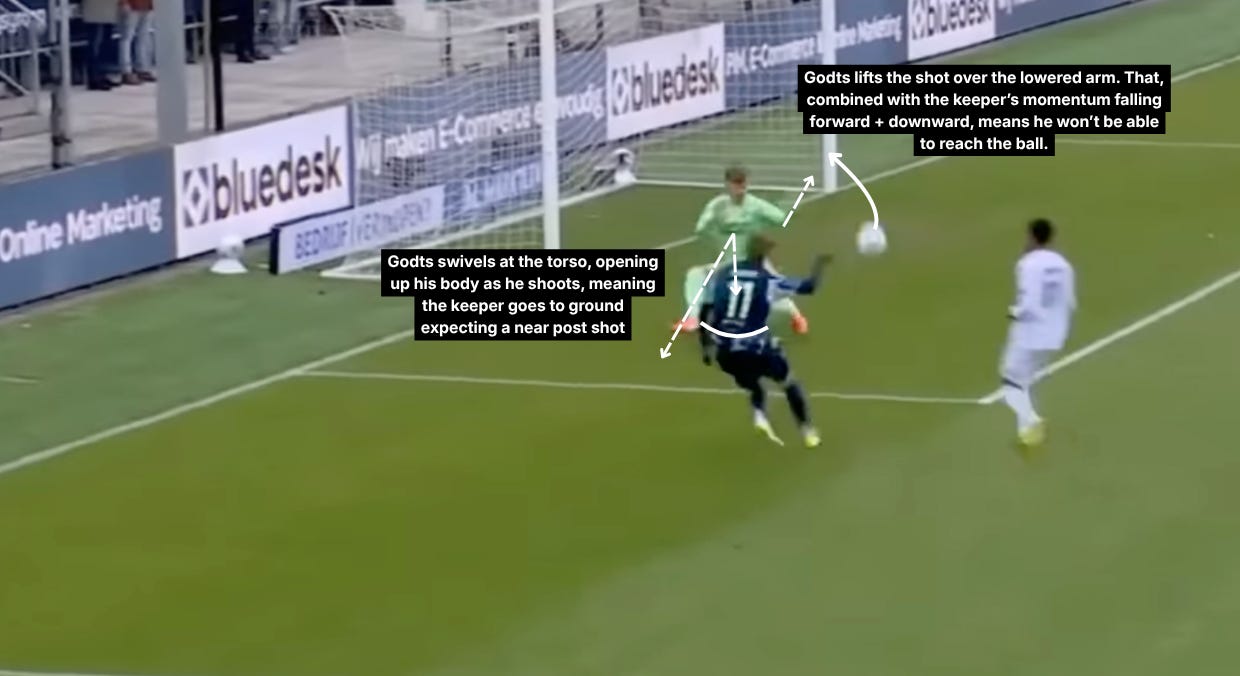
He’s also quite good at getting a shot off in stride, which, while valuable on its own, does some heavy lifting here given his difficulties in creating separation.
Essentially, he’s able to get a shot off whilst decelerating, which not only reduces the time he needs to shoot the ball, but is also more likely to catch the keeper off guard.
Vision and Temperament
The issue with Godts’ next big strength is frustrating purely because he’s being limited by the solutions he allows himself to create.
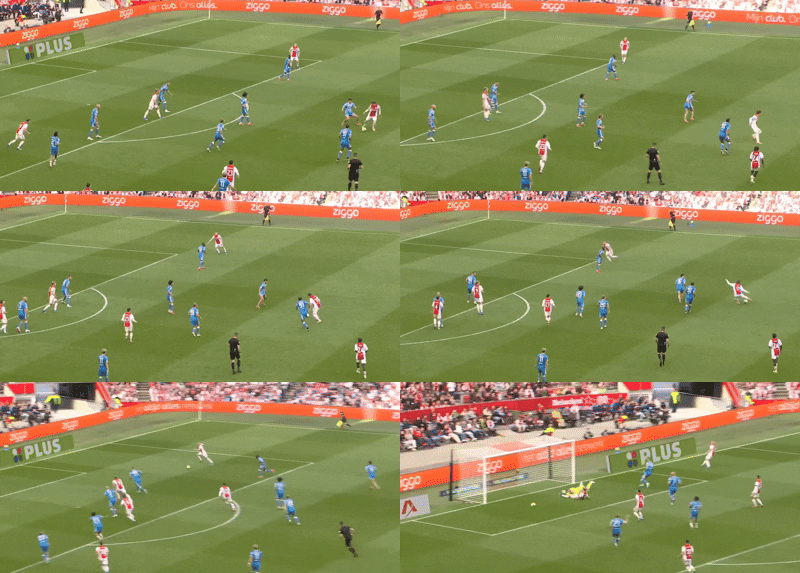
His weight of pass (he almost never underhits passes, unless it’s a long ball) and vision are both quite good:
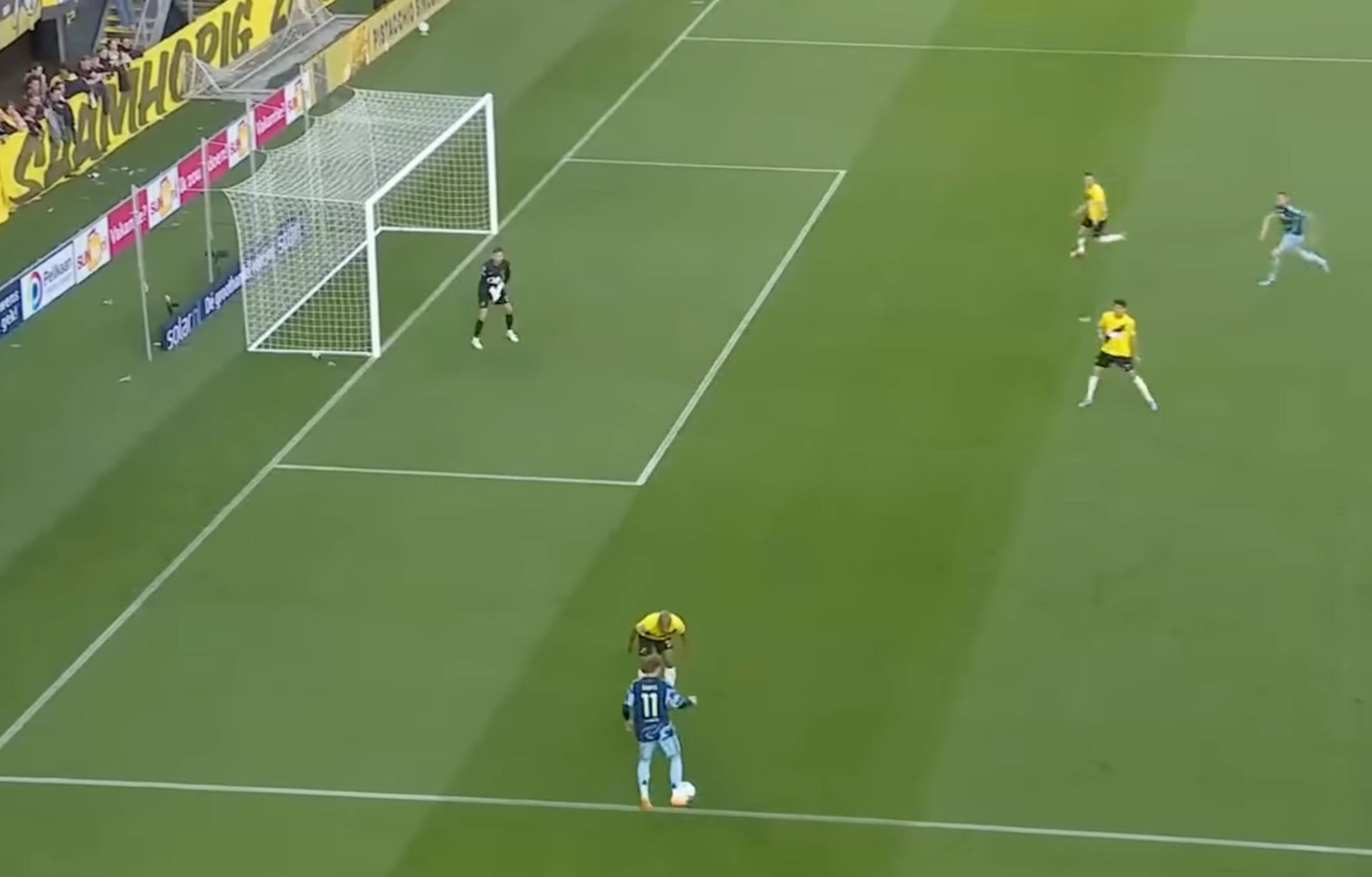
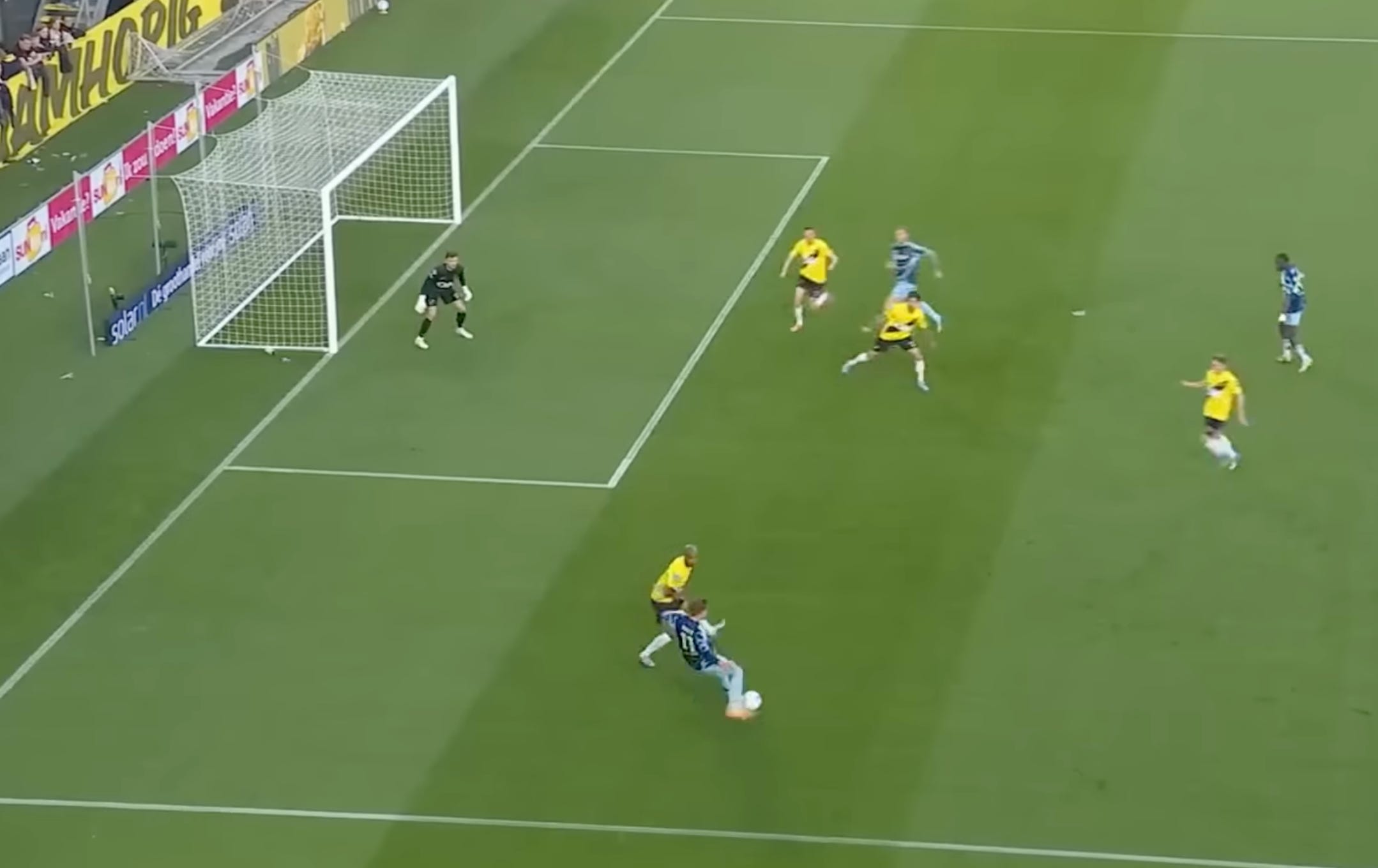
Now that we’ve seen both these pictures, where do we think his pass goes?
If you guessed literally anyone, you’d be… 🥁 wrong
It takes a certain kind of temperament (especially from a dribble-y winger) to look up, take his time, and thread a pass through to someone who was ~20 metres away at the time, so I do quite like that Godts is able to do so. It does also fill me with hope that he could be a pretty fun 10 if he becomes more comfortable with his left foot.
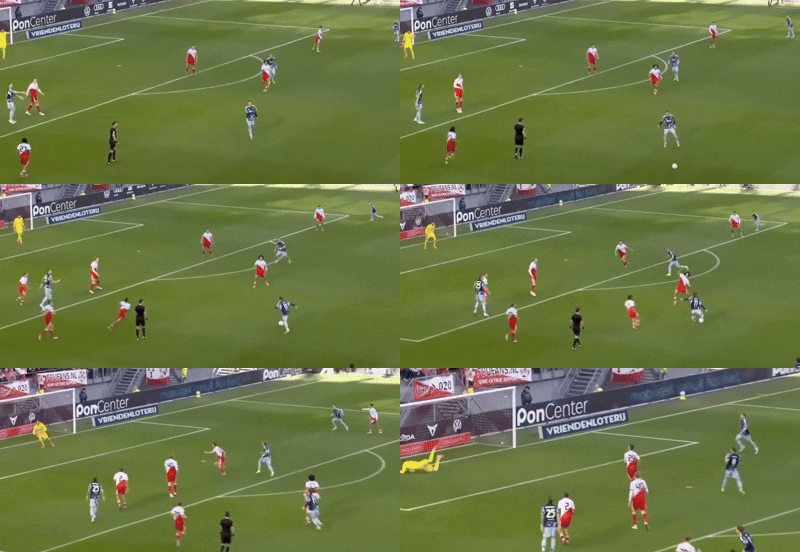
Godts also understands angles really, really well. The latter actually enables him to do well enough in tight spaces (good close control before the last dribble in an action) assuming those spaces are tight centrally, given he has enough room to run away from his man:
Anyhow, this understanding of angles means he’s always pretty aware of his surroundings (see efficiency of scans in the milliseconds before he receives and the decisiveness in the decision to drive + shoot):
You can see the full extent of this when he’s carrying (or receiving) in open space, given he’s able to shift direction at speed, whilst carrying at equal speed, and he does like to cut inside and ‘float’ on occasion.
I do wonder if that’s the strategy for him: cut in, get central where you may have more space, from where you could either lay it off, or try and run around your man either inside or out wide (though the latter depends on him improving his left foot and assumes he’s still unwilling to run at his man).
Profiling and Conclusion
While I think Godts clearly has the ability to become a really good player, I don’t think he’s currently at that level. Moreover, I do believe you’d need to “manufacture” scenarios around him, so as to hide some basic issues.
In an ideal world, that could look something like this:
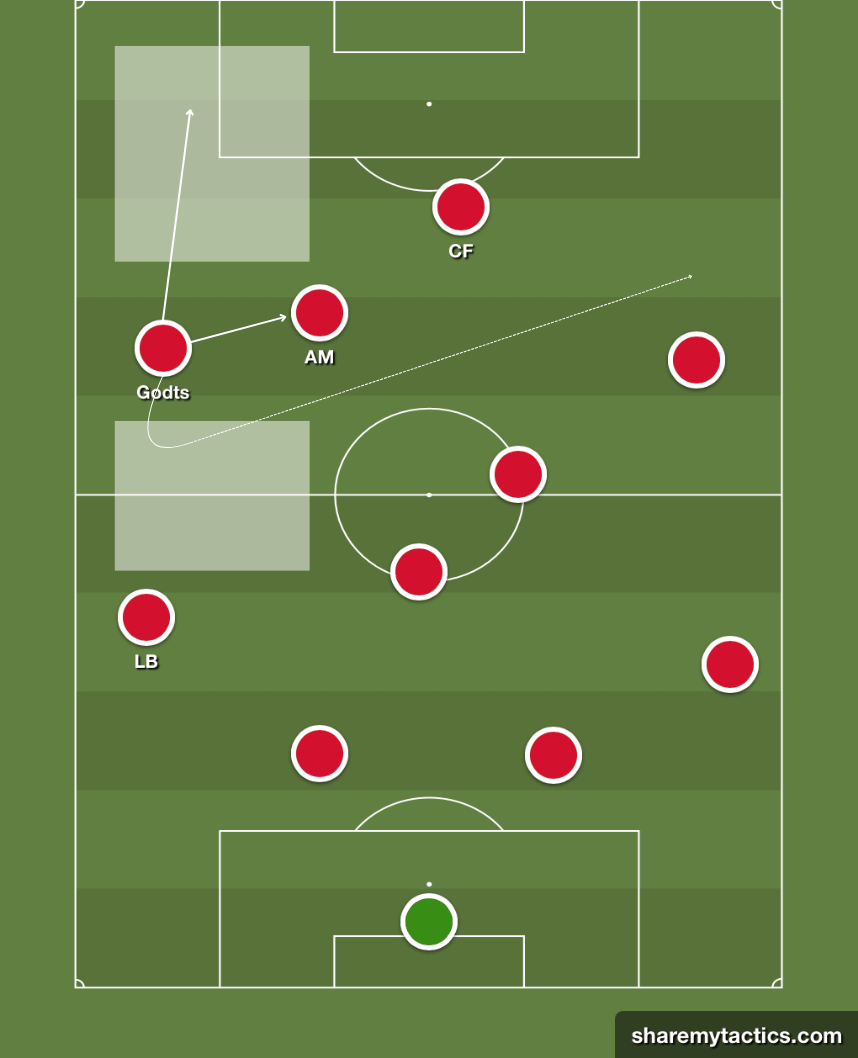
You need to give Godts:
— Space in front of him to run into
— A player close by with whom he can play 1-2s before running in behind
— A striker who’s comfortable barraging through a few CBs, so as to reduce the number of bodies between Godts and goal
— Enough room behind him to either play a simple pass to the LB, or switch play to an isolated right winger
Resulting in a final shape that looks something like:
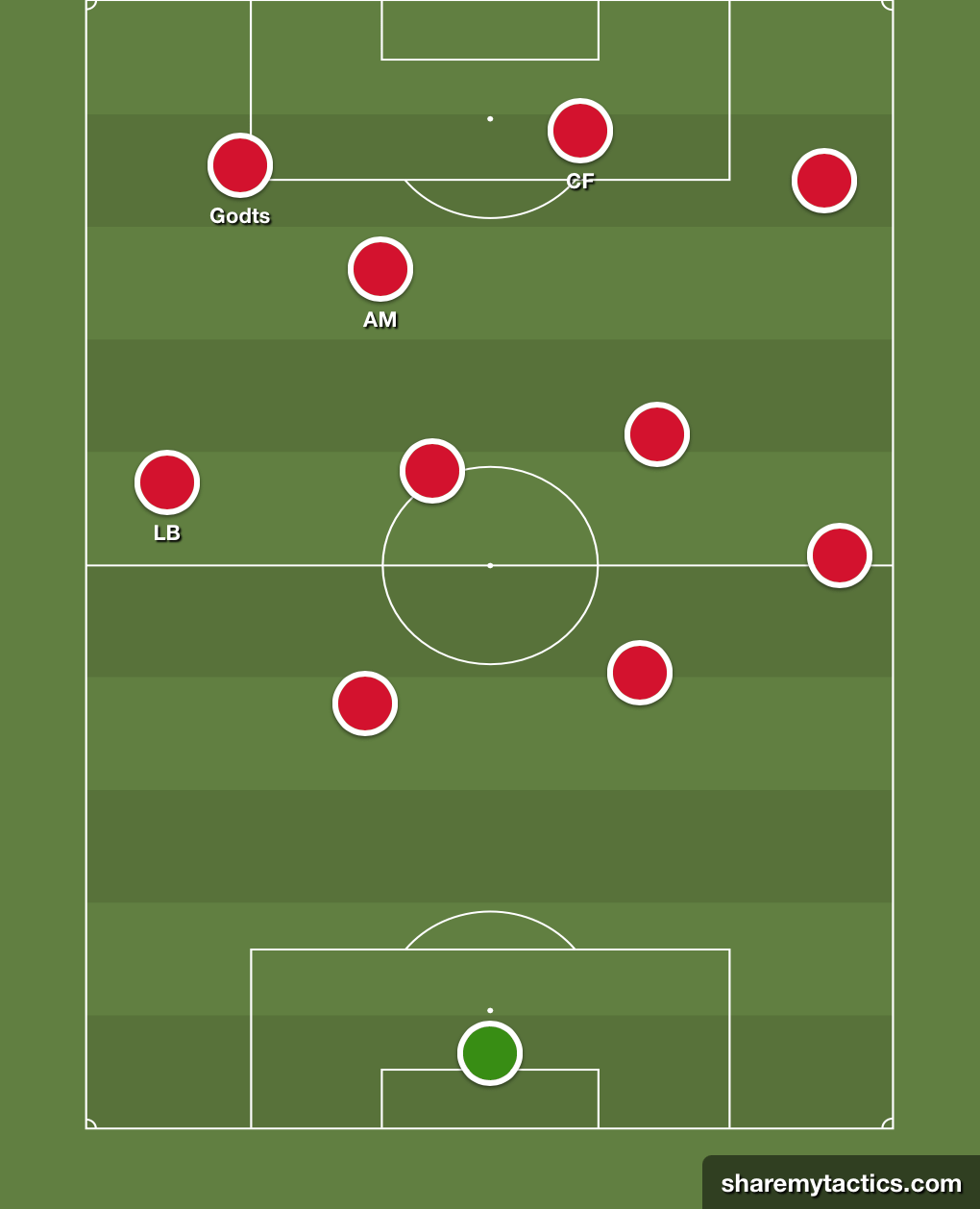
From where Godts can either drive forward and play a ball across the box, or cut inside and curl/drill one in.
On the whole, and as mentioned before, I think the number of factors you need for an “optimal” environment around Godts shows why he isn’t the finished product, nor the saviour of your club, just yet.
If his effectiveness can be diluted by either taking him out of a transition-based style of play or having him try to unlock deep blocks with dribbling (he could do fine with passing, but you can find better passers for that), he likely won’t suit the best teams in the world just yet.
But hey, if he becomes more comfortable dealing with contact, he has the tools to become pretty darn good. But, regardless of his 29 goals and assists in the Eredivisie this season, he just isn’t there yet.
Thank you for reading! I hope you enjoyed. If you did, please consider subscribing (it’s free):
Or sharing this with a friend:
Take care, and have a great week ahead!
If you’re interested, here’s more of my work:


