

📚 Contents
Note for email readers: This email may be truncated. To read the full article, please click on this link or the link to the right of [Message clipped] note at the bottom of this email.
False Fullbacks and a True Carlos Baleba?
It’s worth noting that Hürzeler had to move away from his preferred back four of Kadioğlu - Dunk - van Hecke - Wieffer following Wieffer’s injury. While Veltman seemed the natural choice to fill in at RB, Hürzeler instead played de Cuyper at LB and Kadioğlu at RB (presumably down to the quality of opposition → game state).
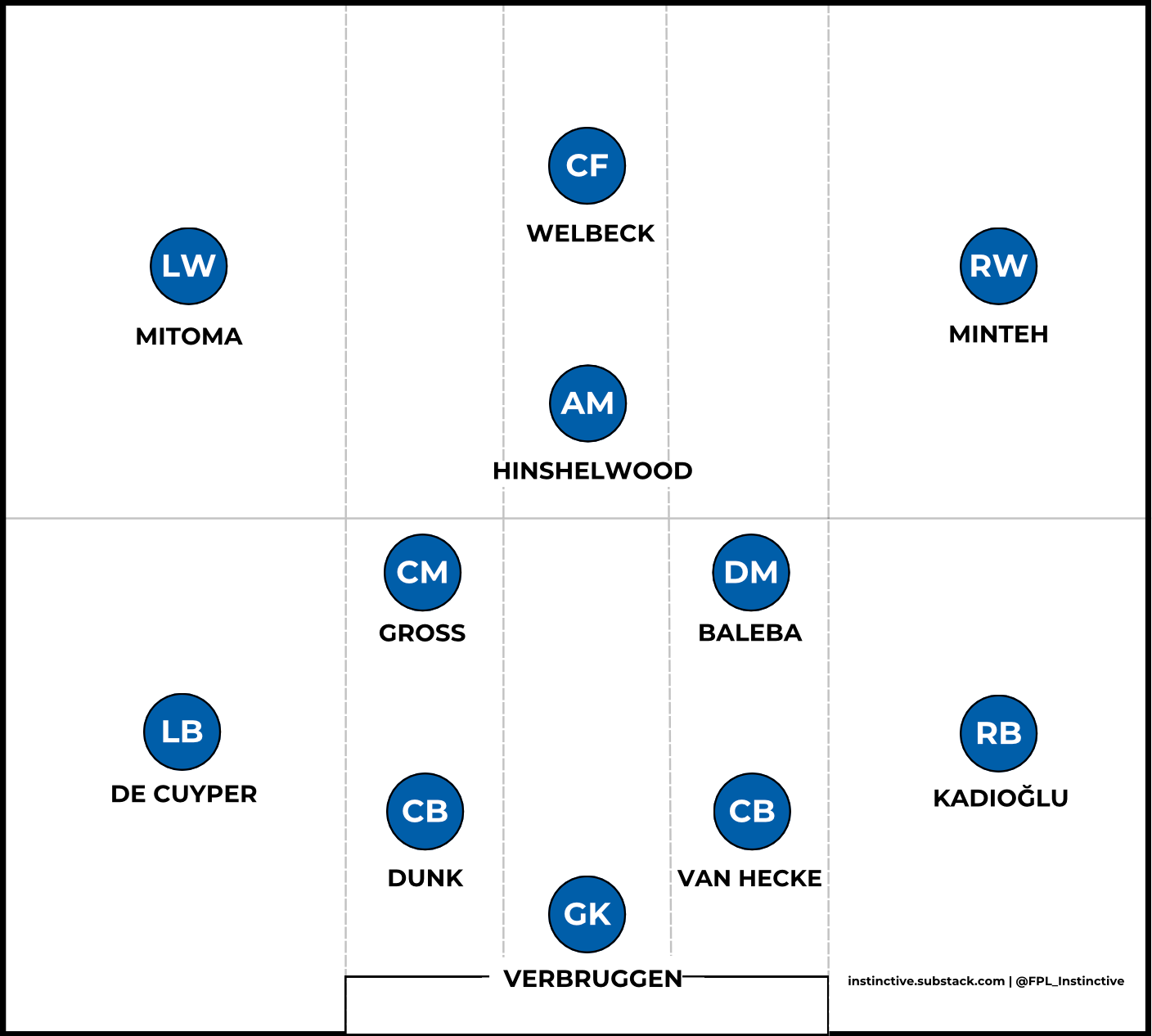
Consequently, Brighton’s flanks lined up with a pair of fullbacks that are both more winger-y than your stereotypical, passive FB. Both de Cuyper and Kadioğlu have played decent minutes as left and right wingers respectively, and like getting to the byline and finding a crossing option.
Ahead of them, you have two direct and expansive wingers. Sure, Mitoma and Minteh have experience defending as wingbacks, but ultimately, they get the ball, put their head down, and drive at their man.
In theory, this should mean both flanks end up somewhat neutralising themselves. The fullbacks overlap, but in doing so, run into the spaces the wingers want to dribble at, and BAM! Brighton do nothing in attack and become gettable in transition.
Well, that’s what it should mean. But, à la PSG, that wasn’t the case.
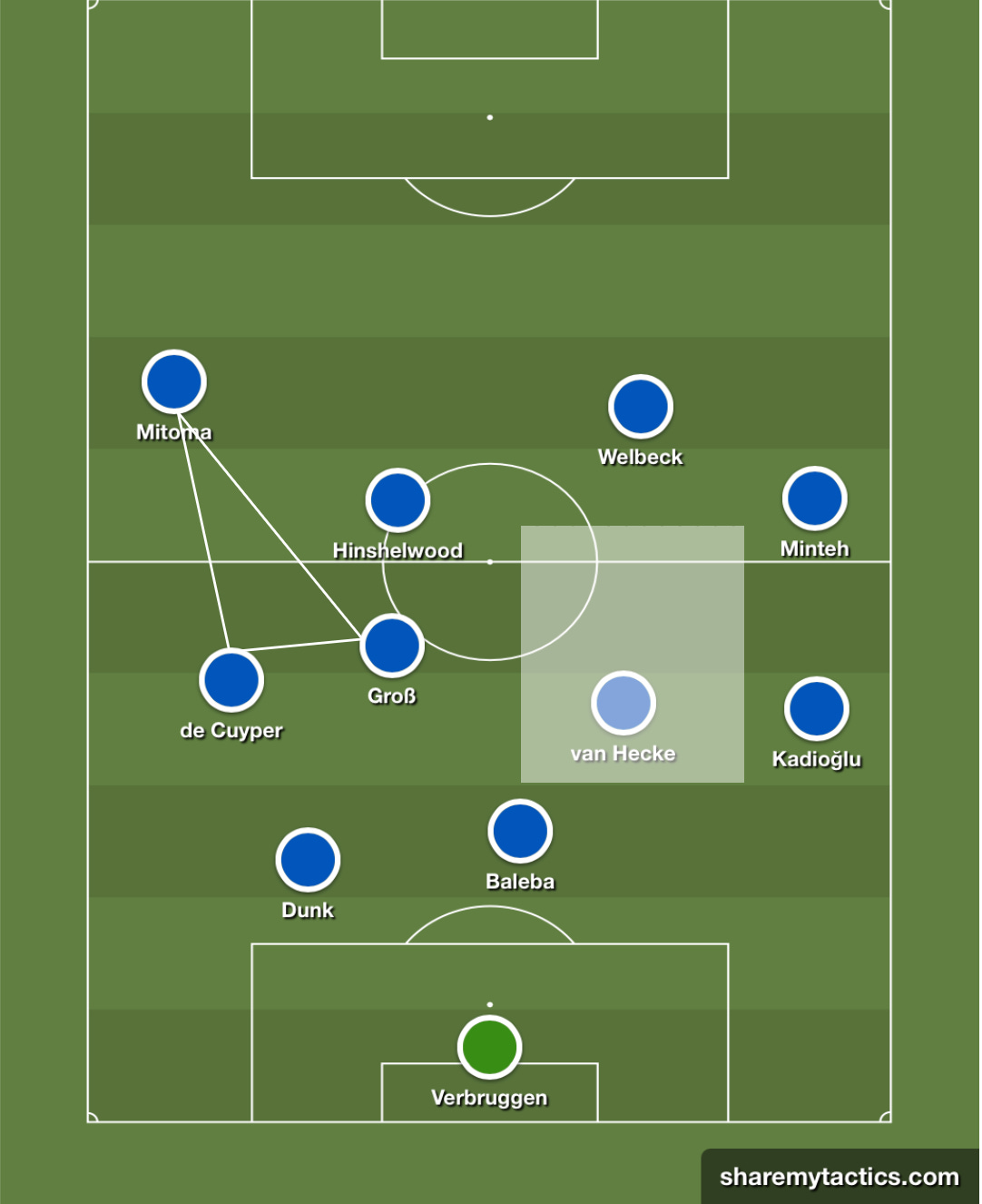
Hürzeler’s setup created enough separation between the fullbacks and wingers for both to play to their strengths pretty effectively, largely because both fullbacks stayed fairly narrow until it became clear what the wingers wanted to do.
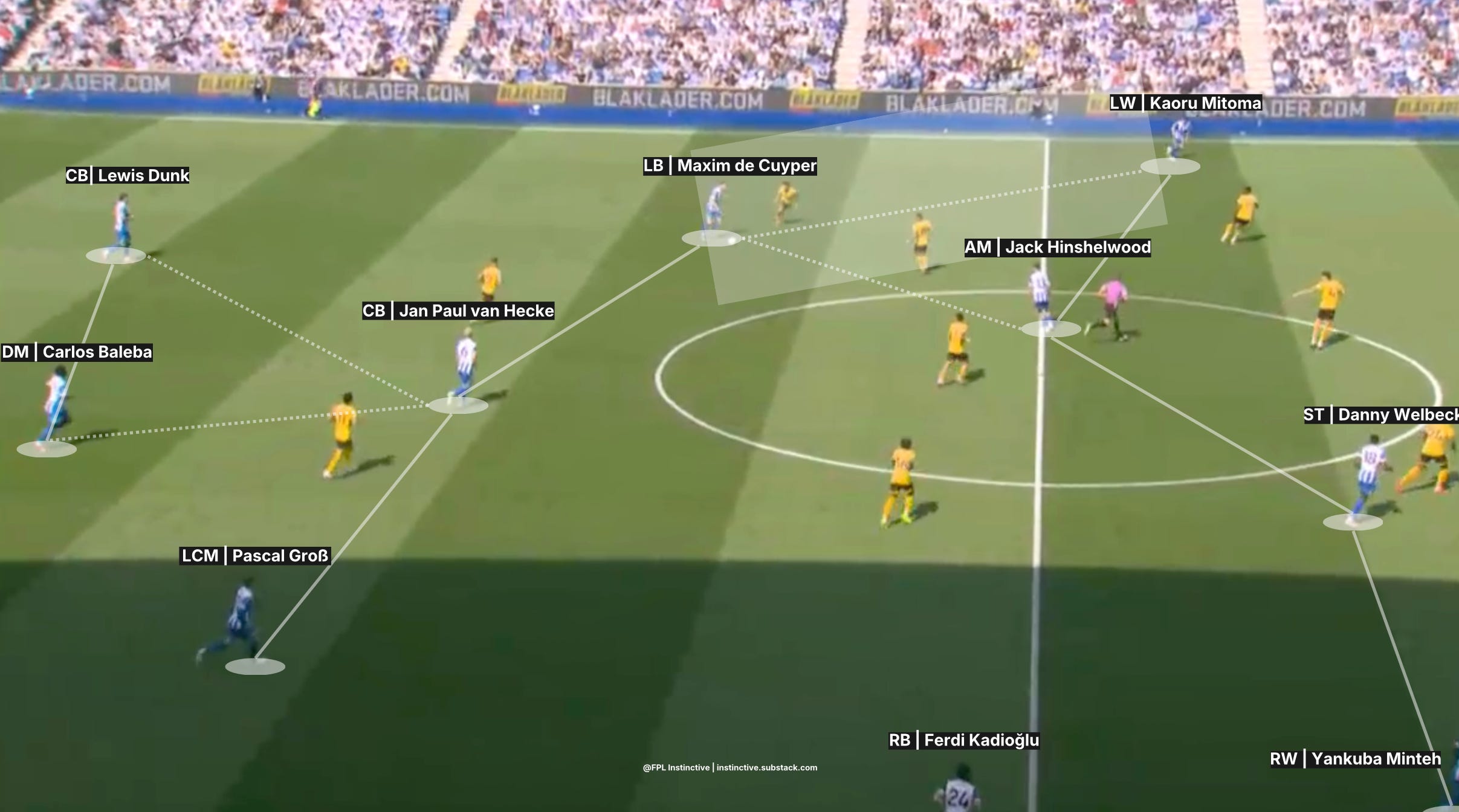
For eg: de Cuyper would stay deep, with Groß sitting veeeery wide as the LCM to create a sort of triangle between de Cuyper - Groß - Mitoma, from which he could find Mitoma with a simple pass:
*While this is brilliant in theory, its application faltered because of basic executional issues — a lot of the passes played to Mitoma were underhit.
I get that Mitoma is a winger who likes to take on his man from a standing start, but considering how his momentum’s been disrupted these past couple of seasons + the fact that he had a LOT of space to run into, I think there would’ve been some merit in playing him in behind.
In that sense, I don’t think this particular setup really maximised Mitoma, especially as the angles in possession were really, really awkward. Groß rarely hit his target (surprising), while van Hecke opened up more than a stiff man at his chiropractor, making it blatantly obvious where he intended to carry the ball.
Brighton’s right flank was a lot less constrained than the left.
Kadioğlu would frequently run beyond Minteh (though he really had complete positional freedom given the void in the RHS), while Minteh dropped deep either to take on his man 1v1 or switch play over to an isolated Mitoma (overload to isolate).
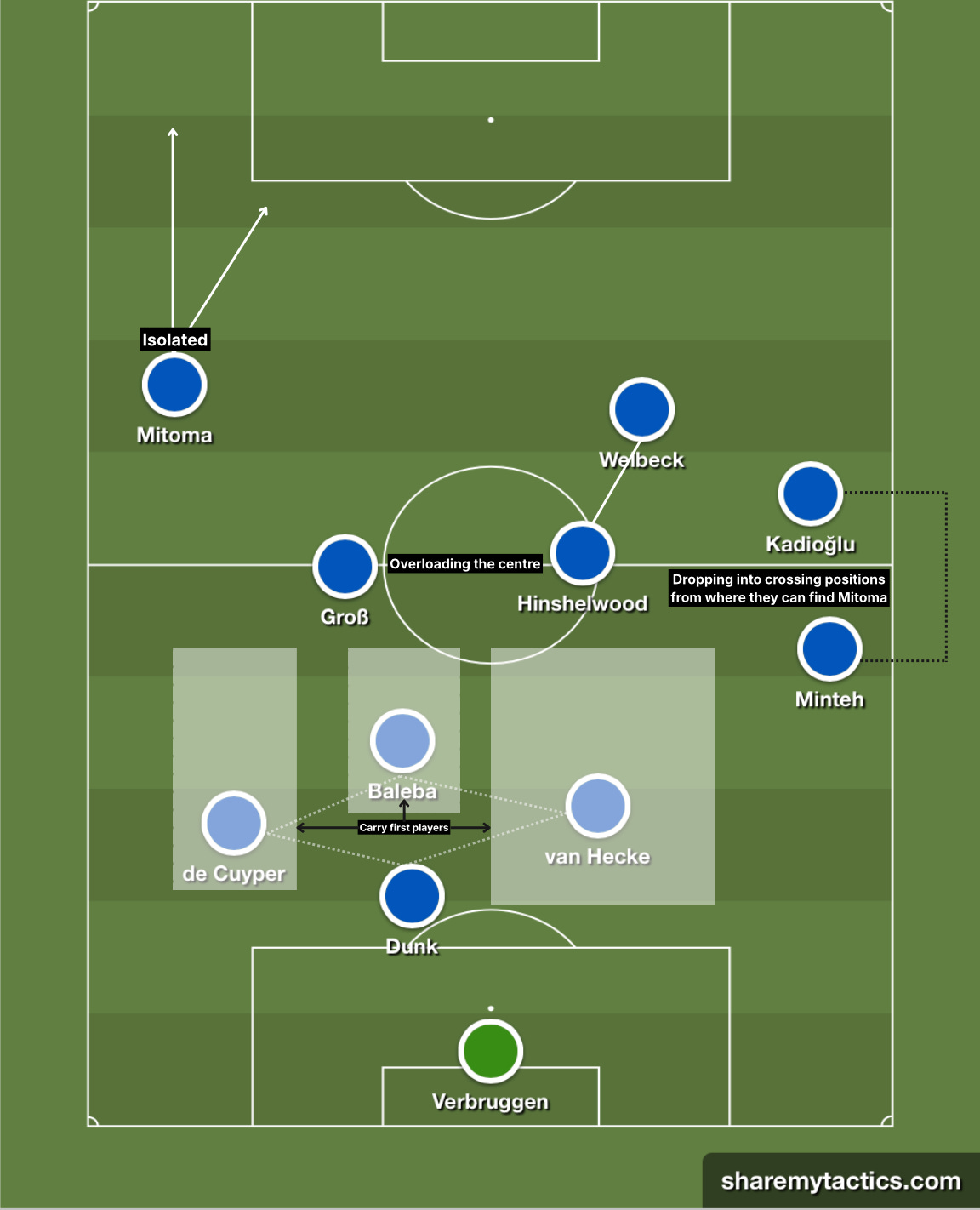
So, while Brighton managed to demarcate FB vs LW/RW zones pretty effectively off the ball, it came at the cost of some combinatory movements that could’ve come from a de Cuyper overlap (akin to the cross for Hinshelwood’s goal, which only happened because de Cuyper could run into the space a fallen Mitoma had left behind).
*Brighton’s fluidity was ultimately made possible because of Yankuba Minteh and Carlos Baleba. Minteh’s fast/physical enough to cover the entirety of the right side (good example), while Baleba can make up enough ground to enable Groß to roam:
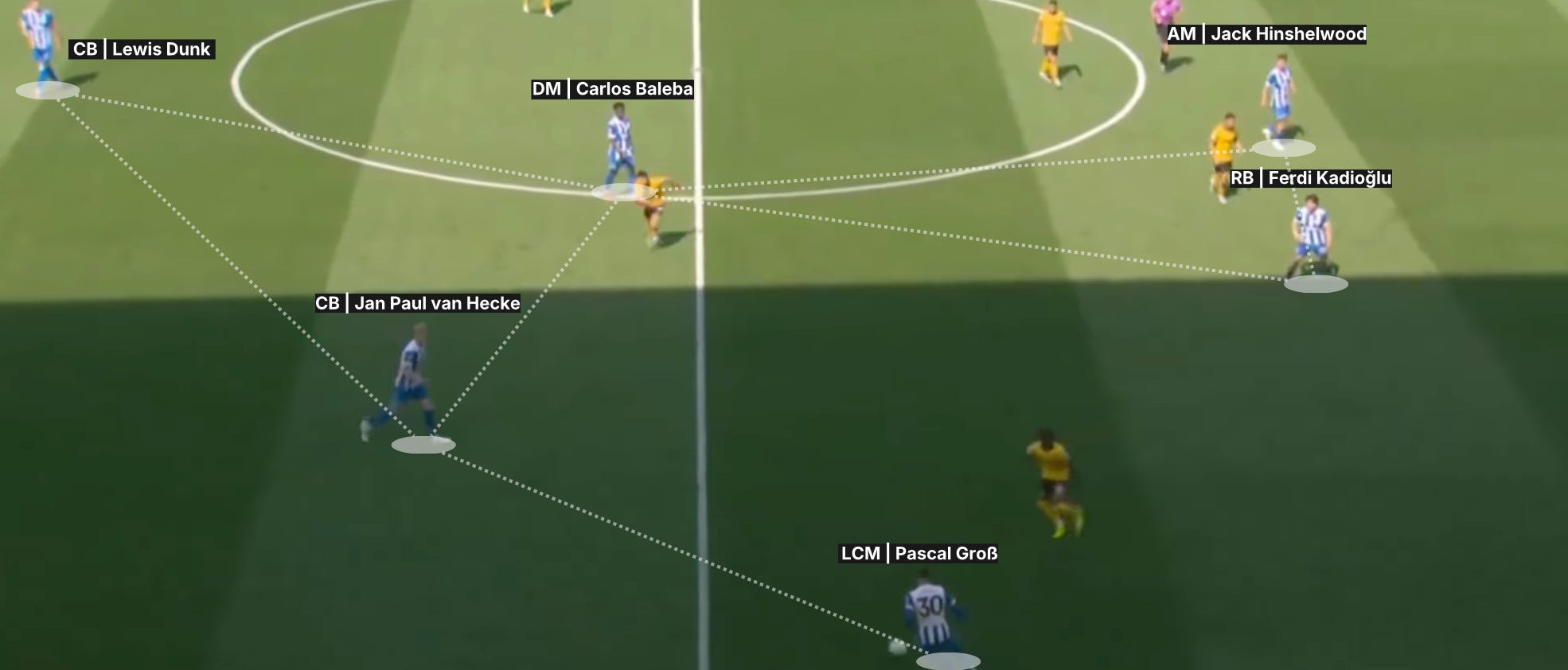
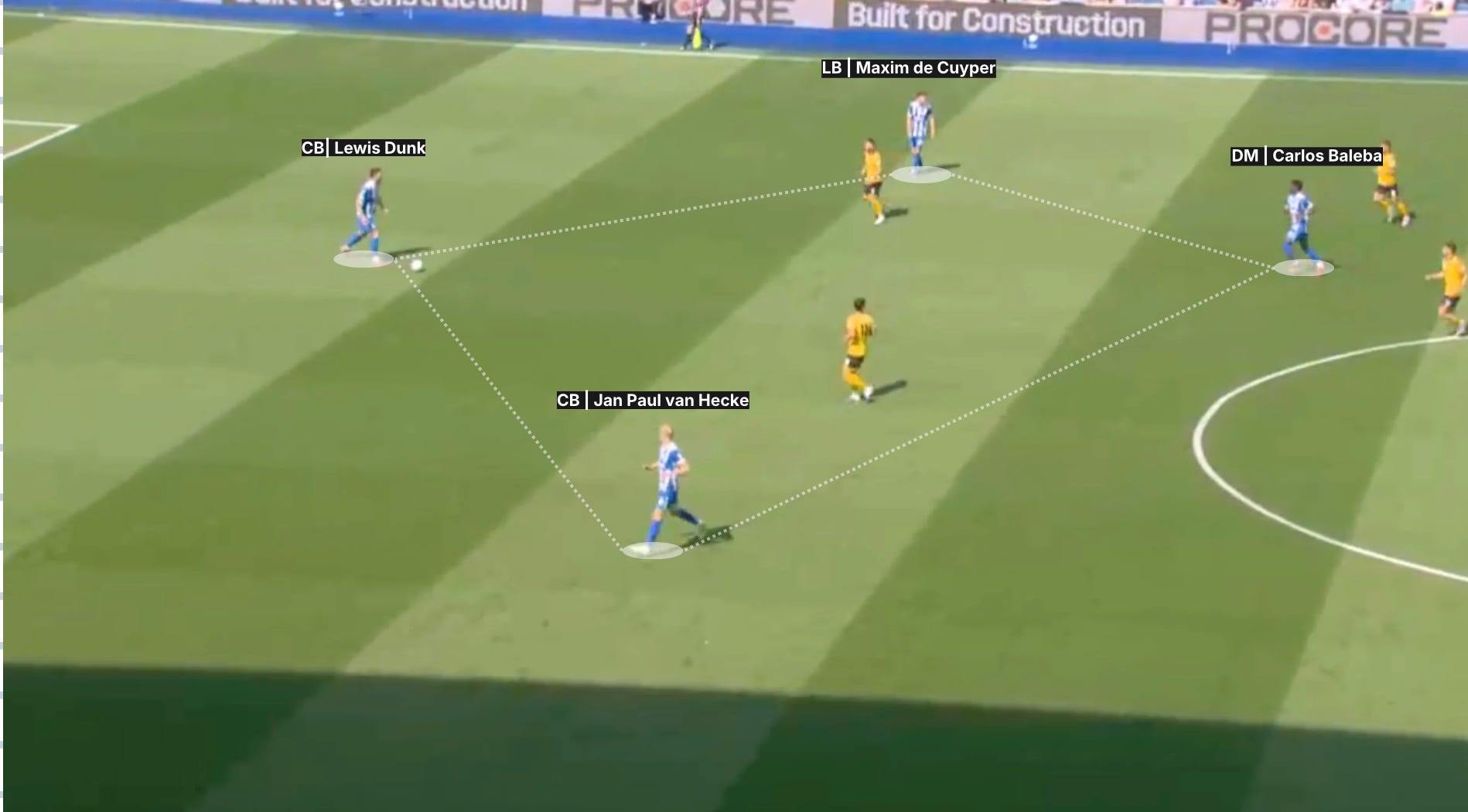
Looking at build-up play - a LOT (and by that I mean a LOT) of the game was spent in a triangle between Dunk - Baleba - van Hecke.
Let’s broadly characterise the trio as:
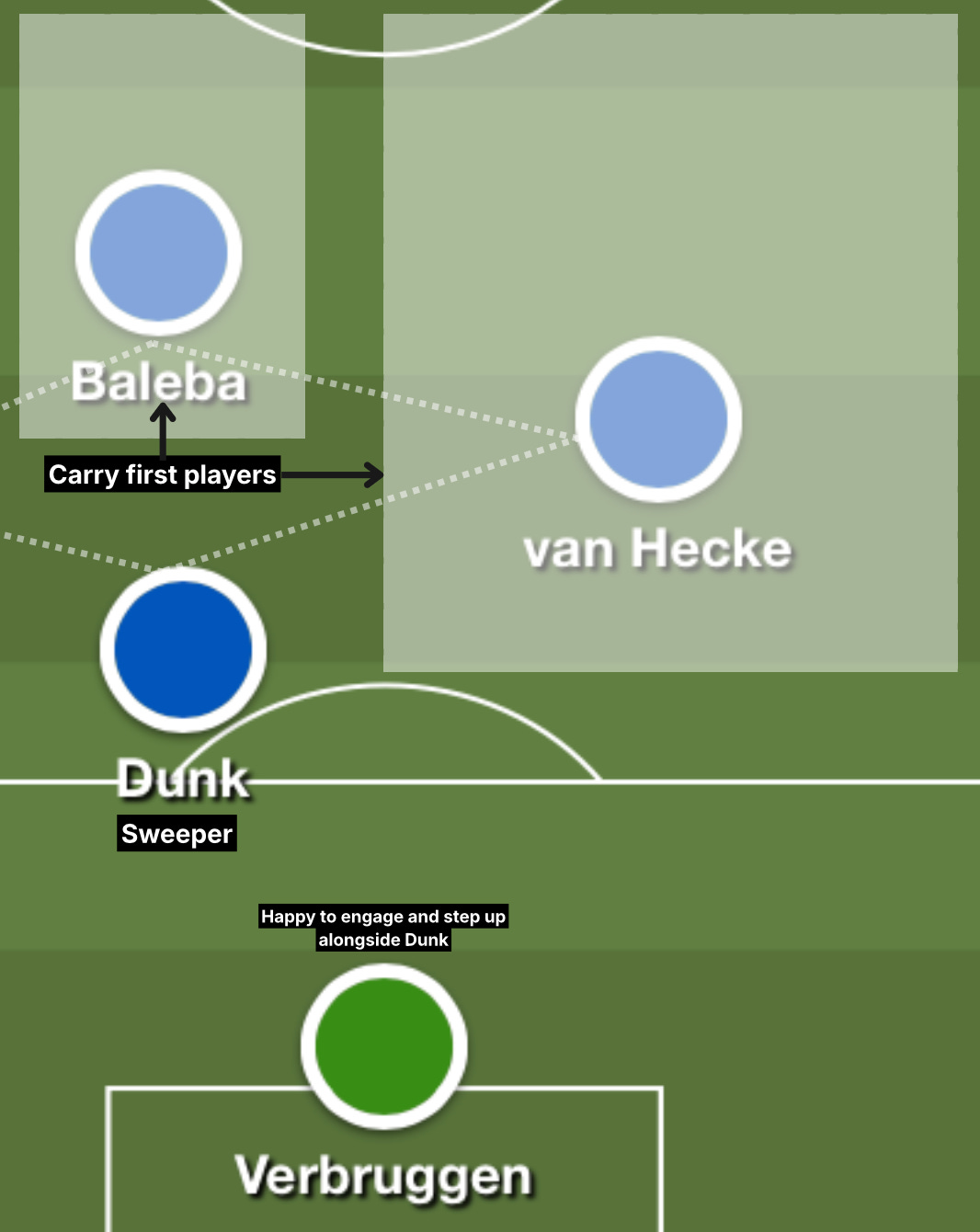
*While I wouldn’t say van Hecke is explicitly a carry first player (he’s more than happy to take a touch or two and then launch a pass), that was his role in this game:
Leaving Dunk as the high-volume progressive passer type, sweeping up around both carriers ahead of him.
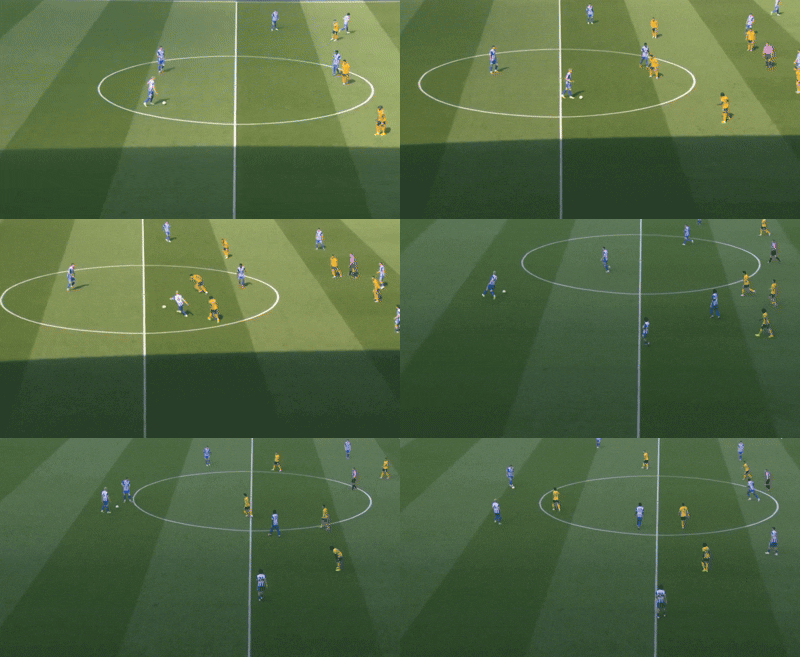
When Dunk had the ball, Baleba would shift over to the left, leaving room for van Hecke to carry into. Baleba would then shift back and occupy CB-esque zones:
From there, Brighton still maintained a triangle in transition.
In more static phases of possession, however, Brighton would build with Baleba dropping between both CBs, from where they could recycle play:
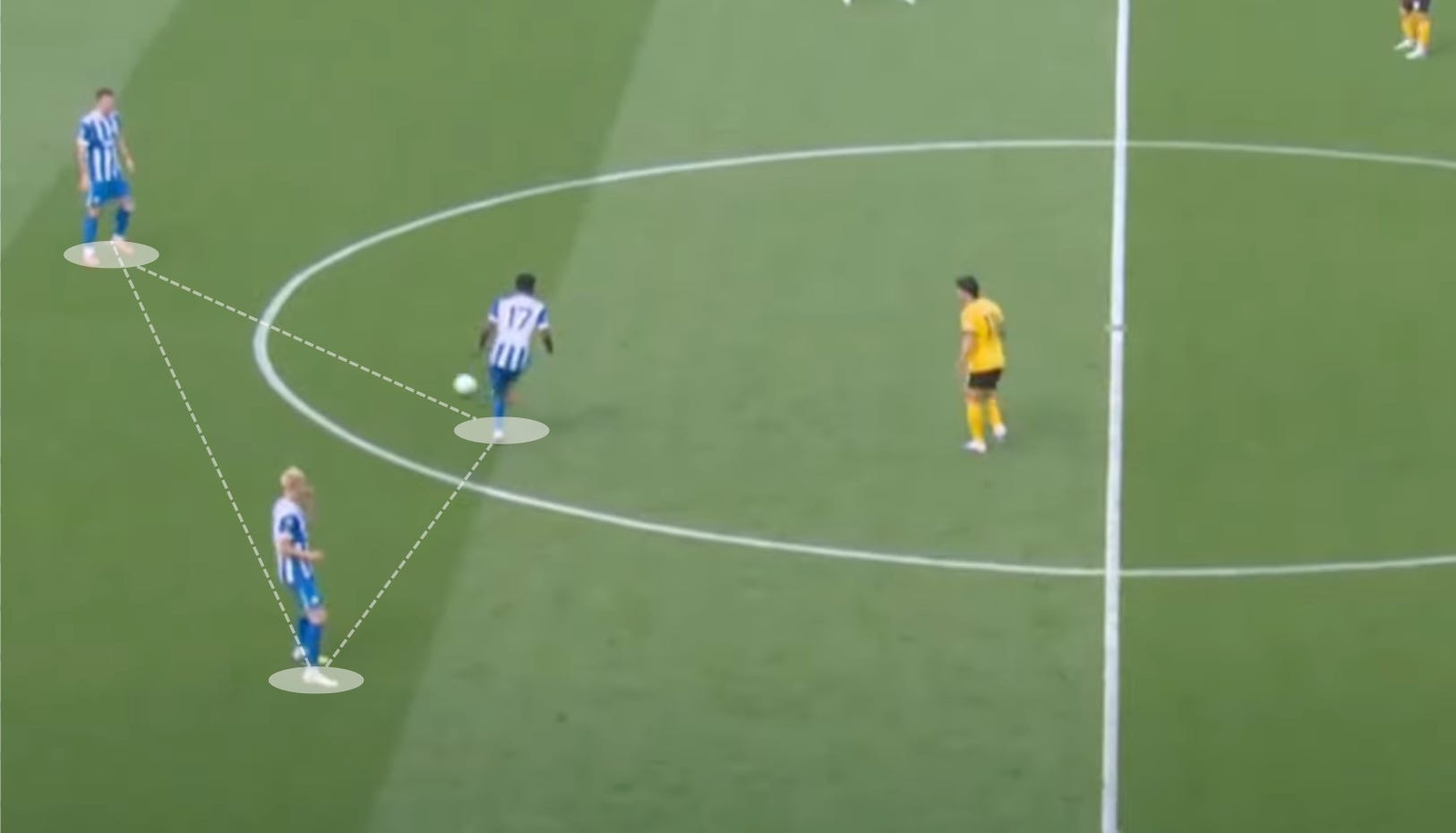
This willingness to receive isn’t necessarily something we’ve seen from Baleba (Groß/Ayari would be used to facilitate such play), but he was excellent nonetheless. He ran (a lot), called for the ball (a lot), and organised forward play around himself. Considering he’s generally seen to lack tempo-setting qualities, this proactiveness is quite encouraging.
So, while Baleba’s forte isn’t necessarily in line breakers and progressive passing, he made up a lot of ground by carrying the ball upfield, which in turn got the entirety of Brighton’s XI closer to Wolves’ goal.
When you can do that with the frequency Baleba can (and with his level of PnP), whilst consistently winning duels and playing as if you’re a couple of inches taller than you are, you’re objectively a good player.
Jack of all Trades, Master of Chaos
While in varying degrees, we’ve seen how useful Hinshelwood’s box crashing can be, particularly vs Newcastle and Wolves:
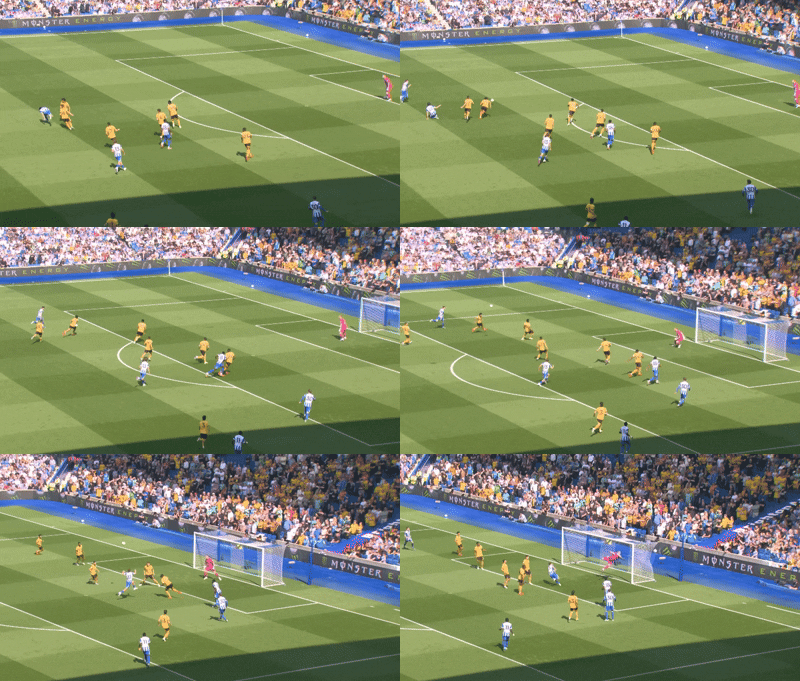
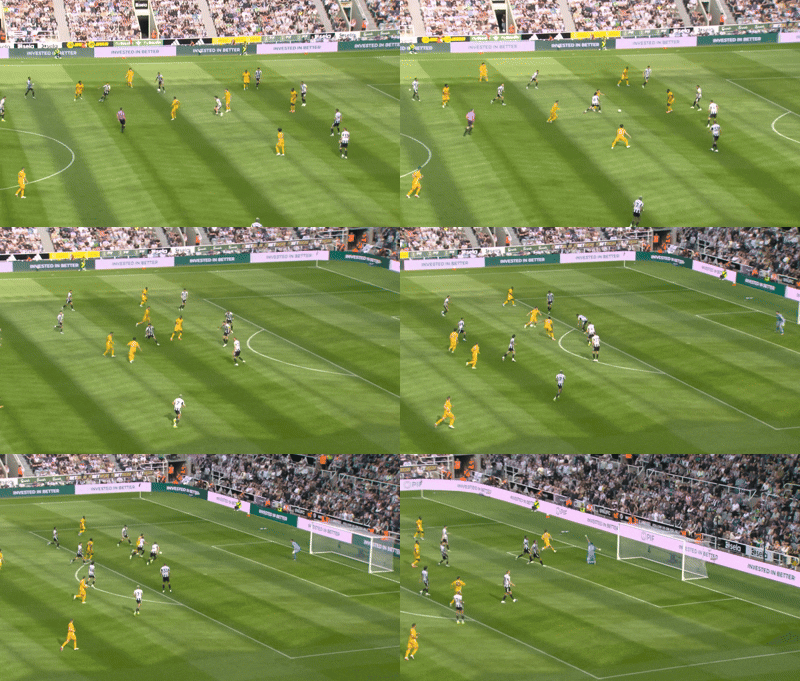
Meaning it’s useful to understand the dynamism between Danny Welbeck and Jack Hinshelwood:
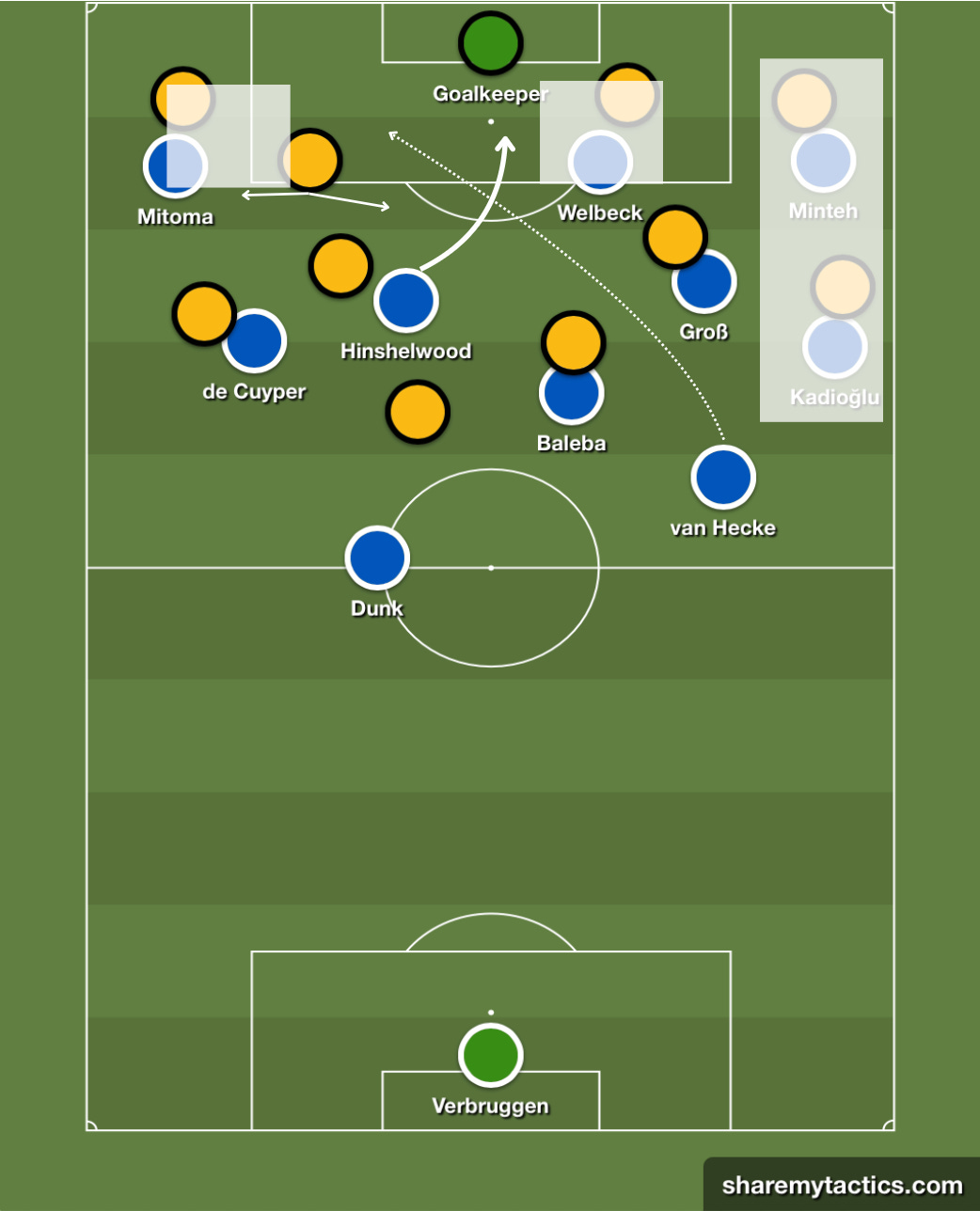
— Both of Brighton’s wingers are direct enough that they’re likely going to be doubled up on, probably by a FB + CB or winger
— You can’t necessarily double with a winger on both sides because both FBs (especially de Cuyper) are good crossers of the ball
— You still need a man high to exert pressure on van Hecke (else, line breakers)
— Groß roams free; you go m2m
— Welbeck can make far-post runs, dragging his CB along a blind spot
— Hinshelwood (or, principally, Diego Gómez) then has room to run into and shoot
One of Hinshelwood’s most valuable traits is his ability to get into the box and just disrupt (annoy) the opposition. What’s even more valuable, then, is the fact that he times his jumps really well, meaning he’s a nagging aerial threat even if he isn’t the tallest player out there.
On the whole, this makes him a really good complementary piece to an aging striker like Welbeck, especially as he loses that natural bit of tenacity/springiness.
Yankuba Minteh
Minteh played the majority of the second half on the left wing, and I find it utterly amazing how Minteh’s first instinct goes from drive → create chaos on the right, to drive → cross on the left.
Given he’s so direct/fast, he beats his man more often than not. The issue here, then, comes from the fact that Minteh rushes his actions far too much and ends up being dispossessed rather frequently. So, the fact that he’s able to shift onto the left, maintain that same urgency, whilst still getting his head up and whipping in early crosses…
Yeah, this fella’s going places.
Indeed, Baleba has gradually learned how to drop deep to receive and orchestrate play, much like Groß used to do. By winning the ball in a chaotic midfield and holding off challengers, he successfully finds the more "intelligent" players—such as Dunk and Groß—to sustain possession.
The hope is that he will develop his passing vision in the future, evolving into a truly complete midfielder capable of both elite organizing and robust defending.