

Context
Norway have intrigued me for a few weeks now. While I can’t say this intrigue comes from a place of being positively surprised (instead, from blind ignorance) this intrigue eventually got the better of me, so, here we are.
Football is generally a game where you maximise your best players, but how do you maximise a player who should be the textbook definition of “efficiency” given the freakish rate with which he converts touches → shots? That is, how do you maximise a player who is, by definition, minimal?
There’s a sort of beautiful idiosyncrasy to this:
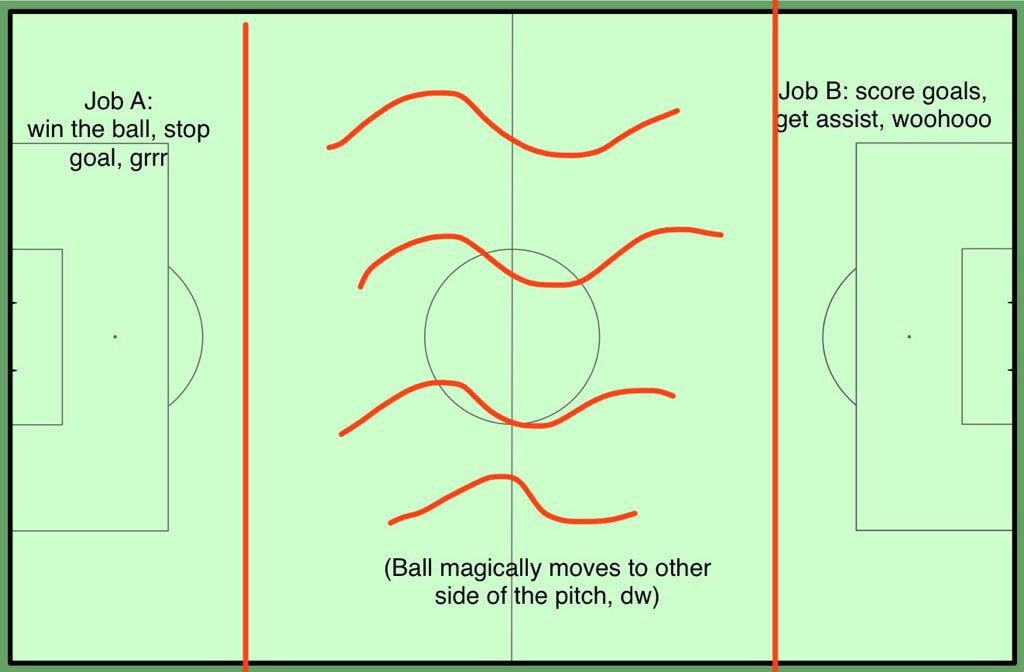
So, Norway’s play can be simplified to:
— Defend compactly. Press high, but get enough bodies up high that you maintain that compactness. When defending deep, have the midfielders almost drop amongst the centre-backs, with one periodically acting as a pressing trigger around an already advanced striker.
— Pick up the ball deep, with all three midfielders running back. This either opens up deep passing routes to lump a ball onto Haaland/Sørloth's head or it opens up spaces in midfield for players to run on to, from where they can counter quickly.
— Alternate width, creating wide overloads → isolates around Haaland.
But, like always, there's a bit more nuance to it. So let's ro! ro! ro! our way to it (erm):


📚 Contents
Note for email readers: This email may be truncated. To read the full article, please click on this link or the link to the right of [Message clipped] note at the bottom of this email.
Playing with Space
Two of Norway's midfielders, namely Martin Ødegaard and Sander Berge, like to drop deep.
While they do this to achieve different things — Ødegaard to progress and circulate, Berge to form a back three when building up, which tends to make for a more secure and varied shape to lean on — both movements generally lead to the same thing: an open midfield.
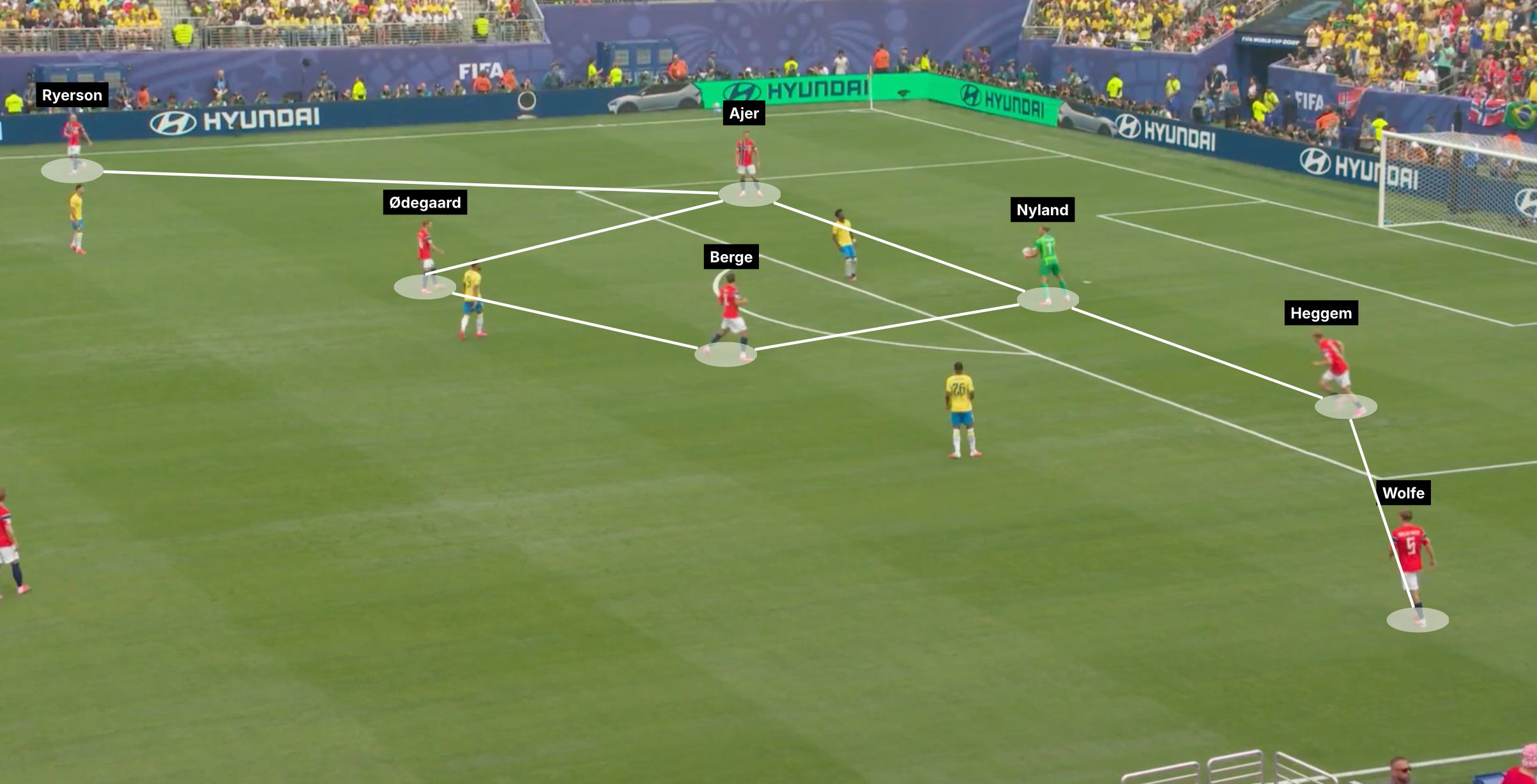
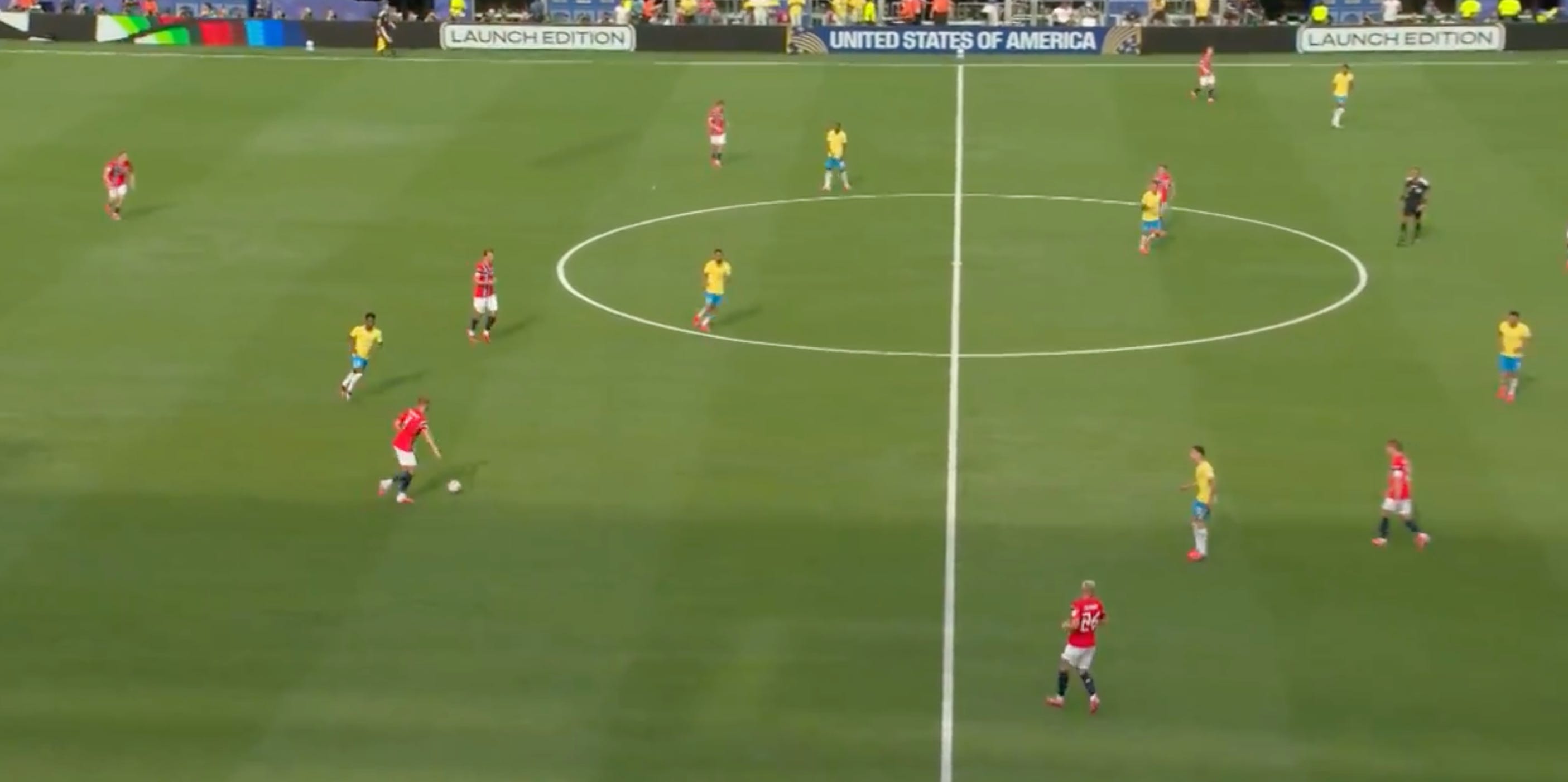
Consequently, the opponent gets baited into pressing high, which leaves the deeper part of their flanks open.
Norway continually exploited this vs Brazil, with Ørjan Nyland often kicking long to their right. This worked especially well as it meant he was kicking onto the head of Alexander Sørloth, and the 6ft 5in (195cm) body it rests upon, from where Sørloth often had the space to head it down to David Møller Wolfe.
Wolfe could then recirculate to Ødegaard, as he took this as his trigger to bomb forward, meaning Norway were in good stead to make use of their isolated left side. I like these backward-forward dynamics, especially for a team who emphasise ball circulation.
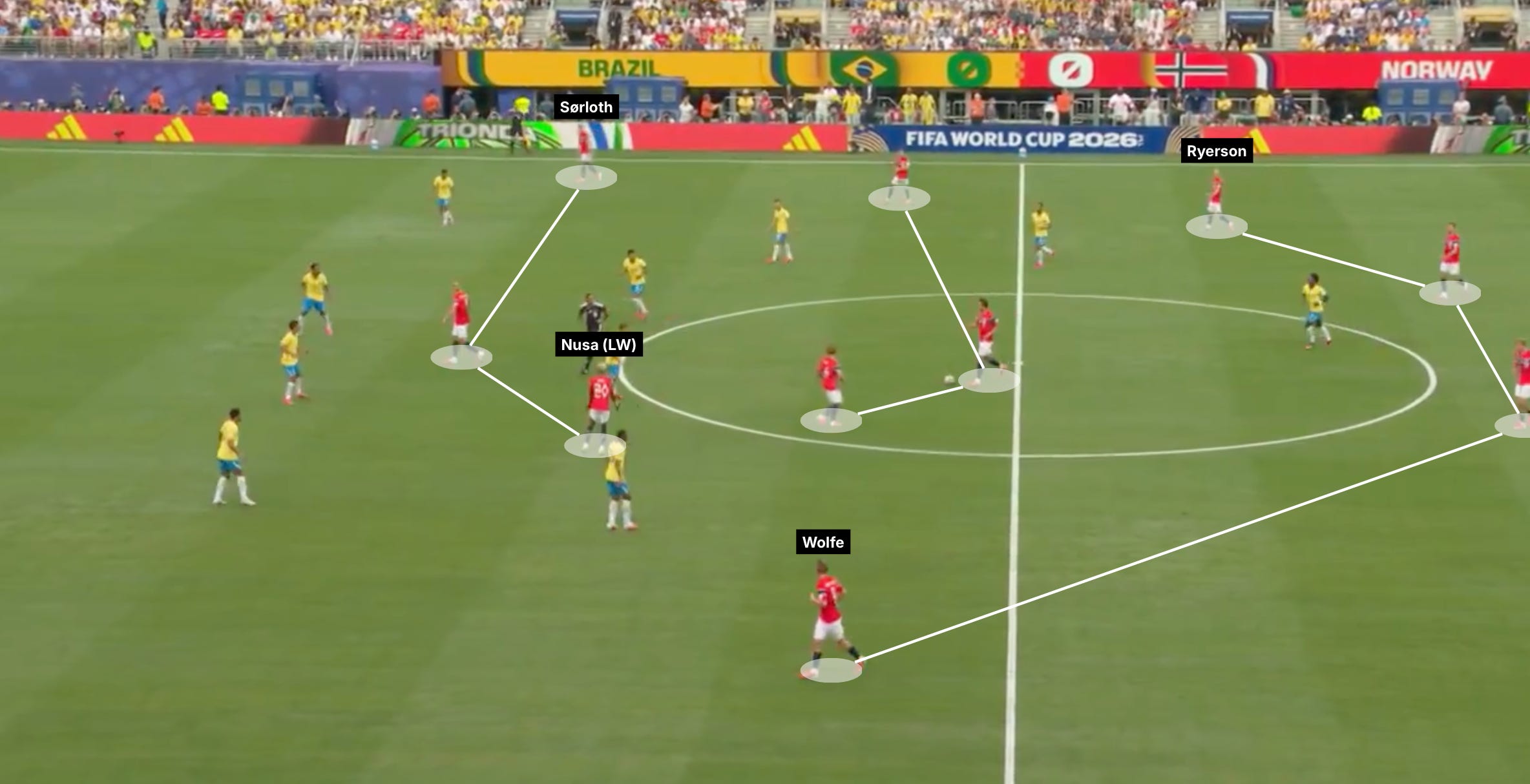
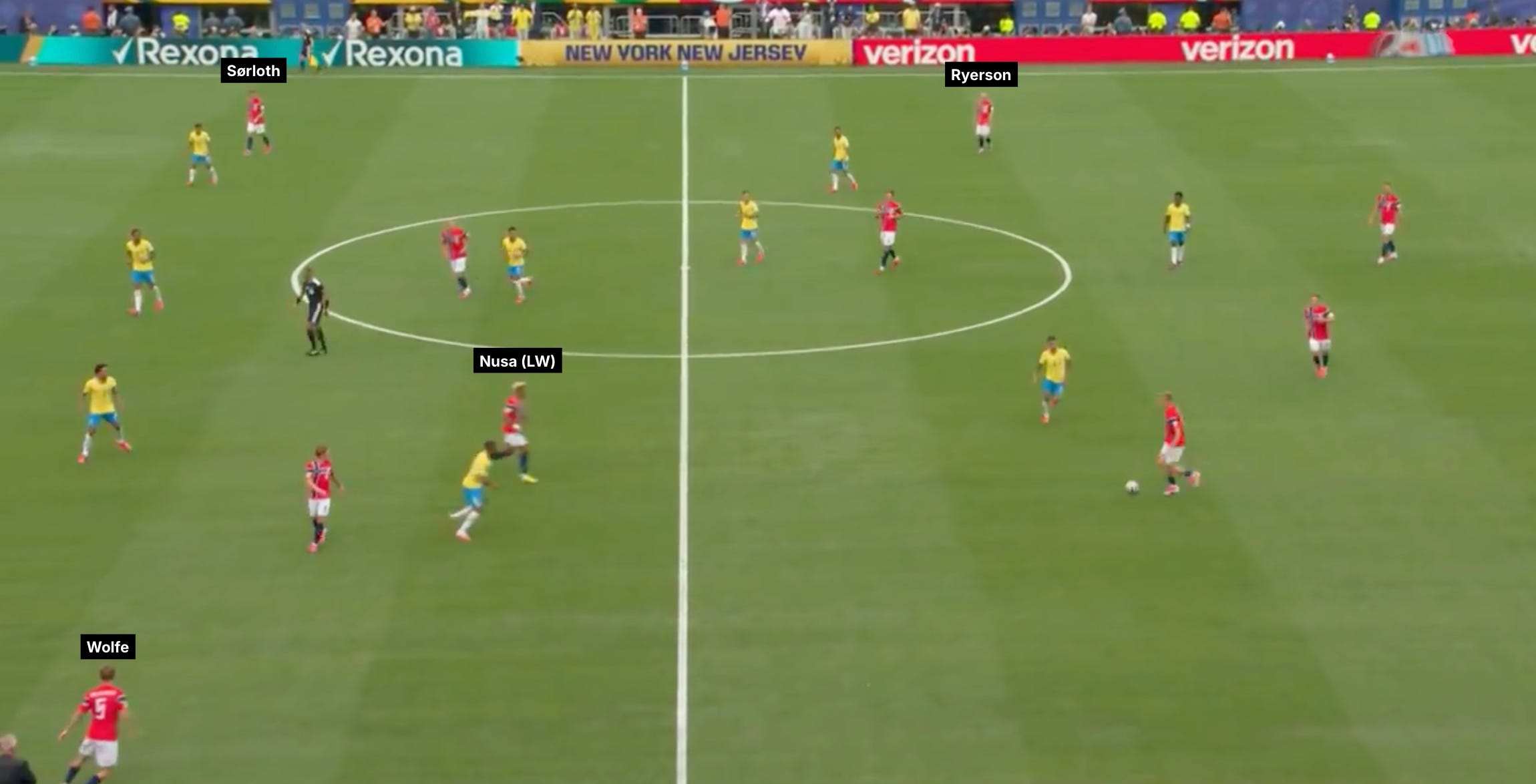
This also meant that Norway alternated the side with which they played wide vs narrow. For the first half, that meant Antonio Nusa came inside from the left, playing as the No. 10, almost, with Wolfe holding the width.
On the right, Sørloth stayed wide for the first two phases of build-up, after which he darted inside and sat in the box, which was Julian Ryerson's cue to occupy the width:
And in the second half:
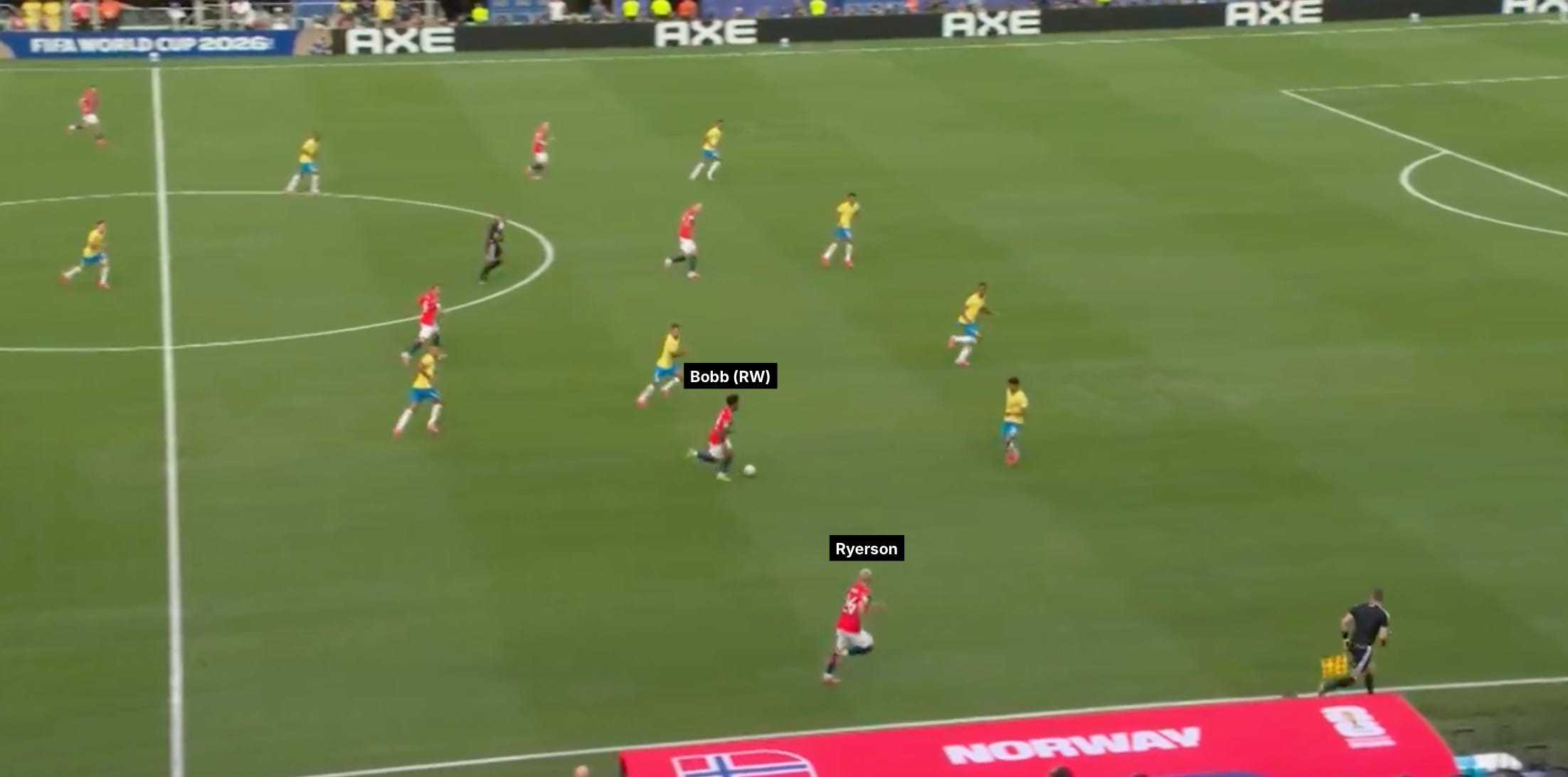
Anyhow, Nyland’s kicking was solid too, and considering Norway have two elongated players who are good at heading the ball, they’ll always have a failsafe. Nico O’Reilly’s athleticism could be helpful in blocking off this lane, though, so it may be best for England to stick him onto Sørloth like a leech.
This does bring me to another potential issue: when Norway aren’t building up from a static situation, they don’t have enough bodies, nor enough agility within Sørloth, to use him as a consistent outlet. As a result, he’s sort of just… there, in transition play.
Cops and Robbers
While this subheading may need a little bit of work, I do sort of view Norway's midfielders as the robbers to their CBs' cops. While they don't literally rob the CBs of the ball, the midfielders, particularly Ødegaard, looooove to get onto the ball.
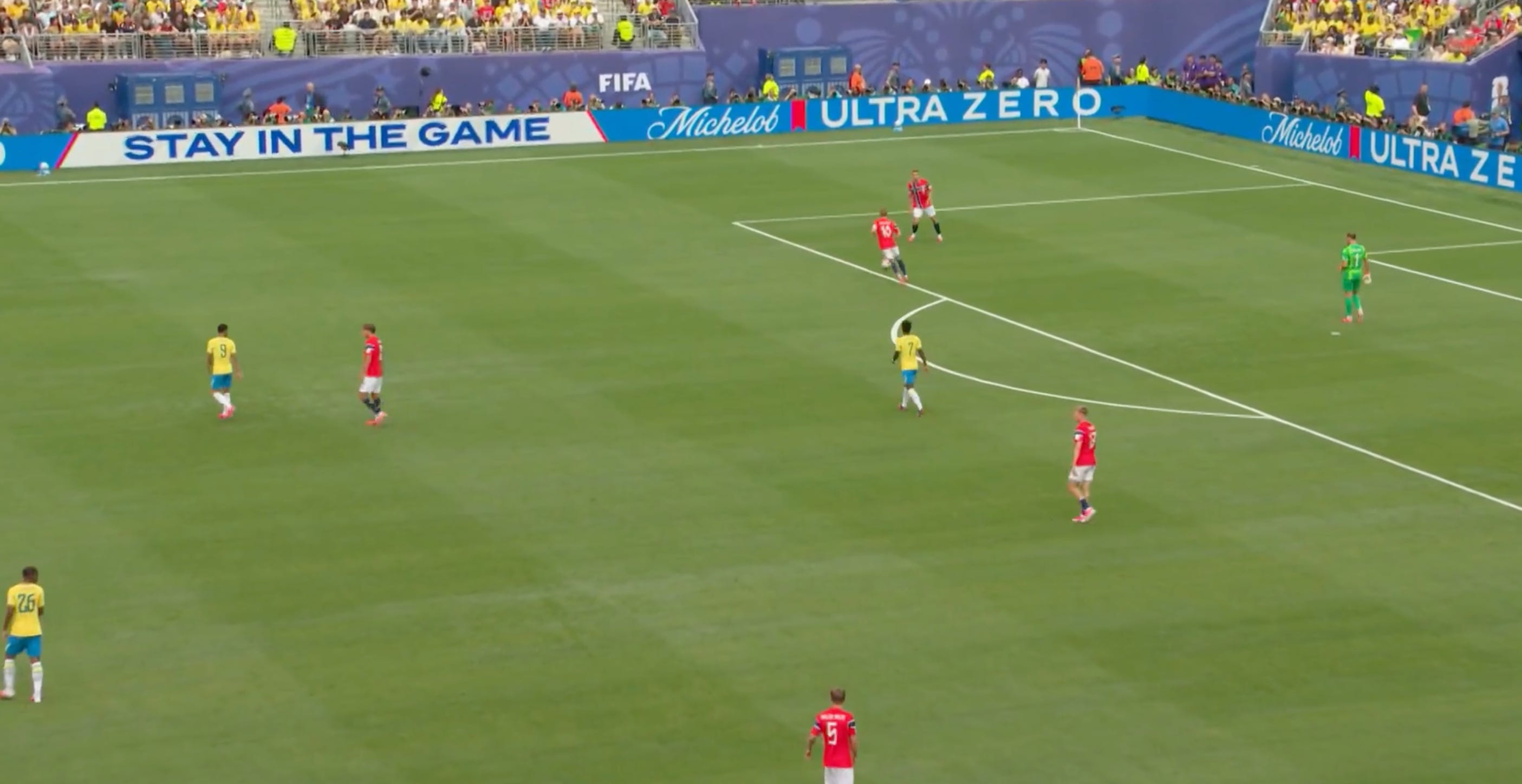
This even extends to taking it off the midfielders:
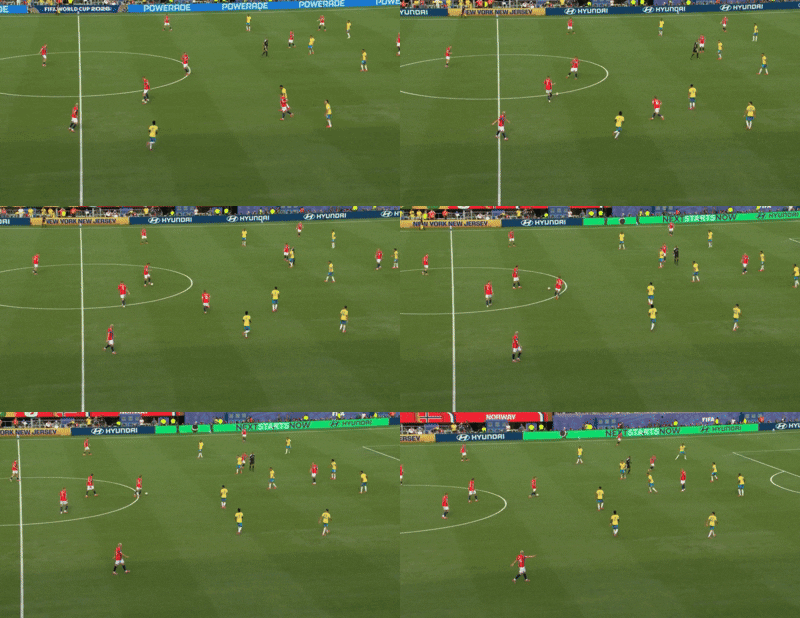
While that isn’t necessarily a bad thing (you naturally want your best passers on the ball), I’d argue he wants to get onto the ball at such a rate that he loses some coherence going forward.
Take this phase of play, for example:
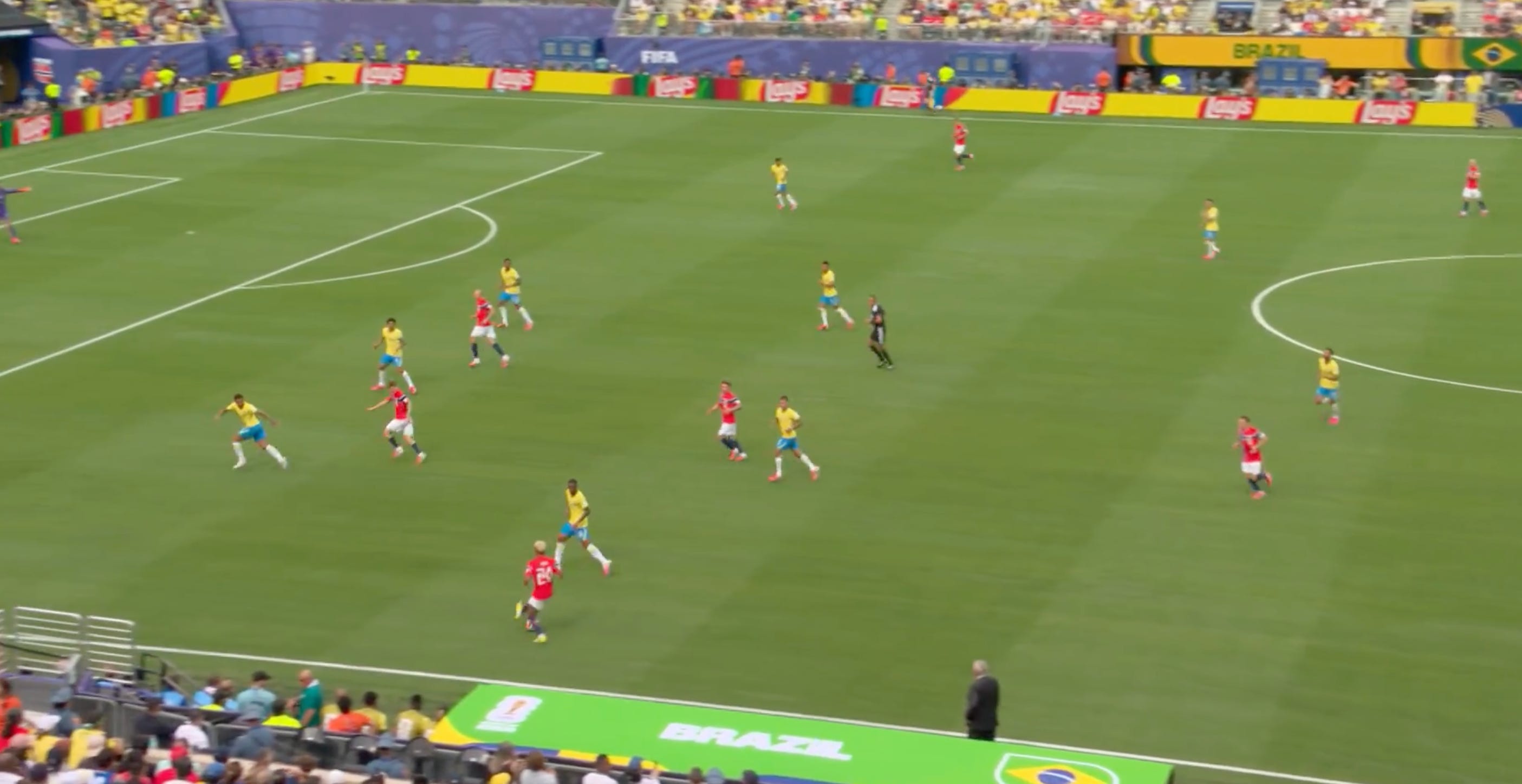
Ødegaard vacates his nominal starting point, right central midfield, and follows the ball along to the left wing.
Consequently, when Norway shift the ball to the right, he's left chasing after the ball, and Ryerson, on the right, is isolated with no forward options to play into (Sørloth plays to his instinct and lodges himself in the box [good]):
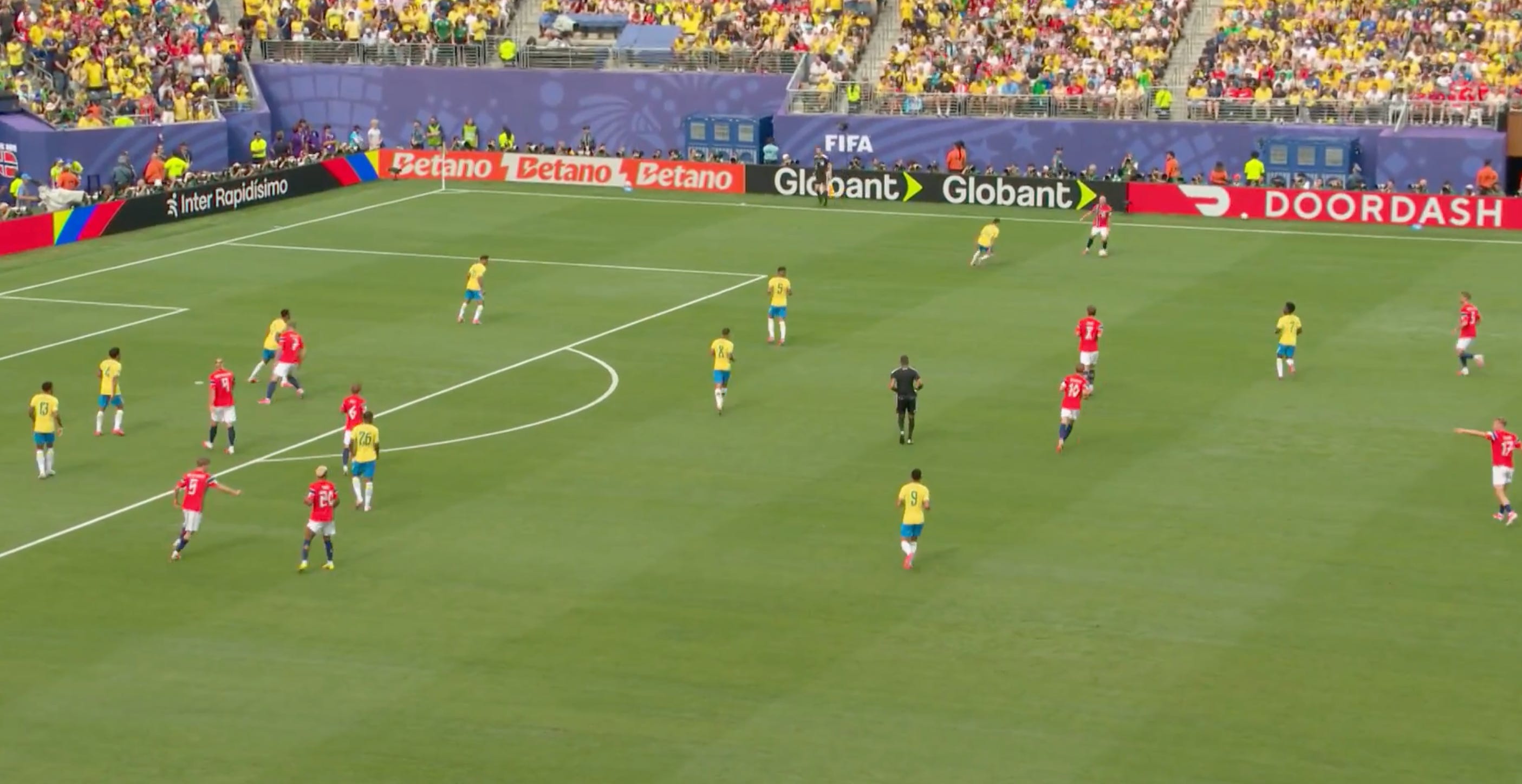
But this doesn't tend to bode well for finding solutions to play forward when your full-back is the only one in place to find said solution.
This also means that a lot of Norway's play is forced to go backwards, given Ødegaard's propensity for dropping deep [to receive]:
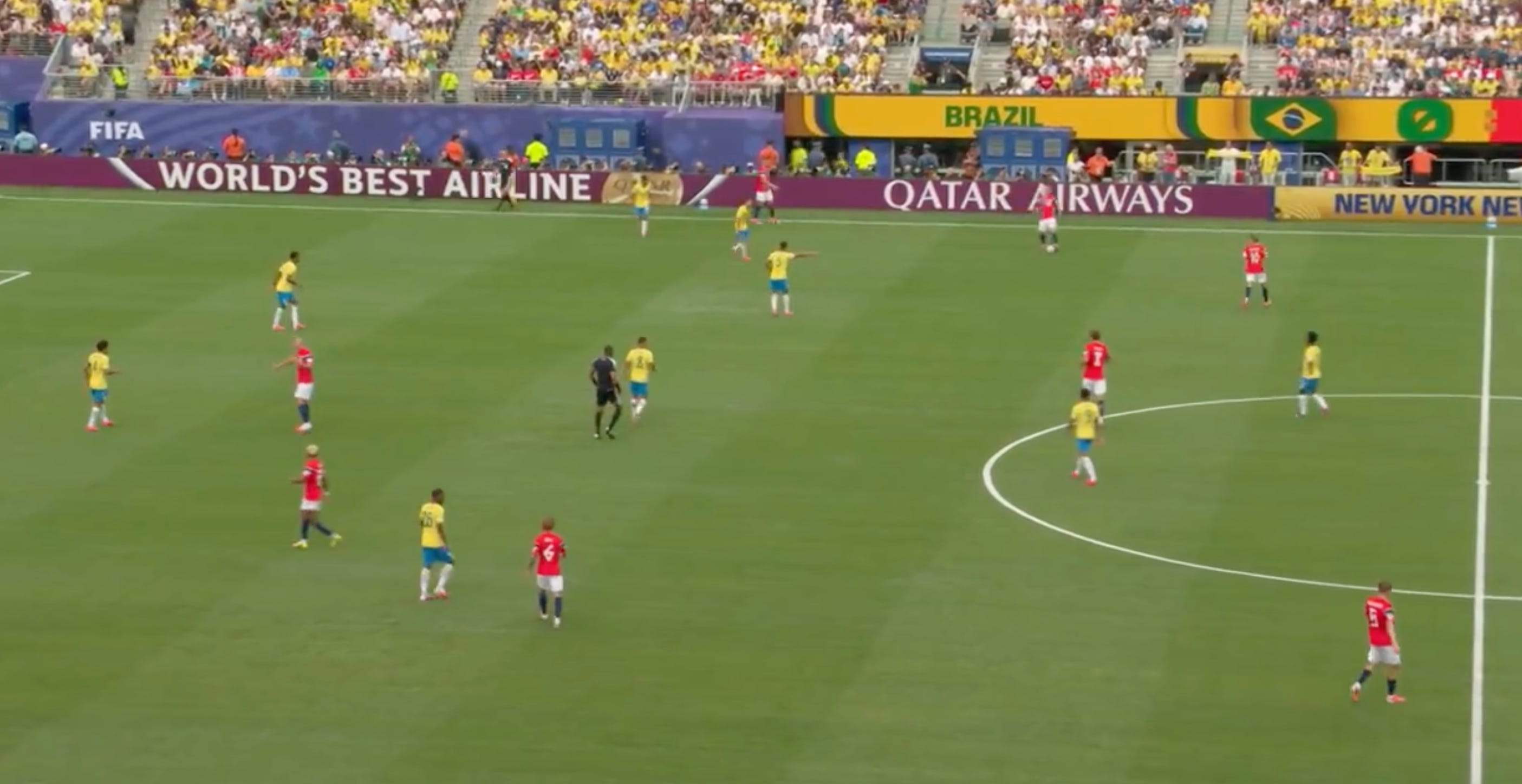
While it's a little difficult to quantity the implications of this, I believe this dependency may lead to Norway sleepwalking into a world where they're overdependent on Ødegaard for first-phase, central progression.
Consequently, man-mark him, and well… if you have a counterpress that's half as good as Spain's, you can swarm and constrain Norway pretty easily.
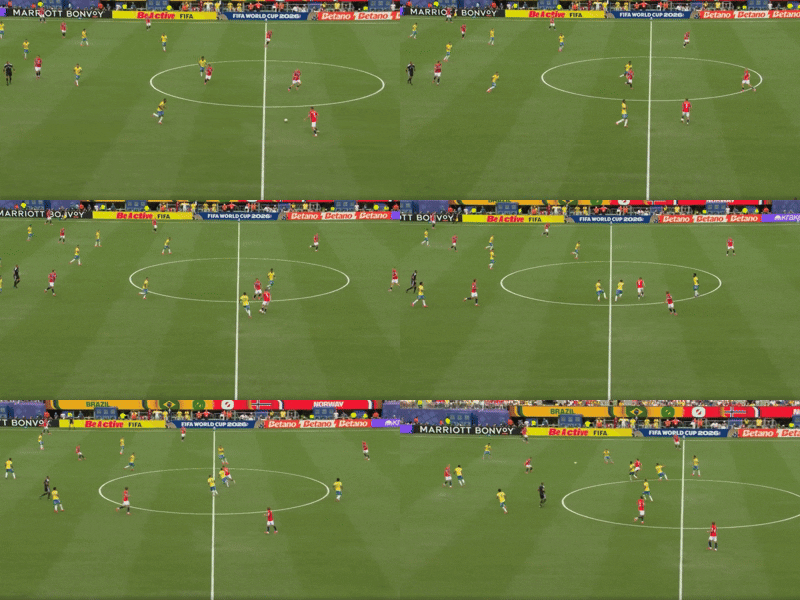
Distances and Momentum
In a similar vein to incoherent movements, I find Norway's distances to be far too big relative to the athleticism of their players.
As a result, some of their attackers, particularly those who need to make things happen (Nusa, Oscar Bobb, Andreas Schjelderup), found themselves rushing to, well, try to make things happen, because they had no one else to help make things happen.
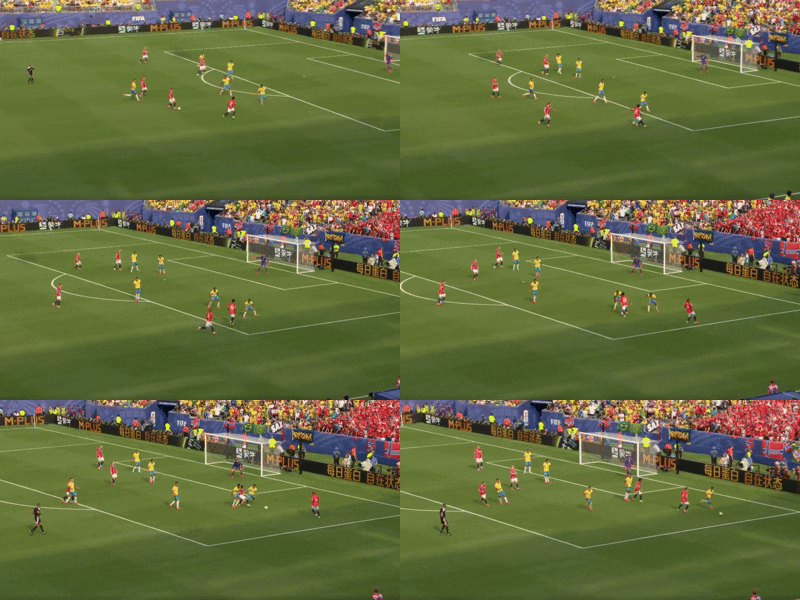
Bobb gets onto the ball here:
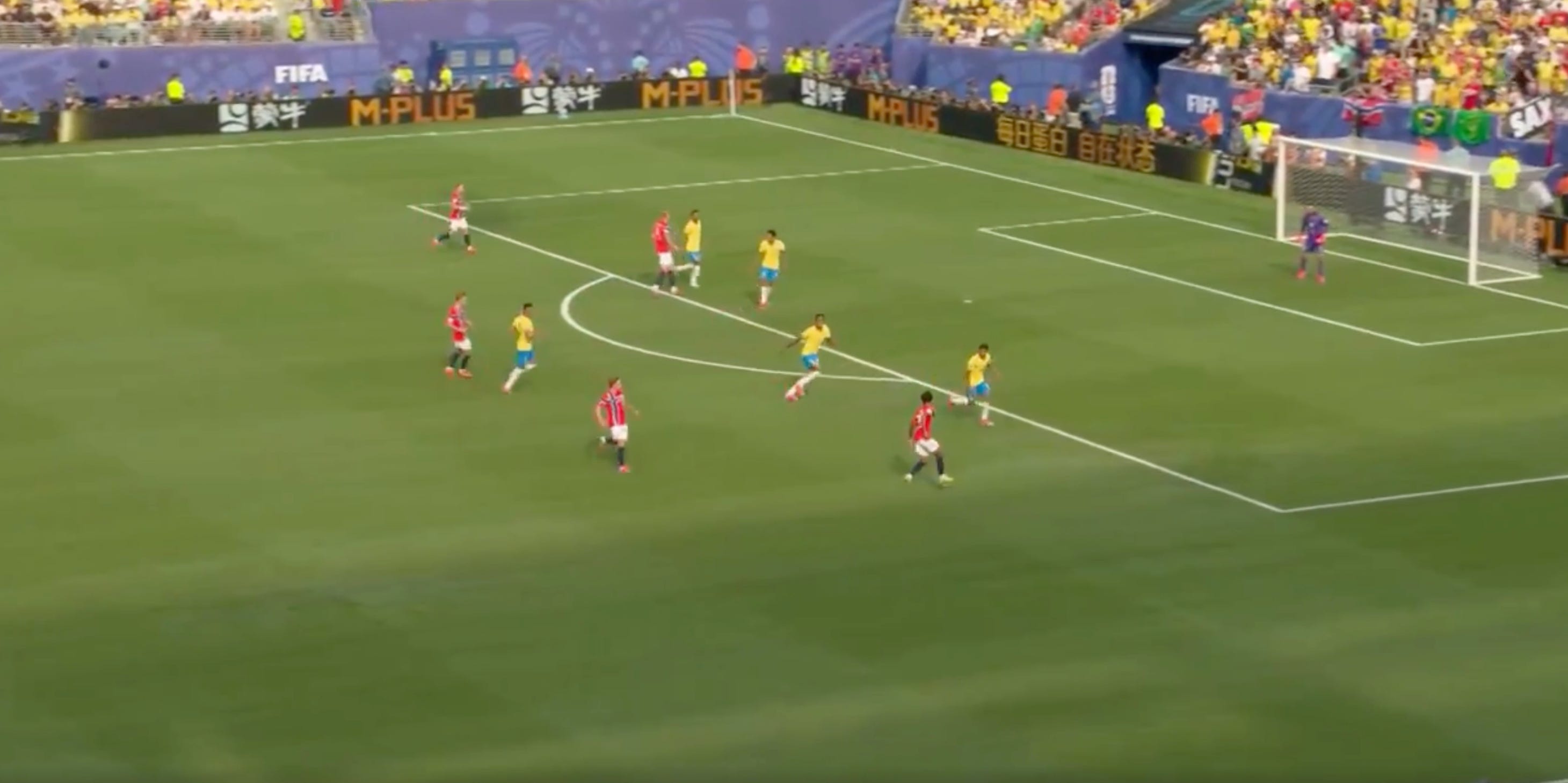
And makes his intentions (going 1v1) known here:
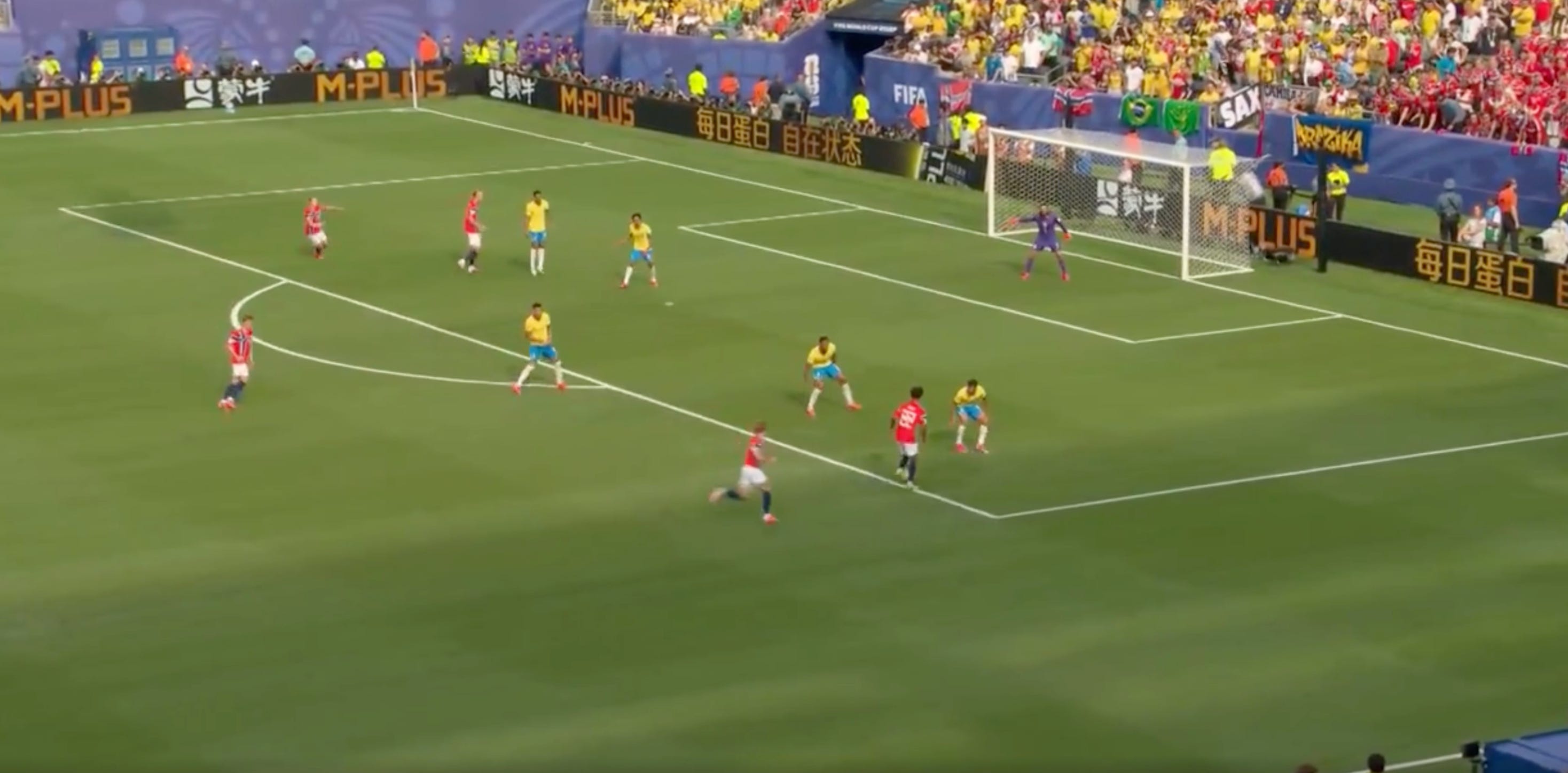
Any angle to pass to the overlapper is closed off here:
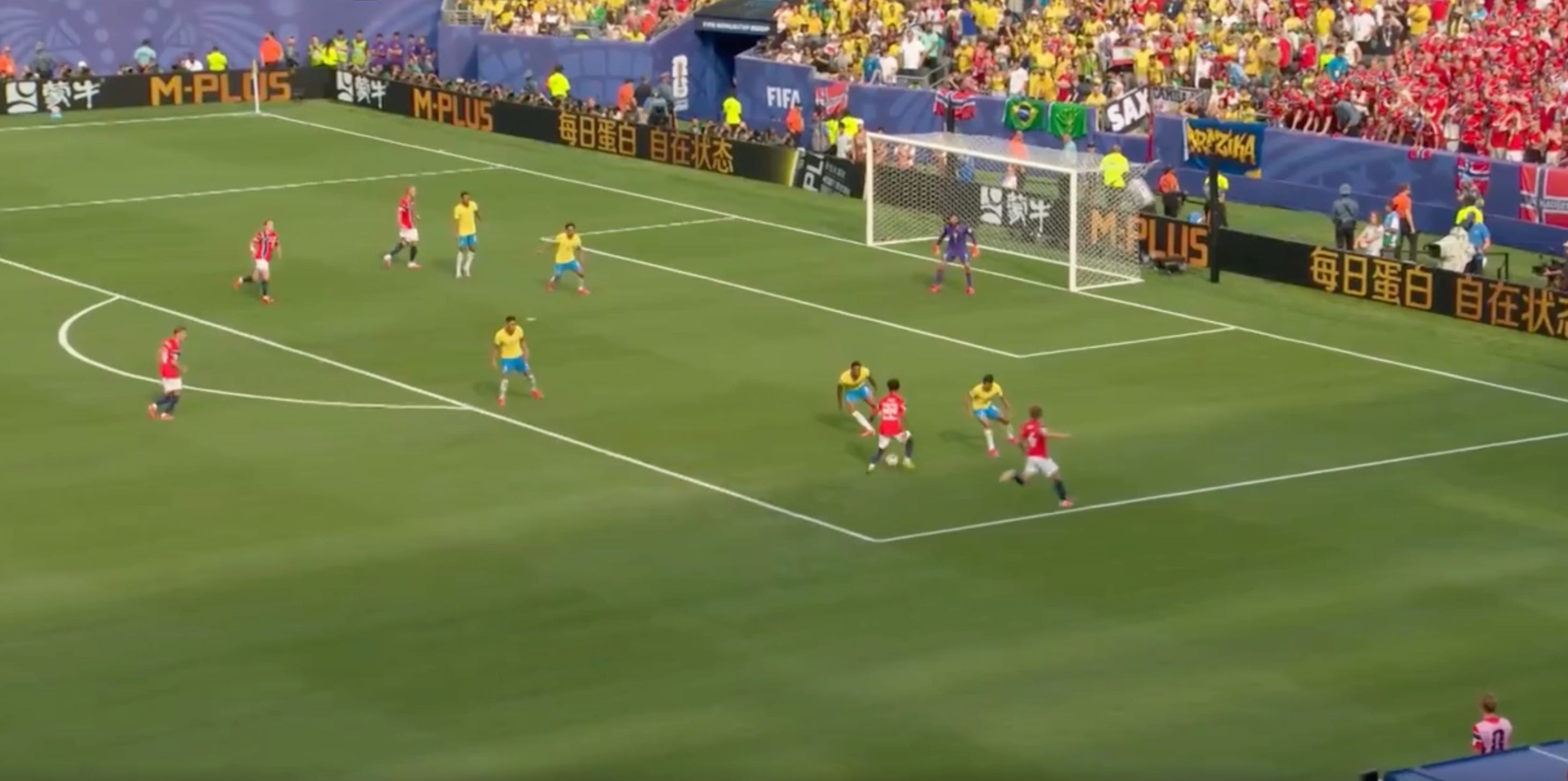
And even though Bobb does well to get the ball off his feet, it's not something anyone would be able to do more than 50% of the time:
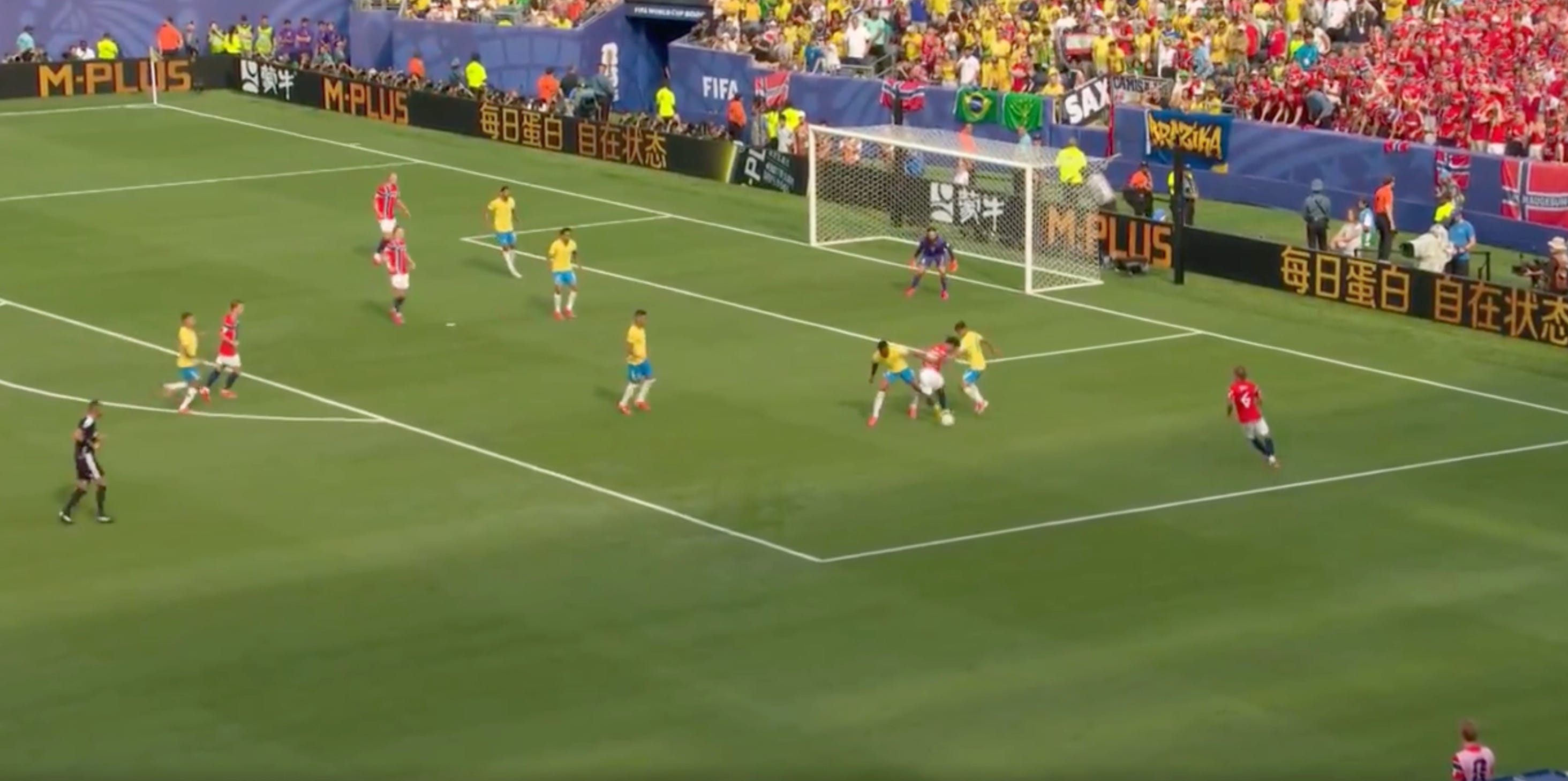
This concept of big distances → momentum issue in small spaces is quite an interesting one, and can be quite costly if you don't have springy athletes to compensate.
Erling Haaland
I think Haaland’s great. Shocker. He’s:
— Big
— Fast
— Strong
— Clinical
— Good aerially
— Literally never offside
And that last point boggles the mind. His runs are just so efficient. More than just the quality of runs, though, I find the speed with which he gets up from the ground [after being pushed] to actually making a run, extraordinary.
As a defender, you’re going to exert a LOT of effort in actually throwing him to the ground, which then reduces the energy you have left to try and match his acceleration/cover off his run:
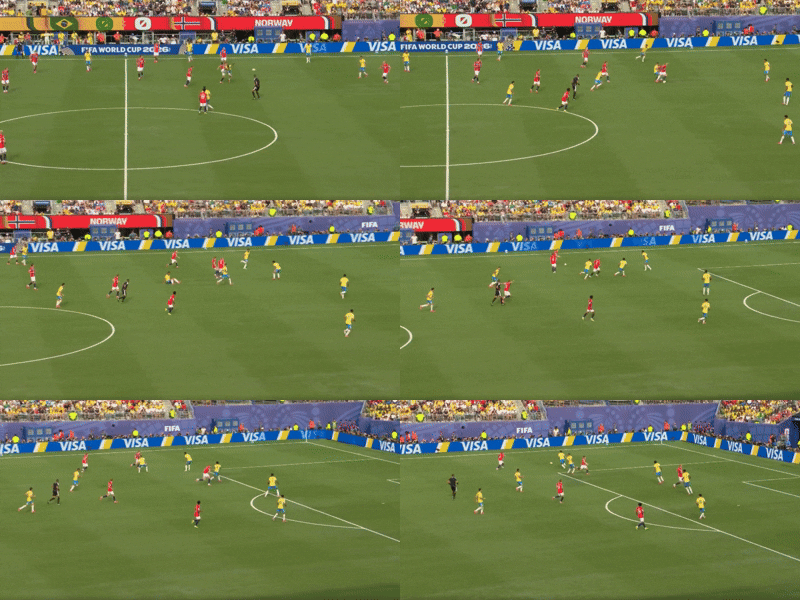
And it’s here that I must, once again, talk about the benefits of shooting the ball between the legs.
Haaland’s shift-to-shoot is fast. Receives the ball, nudges it out of his foot, and lands onto it within a matter of seconds:
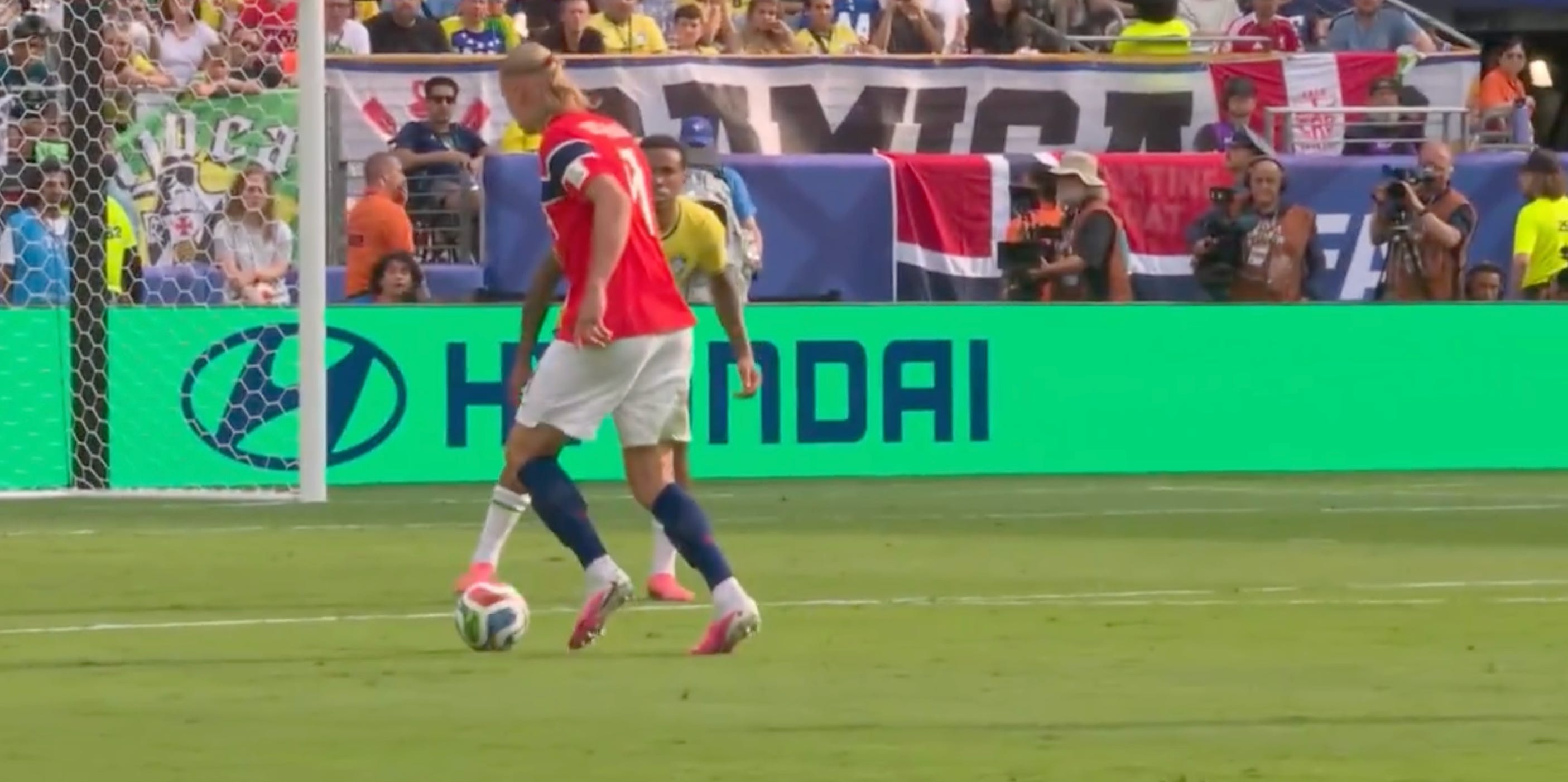
Before placing his shot between the legs, making it harder for the goalkeeper to judge motional cues:
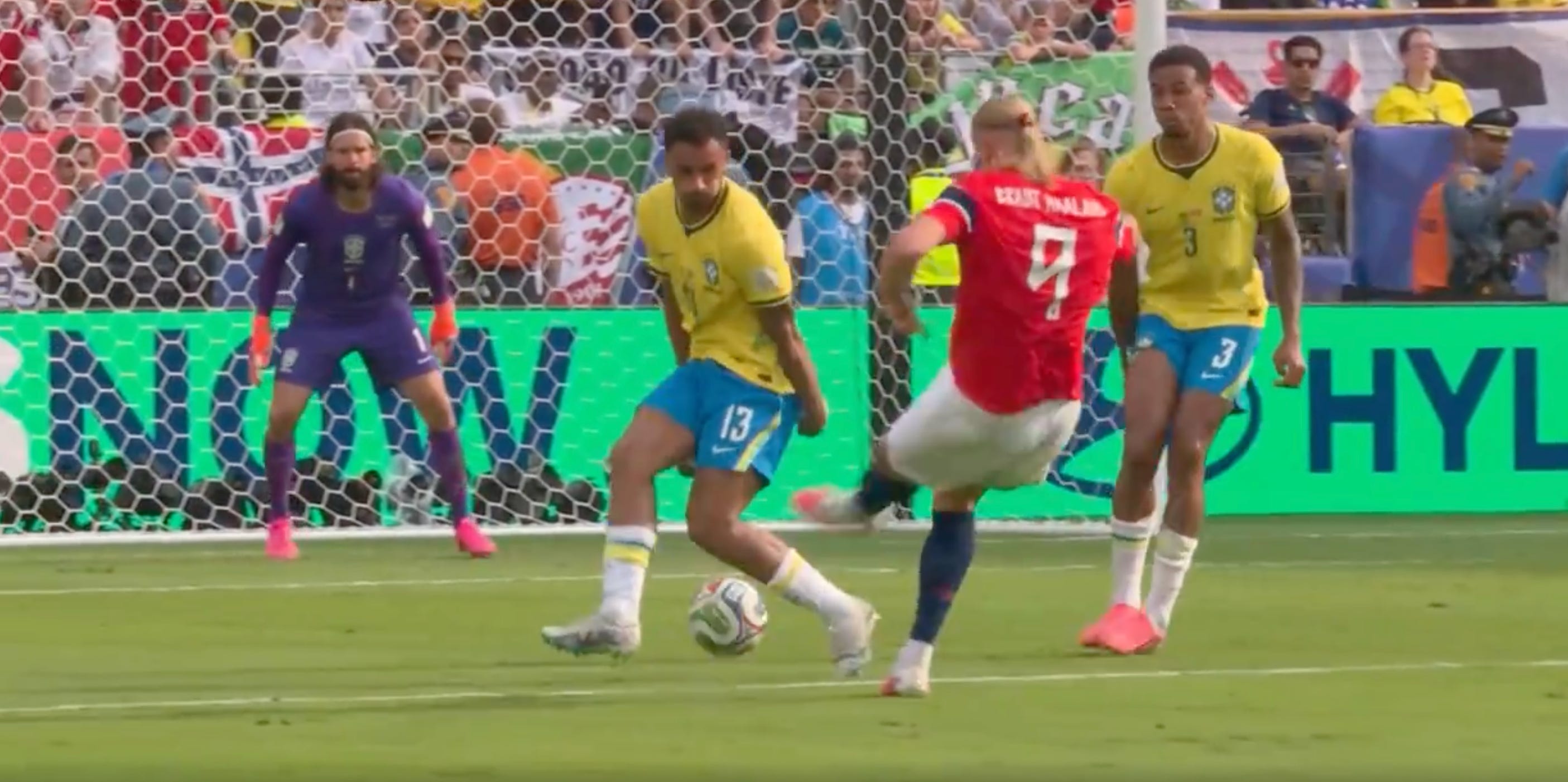
Crowding Out in Defence
When pressing up from goal kicks, Norway press high in a 4-1-3-2. This 4-1-3-2 is naturally veeeeery aggressive, with Haaland (as part of the 2) pressing the goalkeeper, while Ødegaard splits the CBs.
The 3 press aggressively in order to compact the space between the 3-2 that it becomes inherently difficult to bypass the press, leading to a good counterpress.
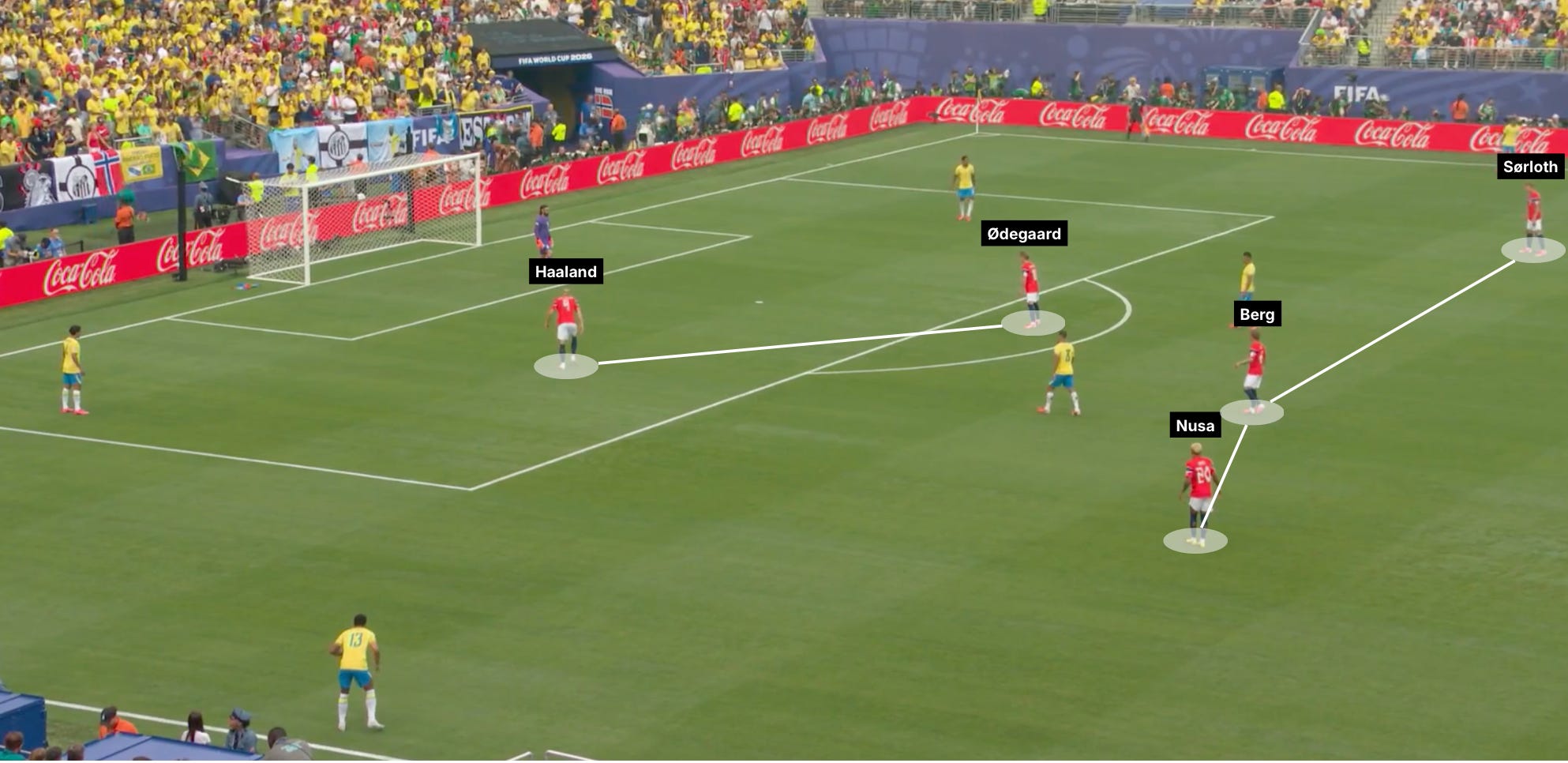
Which becomes a 4-5-1 when defending deep:
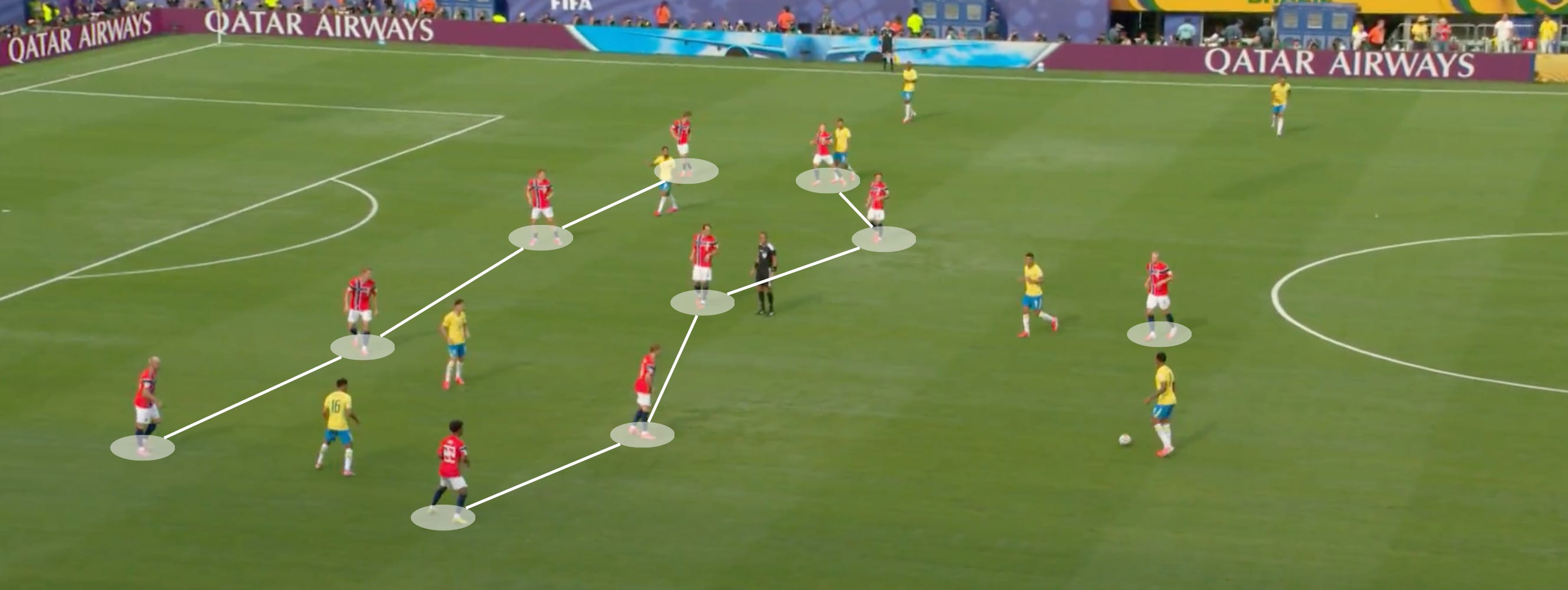
Which then becomes a 4-4-1-1 as any one midfielder presses up depending on where the opponent tries to penetrate from.
This 4-5-1 collapses inward onto itself, almost, as some midfielders press forward, whilst others find sanctity in dropping between the CBs. Either way, Norway’s out-of-possession remains consistent: they compact space, and do so very quickly.
The most interesting part of play here is when the opponent tries to drive in from wide:
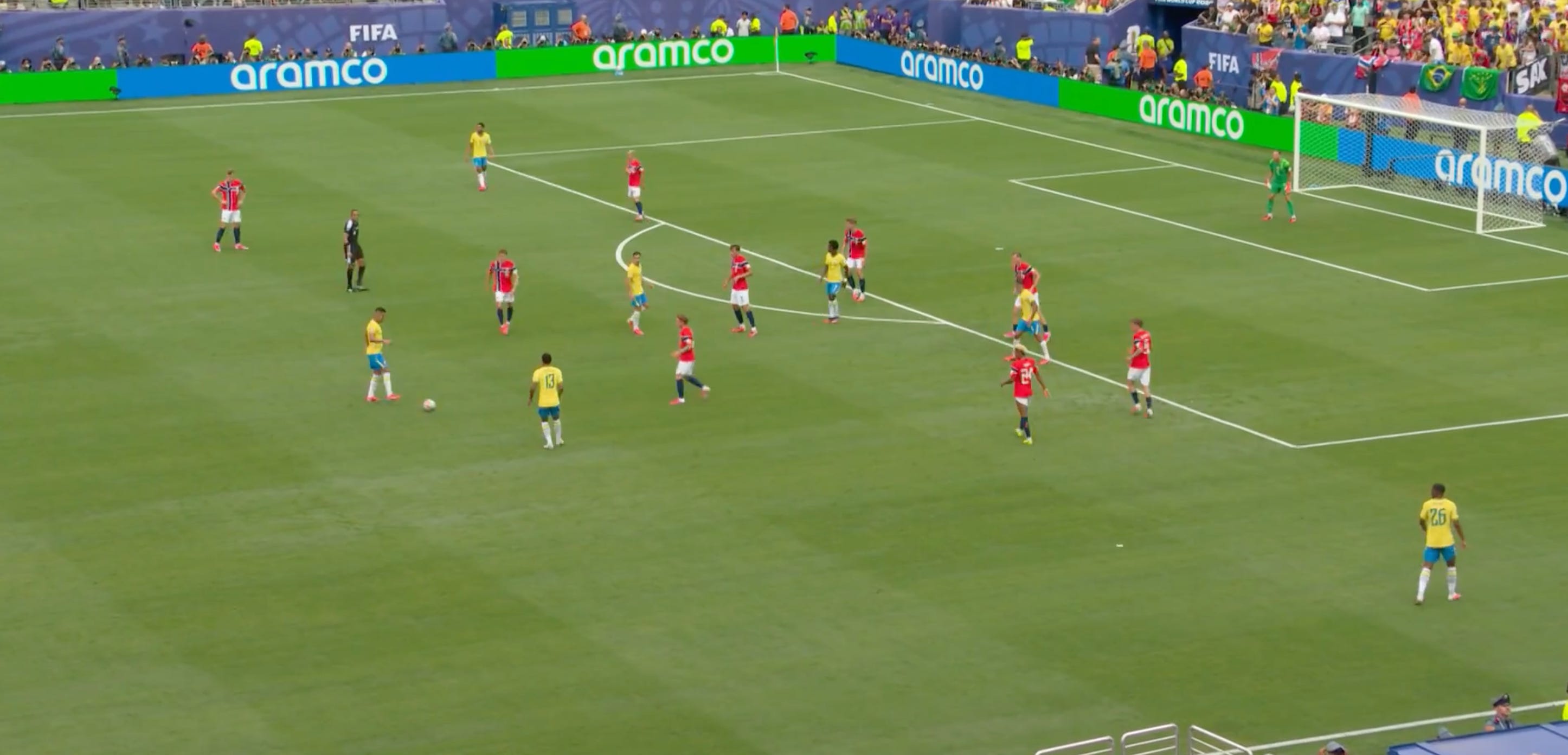
Norway sort of forgo defending wide… at all? Once again, this comes down to how well they compact space.
Their left winger and left-back (in this case, but it's the same for the right) must remain compact enough, such that they automatically double team on the winger who finds himself isolated.
They can do this pretty aggressively given how many bodies Norway always have centrally, which is comforting to think of.
England Preview


In terms of selection dilemmas, the only real question marks for Norway come on the wings. Schjelderup was superb vs Brazil, but if you start him alongside Sørloth, you may have two players who like holding the width.
You can then start Bobb instead of Sørloth, such that Schjelderup starts over Nusa, but you lose out on a reliable outlet, general nuisance, and certified tall boi in Sørloth.
I’d argue Sørloth’s physicality will be of help to Norway, for no reason but to clamp the game early on, after which he can be subbed off, so I’d like to see him start. This probably means Nusa’s best off starting on the left, but if Ødegaard continues to roam, I suppose he can compensate for Schjelderup’s width-holding if he starts.
Now, do I think Norway beat England? Probably not, no. There are things England can exploit, and in doing so, they’ll likely be able to put Norway under pressure early:
Take Ødegaard out of the game. Press him aggressively, stick a man onto him. Brighton have stuck Pascal Groß onto Bruno Fernandes time and time again, with him tracking him everywhere, beyond, and into Narnia, and if you do this, you force Norway out of their comfort zone. That’s not a zone you want to be out of in the quarter-finals of the World Cup.
In a similar vein, man-mark Sørloth. Anthony Gordon is fast enough to compensate for O’Reilly having to track Sørloth, and in doing so, you take away the long-ball game Norway like to resort to.
Play with your full-backs high. Force O’Reilly and Ezri Konsa high. Norway like to double team on an isolated winger out wide, so you’d be leaving Anthony Gordon/Noni Madueke out to dry if you don’t support them. Get O’Reilly to underlap, and Konsa to overlap, such that you get two men onto Norway’s two men, and bam, you’ll have fun.
Let Berge be. Norway like inviting pressure, from which Ødegaard can relieve them of it. So, you either play into this pressure and combine it with point 1, or you just let Berge linger on the ball, and force Norway into a tempo slower than anything they’re used to.
And, from a Norwegian POV:
Do the opposite of 1-4.
On the whole, I think Norway are a really decent team. They defend compactly, have one midfielder who never, ever stops running, another midfielder who can read minds (I’ve been meaning to watch The Mentalist), dribbly wingers, and a tall and fast striker who scores goals for fun. That’s a good baseline to have. They’ve done well, and with their talent pool, should be fine for the next seven to eight years.
Lykke til, Norge.
And that’s that. Thank you, takk, for reading! I hope you enjoyed. If you did, please consider subscribing (it’s free):
And sharing this with a friend:
Take care, and have a great weekend! Ta vare på deg selv, og ha en riktig god helg!
If you’re interested, here’s some of the articles I’ve written during this World Cup:


