

Context
When I analysed Sweden ahead of the World Cup, I had a fair few worries regarding their [lack of] balance. My main concern came from the make-up of their front three:
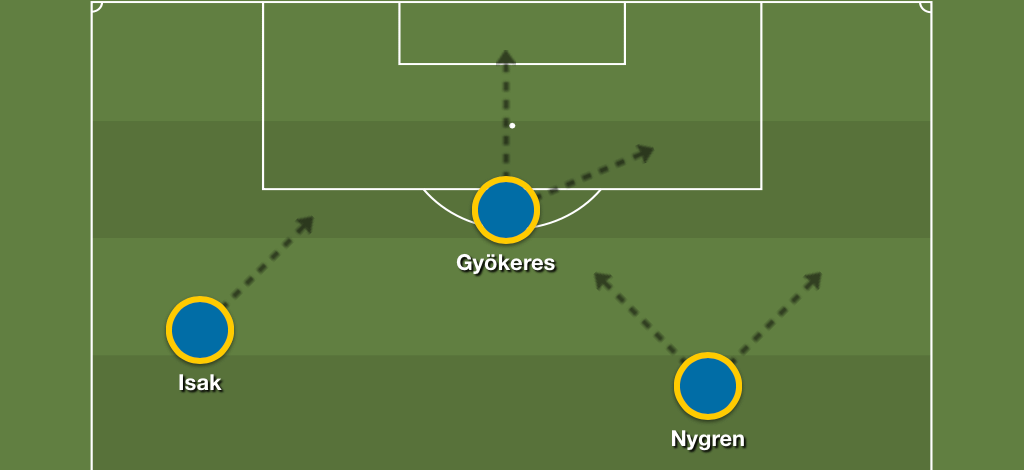
While it feels awfully nitpicky to complain about a front three that includes players with (league only):
— 29 G/A in 2024/25
— 131 G/A over the last four seasons
— 38 G/A over the last two seasons
They all want to do the same thing with the ball: shoot.
This is all well and good because you do need goals to win football matches, but to score goals, you need someone who’s creative. Sweden’s creativity, then, comes from their wing-backs and midfielders:
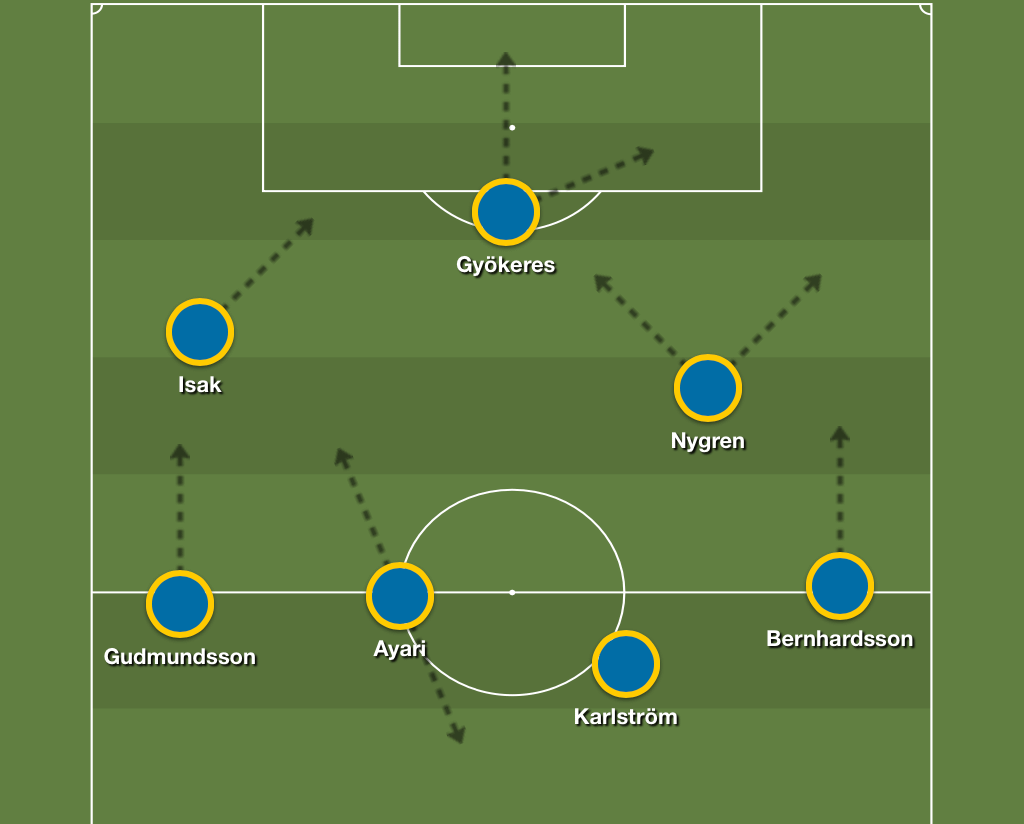
Gabriel Gudmundsson and Alexander Bernhardsson/Daniel Svensson would be relied upon for width. The front three all like to drift narrow so as to get closer to goal, and the wing-backs are needed to compensate for that by occupying those wide spaces.
Sweden’s midfielders are generally very mobile, given they are primarily responsible for progressing the ball out of the centre-backs, and are therefore constantly on the move when building up. Once the ball gets moving, Yasin Ayari is given room to run upfield, becoming a passing option from the edge of the box. Jesper Karlström would typically sit deeper, becoming Sweden’s primary option for deep passing and counter-attacking.
Behind them, Sweden play a back three of Victor Lindelöf, Isak Hien, and Gustaf Lagerbielke:


The square boxes in these graphics roughly mark the zones each player is expected to occupy. The issue I find here is that certain areas are very clearly overexposed or underexposed in the first phase of build-up, whilst the closer you get to goal, the more ground certain players are expected to cover.
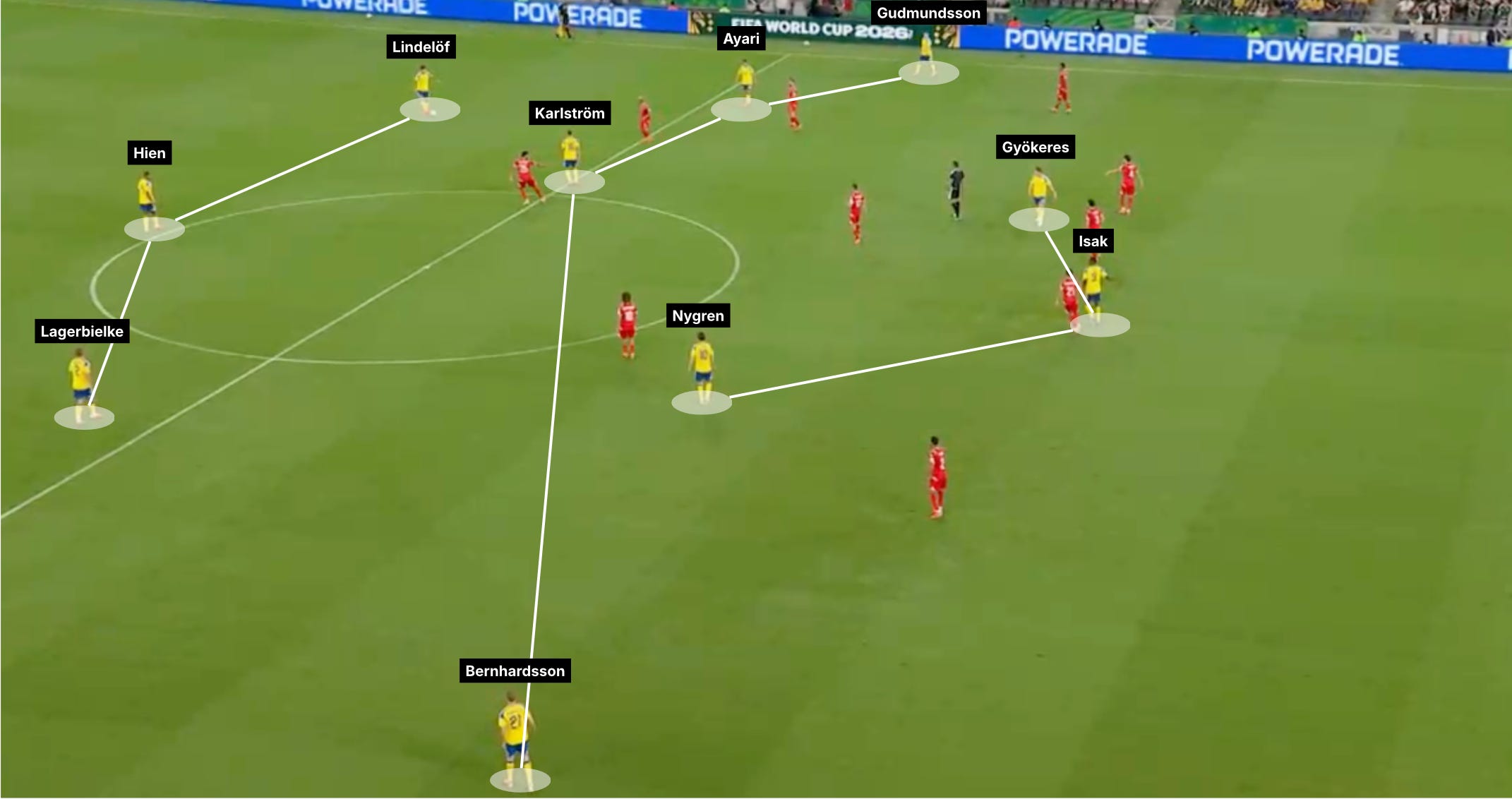
*Whilst this isn’t entirely reflective of Sweden’s shape, given this was following a phase of play where Sweden were shifting play to the left and had Viktor Gyökeres drop deep to create space for Alexander Isak, who was ready to run in behind, it does broadly show Sweden’s intentions when they’re secure in possession.
Consequently, you can reduce Sweden’s entire attacking strategy to:
Hoof the ball long to Gyökeres. His back-to-goal play is good, from where he can lay the ball off to Ayari or Isak: the former gives Gyökeres the option of a 1-2 before getting a shot off, whilst the latter is more than capable of driving → shooting on his own.
Hope either the left centre-back or right centre-back can find Ayari with a pass, who then carries up the pitch and into the box. From here, he can either find Gudmundsson on the left to cross, or go straight to Isak or Gyökeres.
This then means Sweden have very little unpredictability through the centre, and not much scope for rotations when building up, therefore making Sweden rather easy to anticipate → counter, and, more worryingly, meaning my concerns about their lack of balance in the front three extend to a predictable build-up all the way from goal kicks.
And, while this may sound strange to say after Sweden just won their World Cup opener 5-1, it makes me quite wary of their prospects moving forward. So, let’s take a look at how predictable Sweden were vs Tunisia, and how this sets them up for their next match vs the Netherlands.
📚 Contents
Note for email readers: This email may be truncated. To read the full article, please click on this link or the link to the right of [Message clipped] note at the bottom of this email.
Rotations and Midfield Mobility
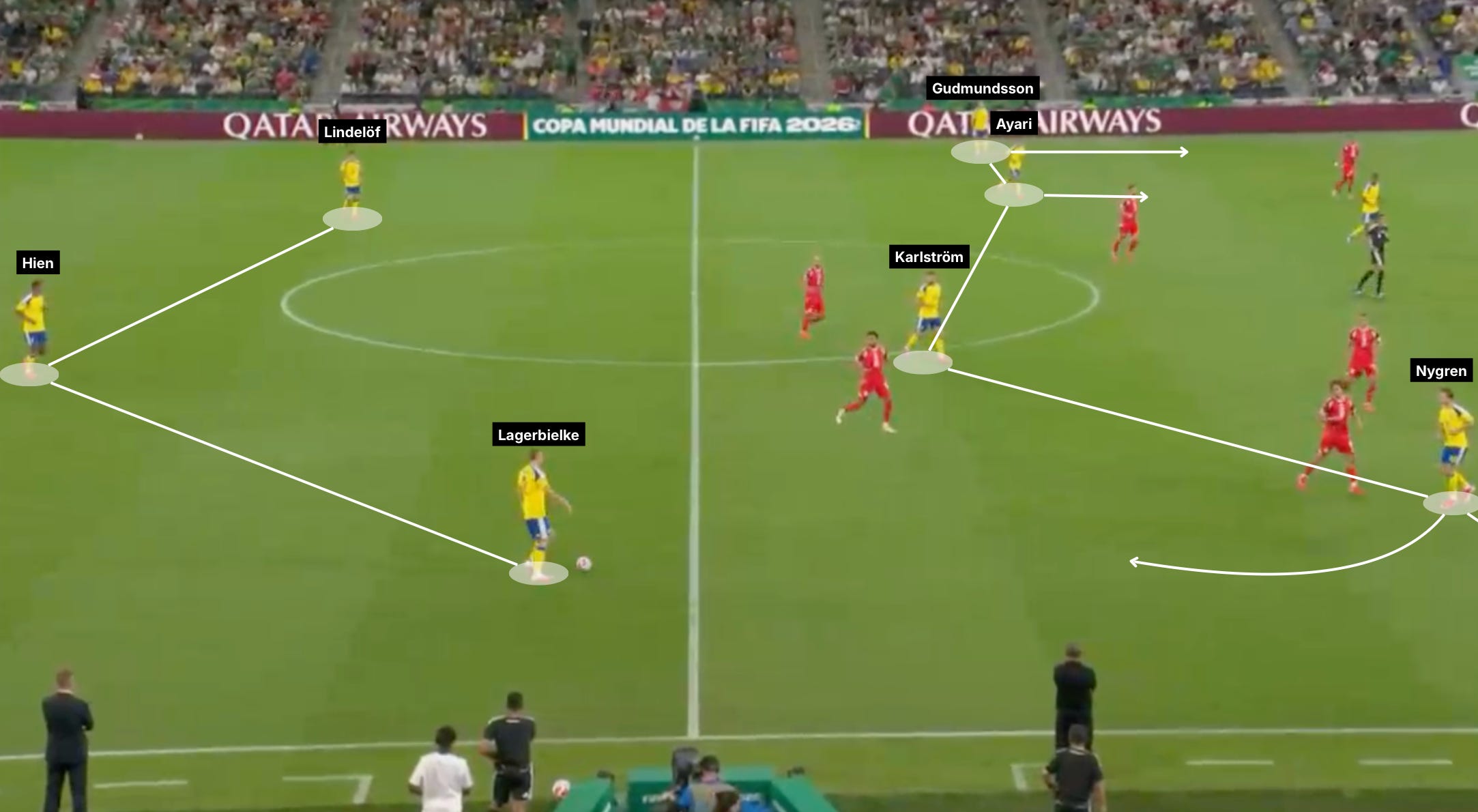
Sweden’s CBs often look like this in build-up:
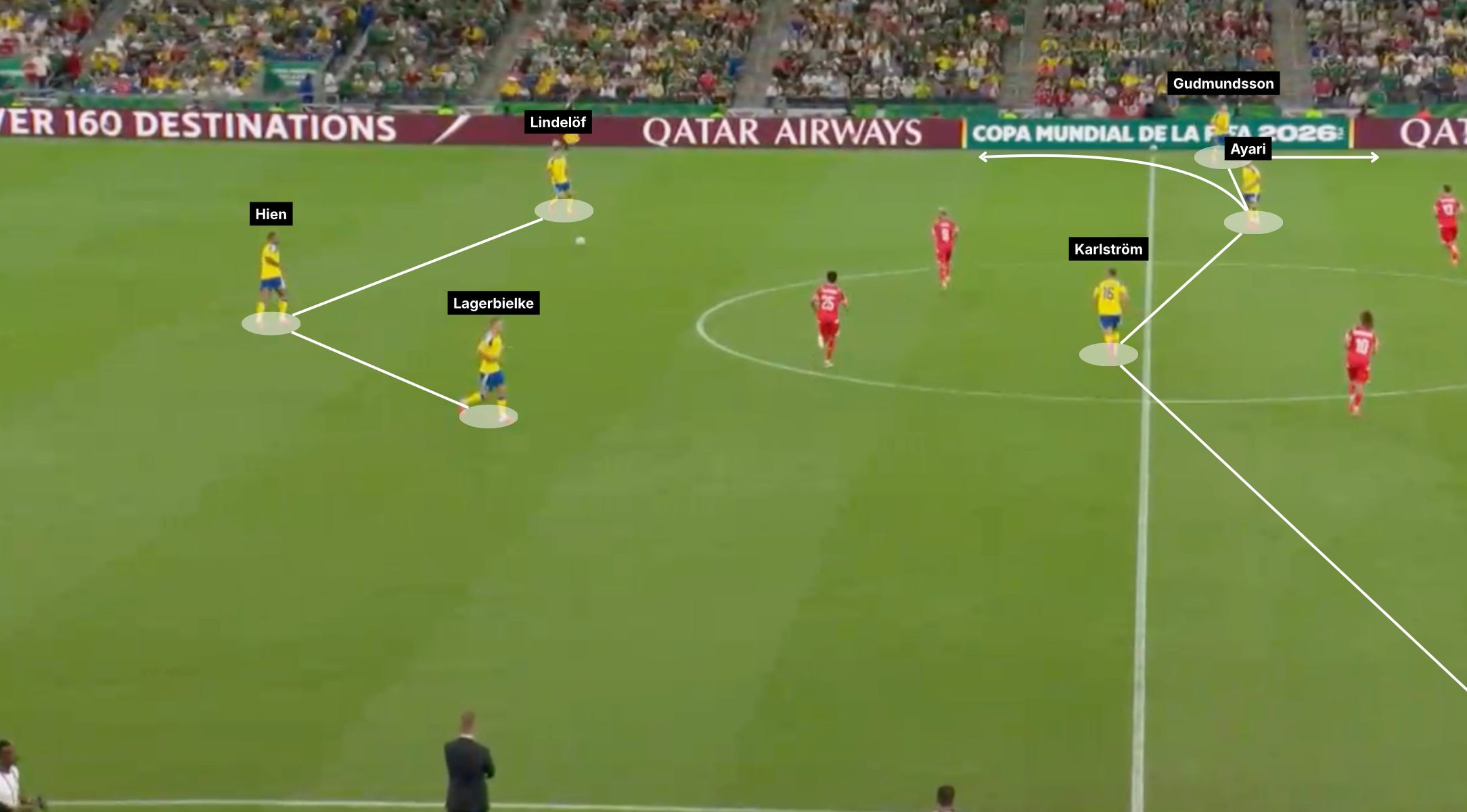
Where the rotations between Gudmundsson, Ayari, Karlström, and Benjamin Nygren are quite interesting.
Firstly, the distances between the CBs and midfield are huge. Consequently, Sweden spent a lot of time circulating the ball between Lindelöf → Hien → Lagerbielke and vice versa.
When Lindelöf has the ball, Ayari drops deep and holds the width on the touchline as Gudmundsson drives, therefore giving Isak room to cut in from.
When Lagerbielke has the ball, Ayari starts running upfield, so as to get into a position from where he can reasonably be expected to get an assist. Karlström stays deep to create another passing channel, and Nygren drops deep + wide, similar to Ayari in the left-sided scenario:
However, given the time Sweden spent playing the ball amongst their three CBs, Tunisia naturally adjusted to press the outside CB. Consequently, the midfielders have to be quite mobile, so as to help bail Lindelöf/Lagerbielke out of this pressure:
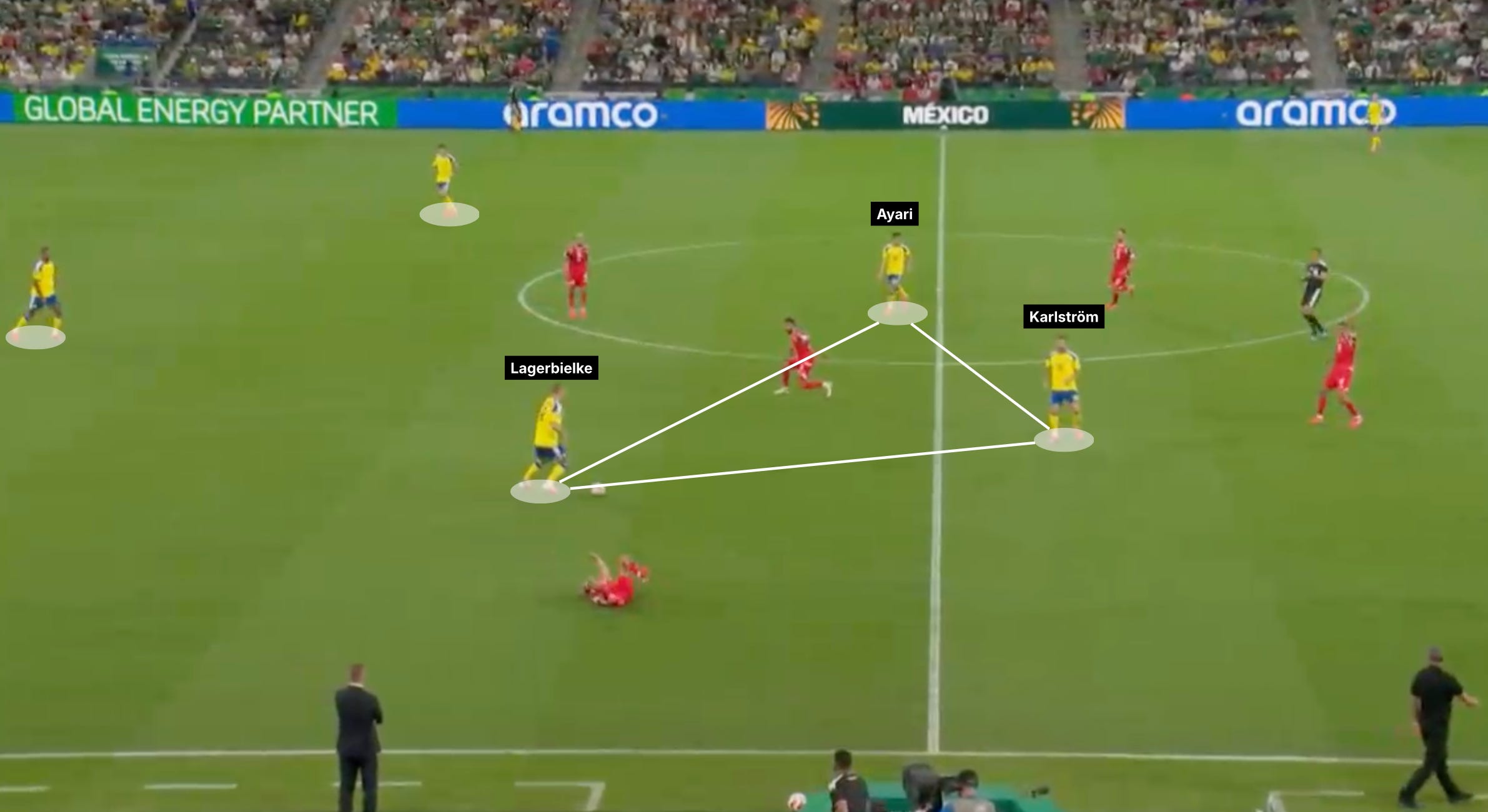
Whilst this is required on the midfielders’ part to make sure you can, well, actually progress, I think there are a couple of structural issues that mean Ayari/Karlström are left [over]exposed and have to run more than they otherwise would.
Firstly, Sweden’s tendency to circulate the ball for long spells before making an incisive movement means the wing-backs naturally find it hard to pendulum up and down. Consequently, both wing-backs find themselves simultaneously high up the pitch (increasing pressure on the 3-2 defensive base) or deep (meaning there’s no width high up the pitch).
Secondly, Nygren often drops deep to collect and progress, which is good, because he sorta has to, to maintain any sort of coherent shape. The issue is, if you press him hard enough, it would be pretty easy to win the ball off him and counter quickly, given he’s more used to receiving and holding up the ball either higher or wider.
Generally speaking though, I find the relational movements between the back three + midfield to be well-rehearsed, as even Hien makes sure to drop slightly deeper from his central centre-back position when he sees either of the LCB or RCB get pressured, so as to protect against transitions.
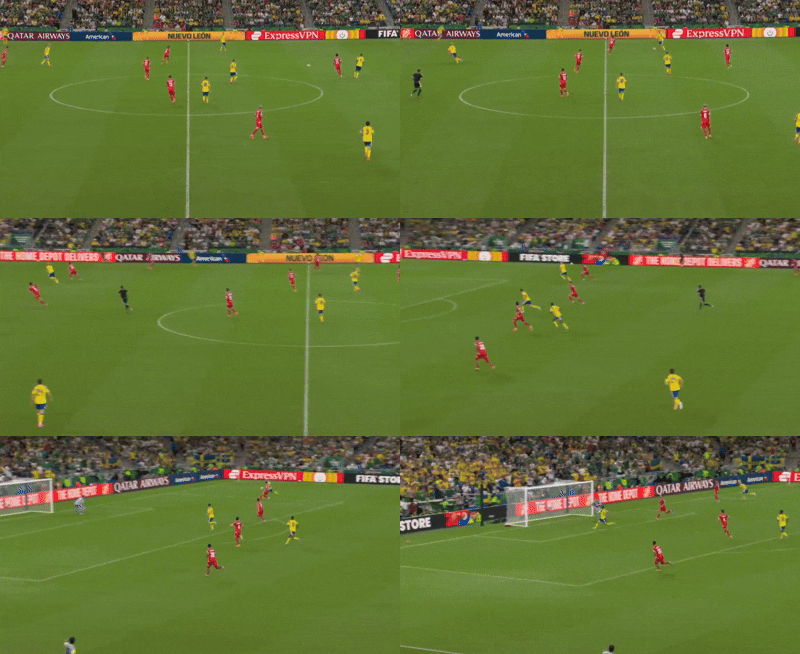
These rotations were especially good in the second half, following Lucas Bergvall’s introduction. Take this instance, where Bergvall instantly makes a run in behind, following Bernhardsson dropping deep, therefore meaning Lagerbielke had two easy “outs”: a lay-off to Gudmundsson, or a ball over the top to Bergvall, who can then play it into the box:
Backwards Momentum and Displaced Strikers?
One weird consequence of these large distances between midfield, wing-backs, and attack is that the wing-backs and the rest of the attack often have to drop deep to receive the ball, therefore shifting their momentum backwards — an issue worsened by Sweden's lack of central progression:
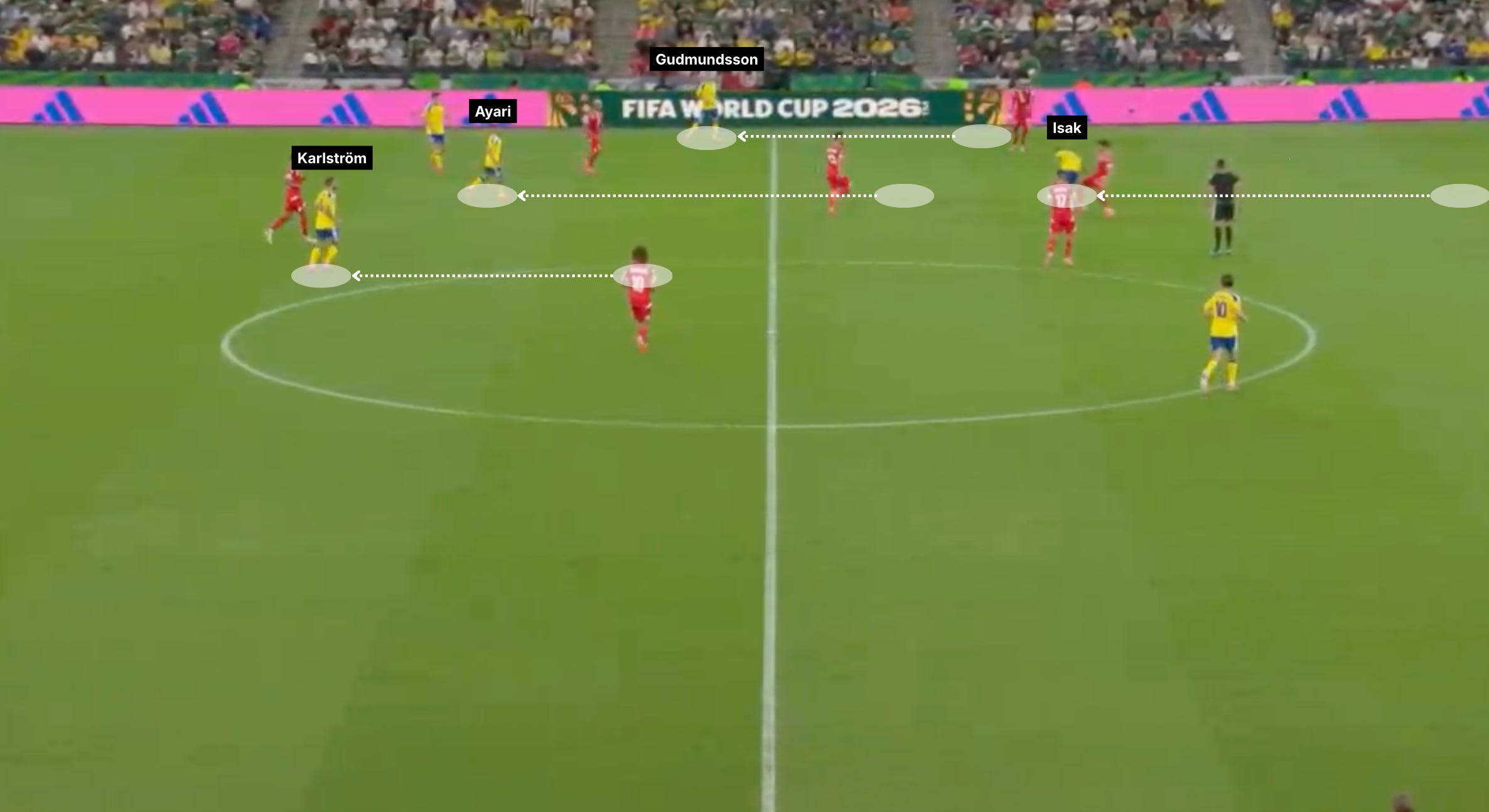
As a result, Sweden found it hard to sustain pressure or attack [quickly] in transition. It also made their structure quite lopsided, meaning that if you have a fast winger who can run in behind on the far side, you could have a fun time playing against the Swedes.
Take this, for example:
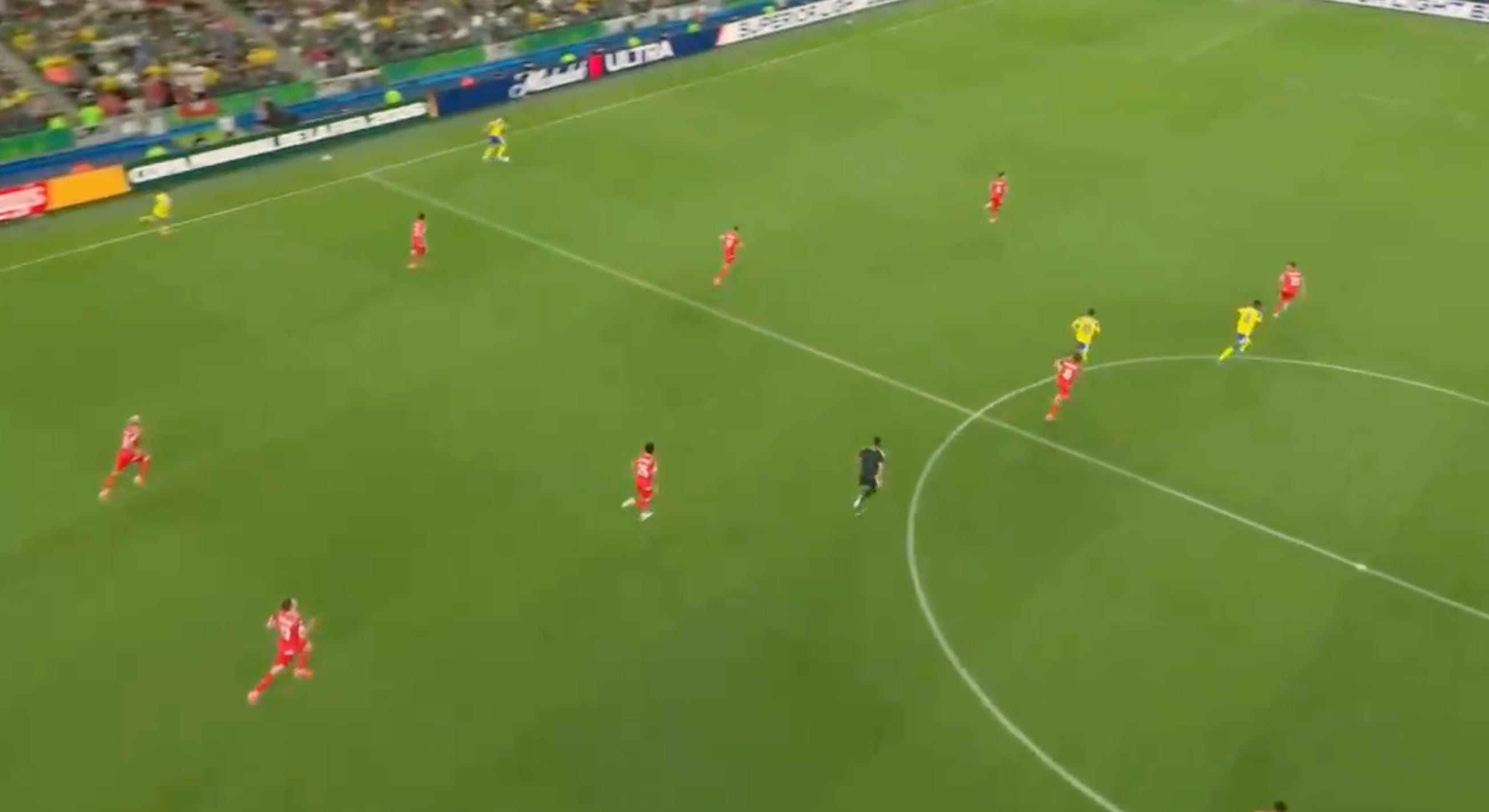
I'm not entirely sure Gyökeres is the player you want receiving the ball there. I'm even less sure he gets anywhere near that same amount of space against a higher-quality team, from where he'd likely lose the ball instantly because he has no one to pass to:


The most obvious solution to this problem of having your best attacking threats find themselves in questionable positions is to surround them with energy + athleticism, allowing them to sit in favourable positions, but that may be slightly hard to facilitate given the short timespan of international call-ups. Anthony Elanga would provide a ready-made alternative in place of Nygren, but then you’d lose some of his movement that eventually goes on to create openings in the channels and half-spaces that Gyökeres needs.
Isak also often received the ball in these areas, which is fine, but still, you’d ideally want him closer to goal.
The one saving grace here is that both Isak and Gyökeres are strong + hard to shake off the ball, especially given the latter’s back-to-goal play. Still, having them be responsible for progression reduces the chances they’ll get, and those chances will already lessen against better opposition.
An Aggressive Press
A lot of these spatial/positioning concerns translate into out-of-possession issues.
Sweden defended in either a 5-2-3/5-4-1, or a 5-3-2 with Nygren dropping next to the pivot:
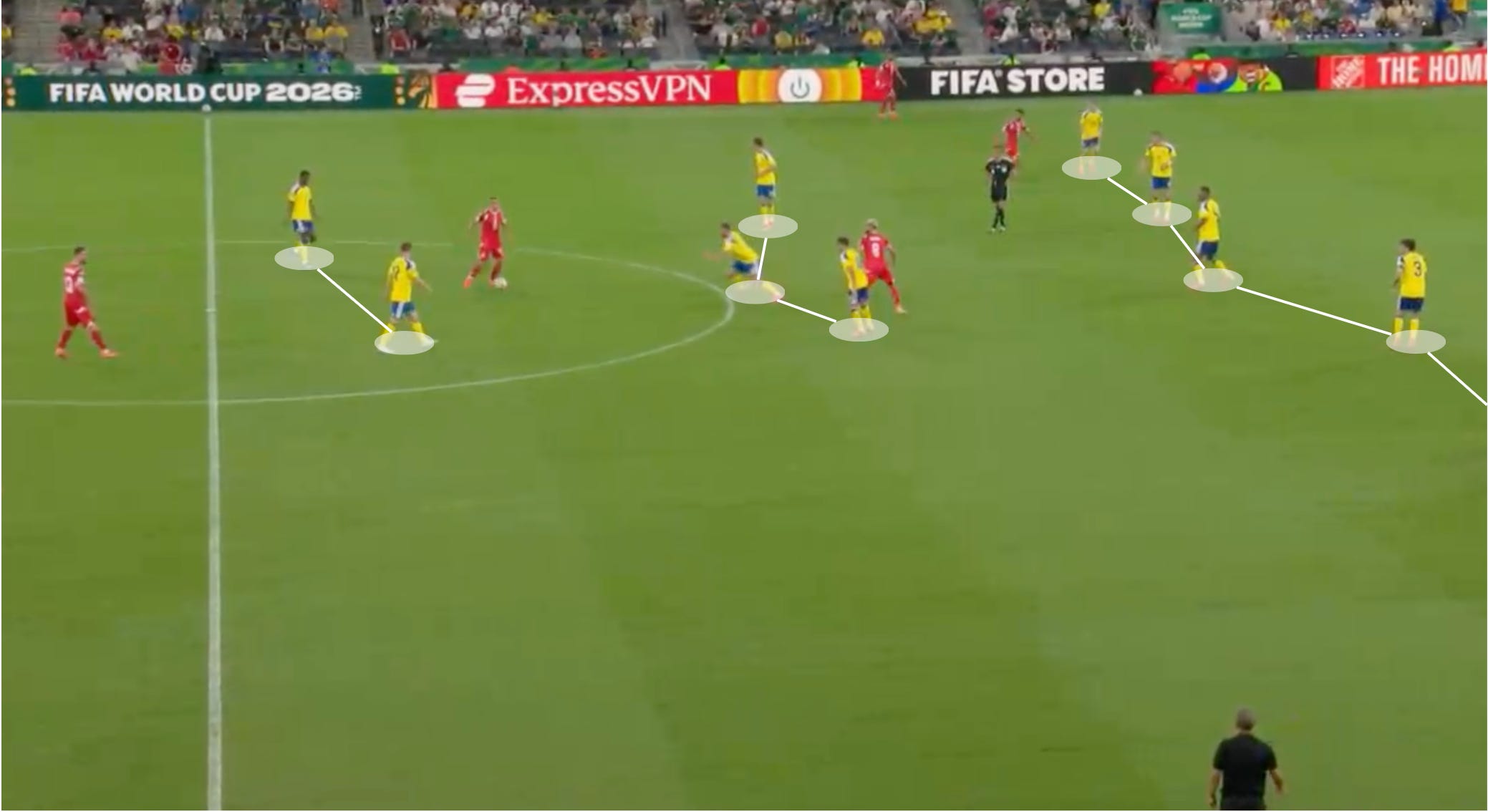
A common theme of Sweden's game was their aggressive m2m (man-to-man) pressing vs opposing wide players:
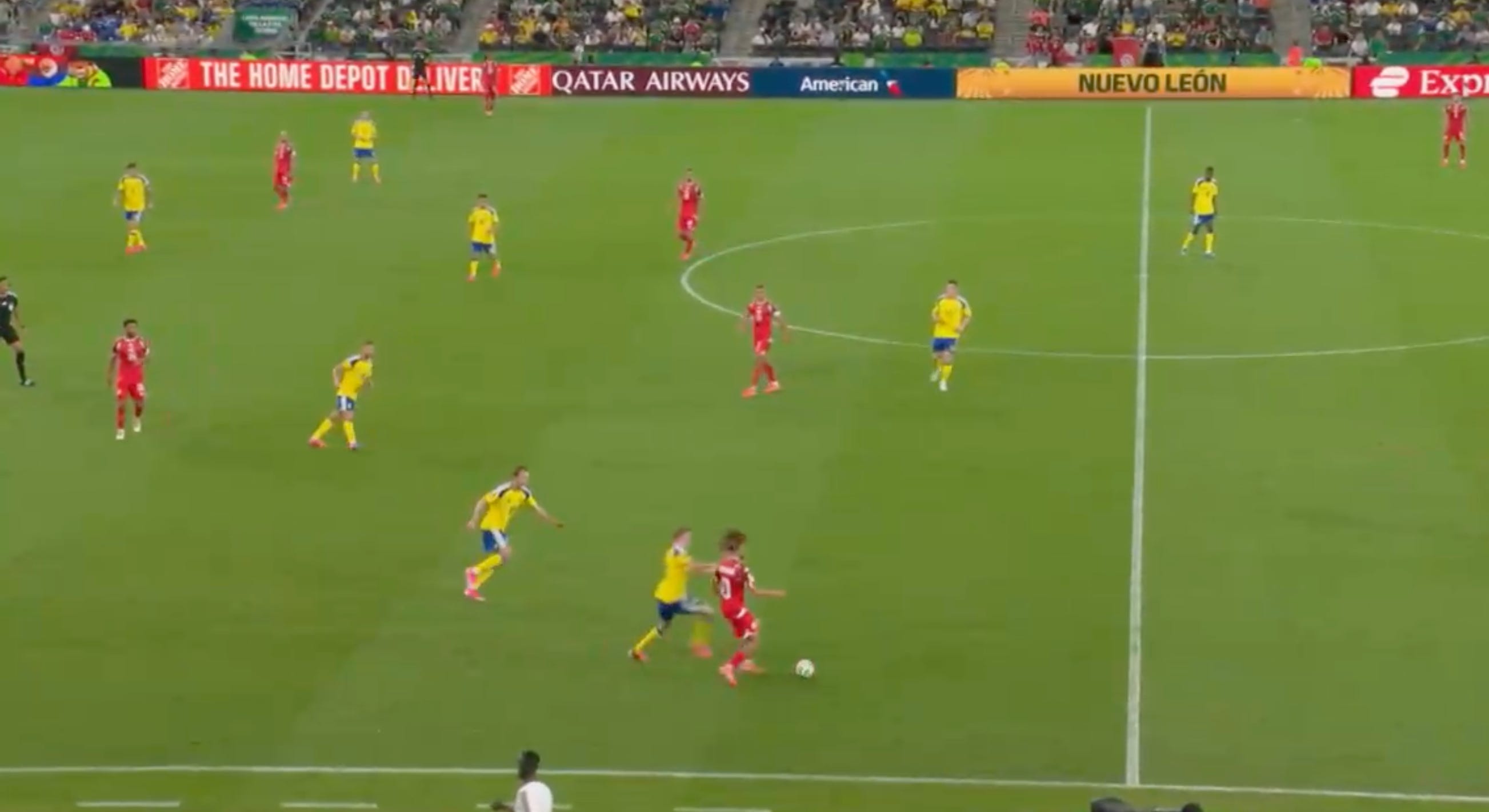
This then forces the opponent to pass backwards. Once they do so, the midfield sees this as a pressing trigger and jumps aggressively. Spielverlagerung wrote an excellent piece on this, which I have linked here.
One consequence of this sequence that I’ve noticed is that if the opposing full-back is good under pressure and can find the same-sided winger with a pass, it’s nearly a guarantee that the winger will be pressed m2m too. This could create room for an attacking midfielder to run into, and just generally wreak havoc with the ball.
Pressing this aggressively can also lead to some rather… suboptimal happenings, such as having your LCB (Lindelöf) taking up positions you’d expect from your RCB or right wing-back:
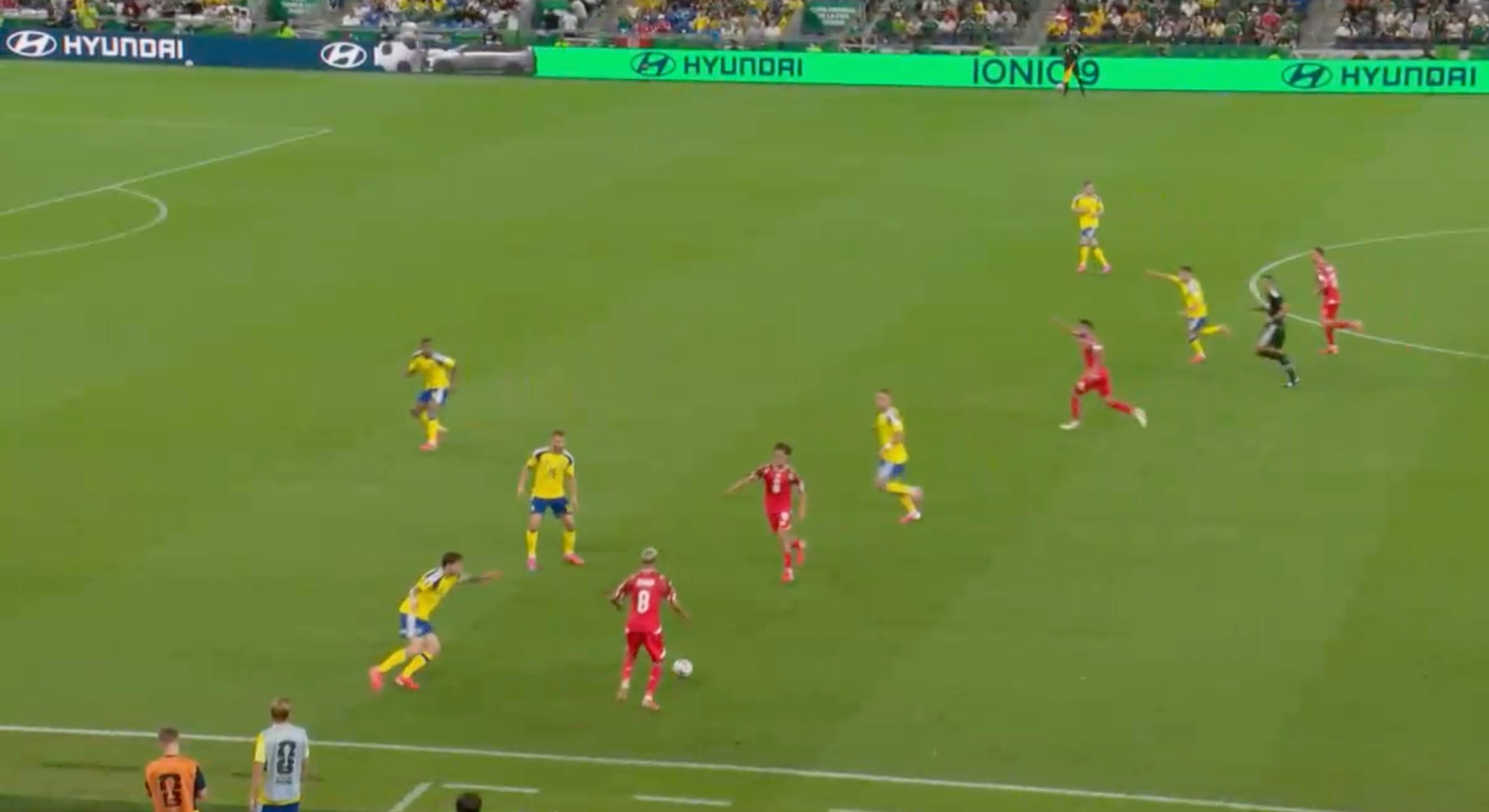
This isolates the other flank, leaving Tunisia with more than enough space to run into.
This was a common theme throughout the game, especially when the midfield pushed up, leaving a void between where the midfield should’ve been and the defence:


Looking Ahead
I don’t necessarily think Sweden need to make any major lineup changes for their match vs the Netherlands. Gudmundsson did go off injured against Tunisia though, so if he is injured, Svensson is about as good a replacement as you could ask for.
Beyond that, there are a couple of selection decisions you could make a case for.
Mattias Svanberg for Karlström could be one of them, but I think Sweden are better off continuing to build synergy between Ayari and Karlström, particularly if they’re looking to iron out some of their midfield pressing-trigger issues.
Nygren vs Bergvall/Elanga is an interesting one. Elanga gives you pace to run in behind and a darn good outlet on the counter, but you lose a little bit of defensive positioning as well as some central presence. Bergvall gives you that central presence, but then you lose some of the width Nygren can provide. What I’m getting at here is that, in terms of positioning, Nygren gives you the perfect middle ground.
Bergvall was superb vs Tunisia, though, and I think he’d best suit an advanced role as opposed to playing in the pivot, where whoever partners Ayari is likely going to have to be slightly restrained.
That said, I do hope to see some structural changes, with a focus on reducing the spaces between the lines both defensively and offensively. Any backline consisting of Virgil van Dijk and Micky van de Ven won’t offer you much time or space, so Sweden need to make sure their outlets start in good positions, whilst players like Jan Paul van Hecke, Frenkie de Jong, Crysencio Summerville, and Donyell Malen can carve through gaps in midfield.
So, more compactness won’t go amiss. Maybe some meatballs too.
Aaand that’s that for this piece. Thank you for reading. I hope you enjoyed. If you did, please consider subscribing (it’s free):
And how about sharing this piece with a friend?
Take care, and have a great weekend!
P.S. If you’re interested, here’s some more of my work:


