

Context
I spent a fair bit of time watching Turkey's World Cup qualifiers, with a particular emphasis on their playoff games vs Romania and Kosovo. I've attached my notes from those games right here:
Romania:
Ferdi Kadıoğlu running into the half-spaces allowed Kenan Yıldız to drift wide, where he’s 1v1 with the opposing full-back (where he generally does well), who is then split between defending Yıldız and Kadıoğlu.
This gave Arda Güler room to roam, which then maximised his creative + passing bag, whilst having Hakan Çalhanoğlu deeper helps him set the tempo. Them + İsmail Yüksek make for a secure midfield.
However, this means that Turkey have very few runners (outside of Kerem Aktürkoğlu and maybe Yıldız, but how much can you ask of him?), in addition to limited progression from the centre-backs.
Furthermore, given how expansive this setup is (especially with the left-back effectively pushing up as a winger), no centre-back has an easy “out”, so you really need both centre-backs to be comfortable on the ball.
So, if you press aggressively enough to take the midfield out of the game, you could sort of take Turkey out of it entirely.
Yüksek dropping deep as the right centre-back (RCB), with Zeki Çelik driving forward, is a neat solution to the above, but you then lose a reliable midfield presence.
Kosovo:
Orkun Kökçü in midfield would solve some of those issues, but it also clogs up the spaces Kadıoğlu instinctively likes to run into. It would also force Güler out onto the right wing, although Kökçü's creativity should compensate for some of that.
With some explanatory graphics:


However, Turkey rocked up to the World Cup with a few injuries in their squad, most notably to Kadıoğlu and Yıldız. Consequently, for their opener vs Australia, they lined up like this:


And this lineup isn’t the worst. For example, Çelik pushing up as a right winger enabled Güler to come inside and float between the lines, doing what he does best, making football happen, from a position that enables it best.
Yüksek sat deep, almost as the RCB in a back three, to facilitate the void Çelik left behind. Çalhanoğlu sat slightly ahead of Yüksek, becoming the main midfield progressor. Barış Alper Yılmaz played on the left wing as opposed to his usual spot on the right, meaning he cut in and [tried to] drive at the full-back every opportunity he got. Kadıoğlu attempted to run into the half-spaces as he had vs Romania, only to be blocked off by Kökçü again, as had been the case vs Kosovo.
And, not dissimilar to both playoff games, Turkey had no one even trying to run in behind (until the second half), whilst being incredibly vulnerable in transition.
But this needs some more nuance. So let’s take an in-depth look at what Turkey did well, and what they most definitely did not, in their 2-0 loss to Australia.
📚 Contents
Note for email readers: This email may be truncated. To read the full article, please click on this link or the link to the right of [Message clipped] note at the bottom of this email.
Rotations and Population Density
A LOT of Turkey’s issues can be explained by one core issue:
Players continually rotated into areas they would occupy if certain conditions were met, without those conditions actually being met.
For example, Kadıoğlu continued pushing up as the No. 10 in this phase of play (below), without really attempting to run in behind:
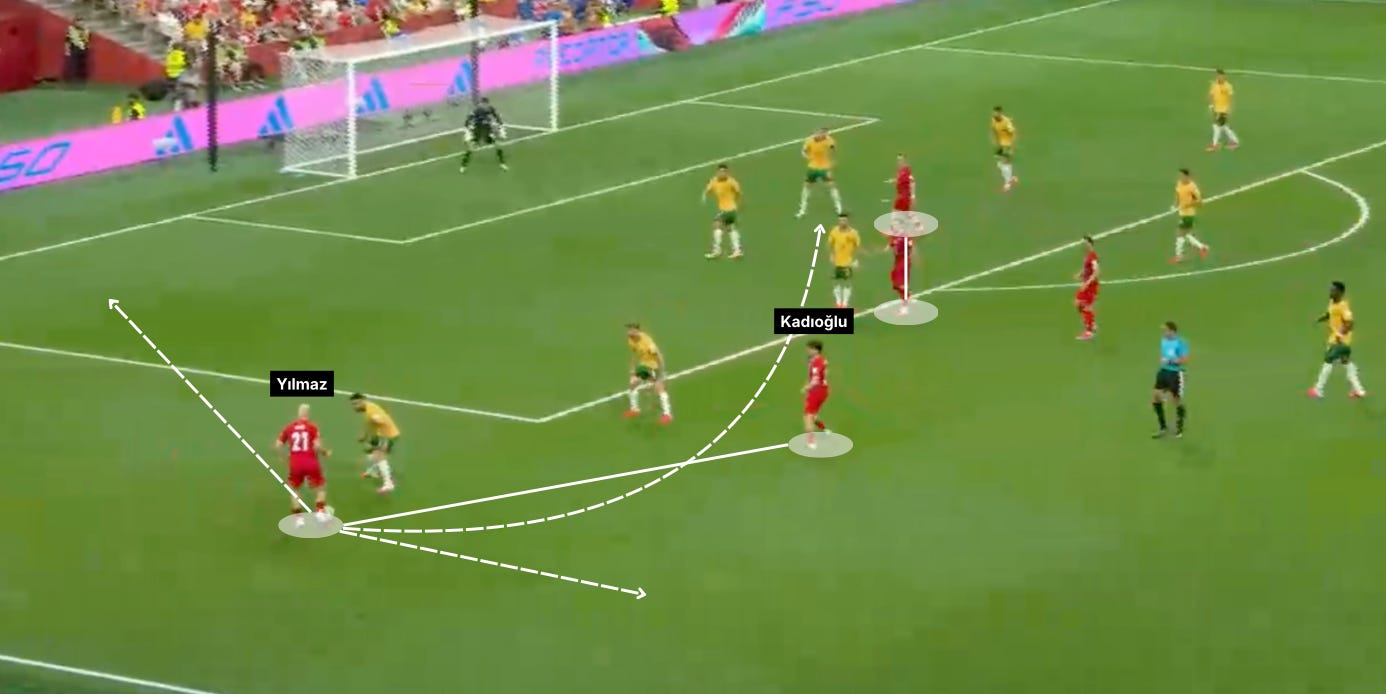
Realistically, you don’t want to rely on Yılmaz beating his man and crossing with his left foot here, so his only options are to play a ball in behind for Kadıoğlu to cross from, cut back and cross into an already crowded box, or cut back and lay it off to Kadıoğlu.
There’s no real intent to do the former from Kadıoğlu’s end, and he’s vacated those deeper areas to the point where Yılmaz can’t even turn and play a safe pass backwards. So what can Yılmaz really do here besides attempt an early cross that’s inevitably going to get blocked?
Something similar happens here:
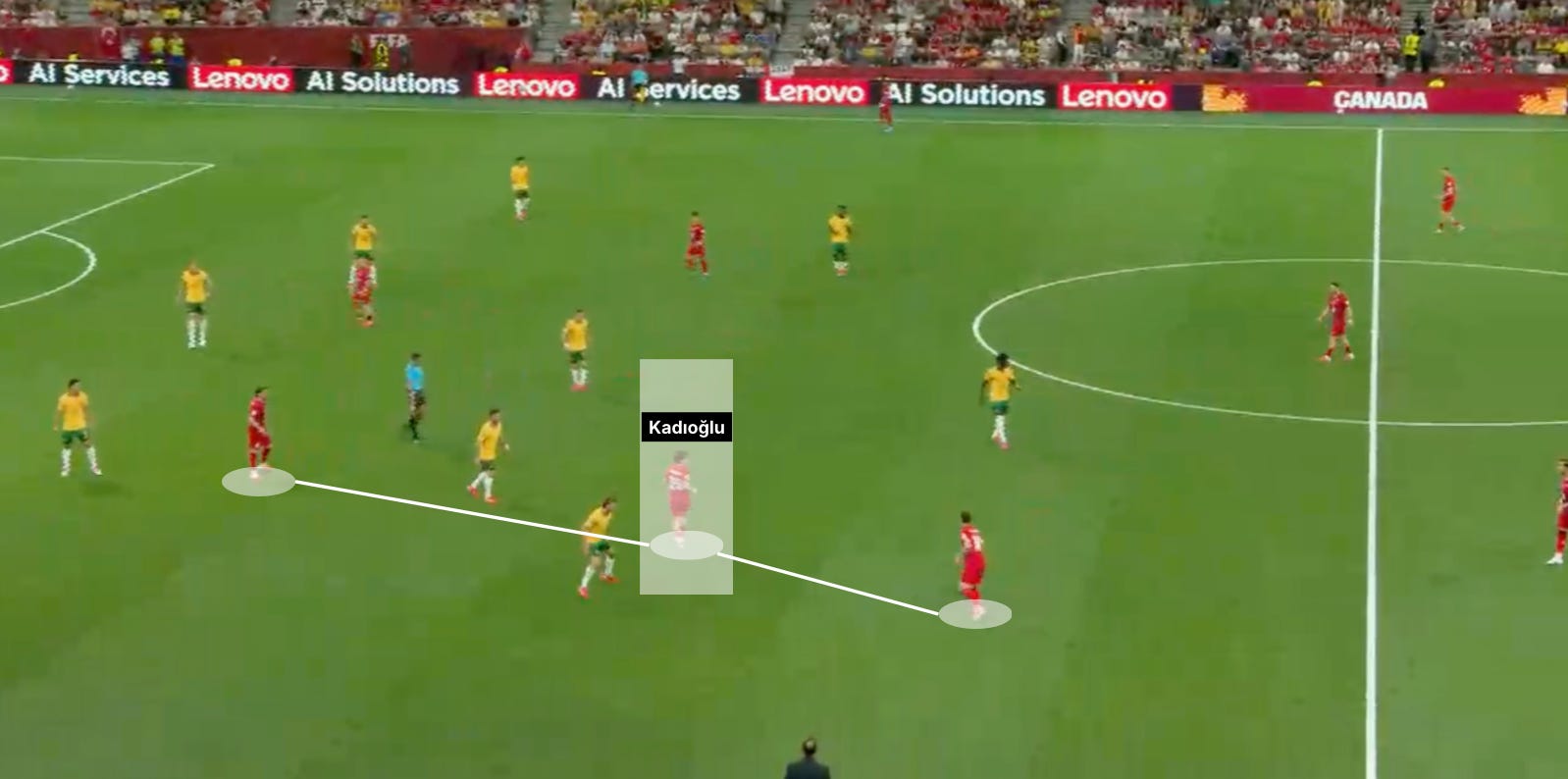
Kadıoğlu lays the ball off to Çalhanoğlu before cutting inside and sitting in midfield. This ultimately further blocks off the already limited passing angle to Aktürkoğlu, who still doesn't try and make himself available.
While this does speak to a larger issue surrounding Turkey’s verticality, which I’ll get into in a moment, I think an issue Turkey persistently had within the first 45 minutes of this game was that they effectively pretended Yılmaz was Yıldız. Yılmaz is NOT Yıldız, and isn’t anywhere near as comfortable in 1v1s.
Anyhow, back to the aforementioned rotational issues and Kökçü clogging up the midfield.
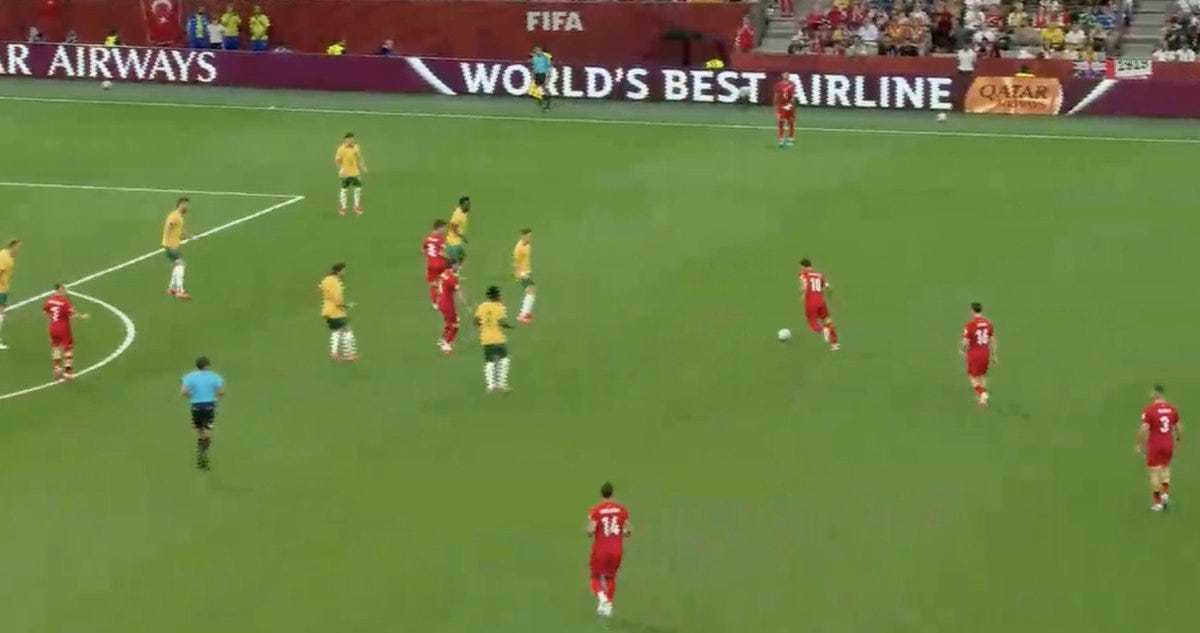
Ultimately, a lot of Turkey’s XI was comprised of players who want to do similar things with the ball in similar areas. Consequently, they couldn’t really get it out of their CBs + Yüksek (+ Çalhanoğlu when he dropped deep), meaning they either had to switch play out wide or pass backwards.
Slow, Predictable, and Toothless
If we take this one step back and look at Turkey’s first couple of phases in build-up, we see two primary shapes, which lead to two foundational issues with Turkey’s performance. The first was a lack of dynamism.
Turkey built up from goal kicks in a 2-4 shape, with both CBs progressing the ball. As they drove forward, so too did the rest of the team, including both full-backs.
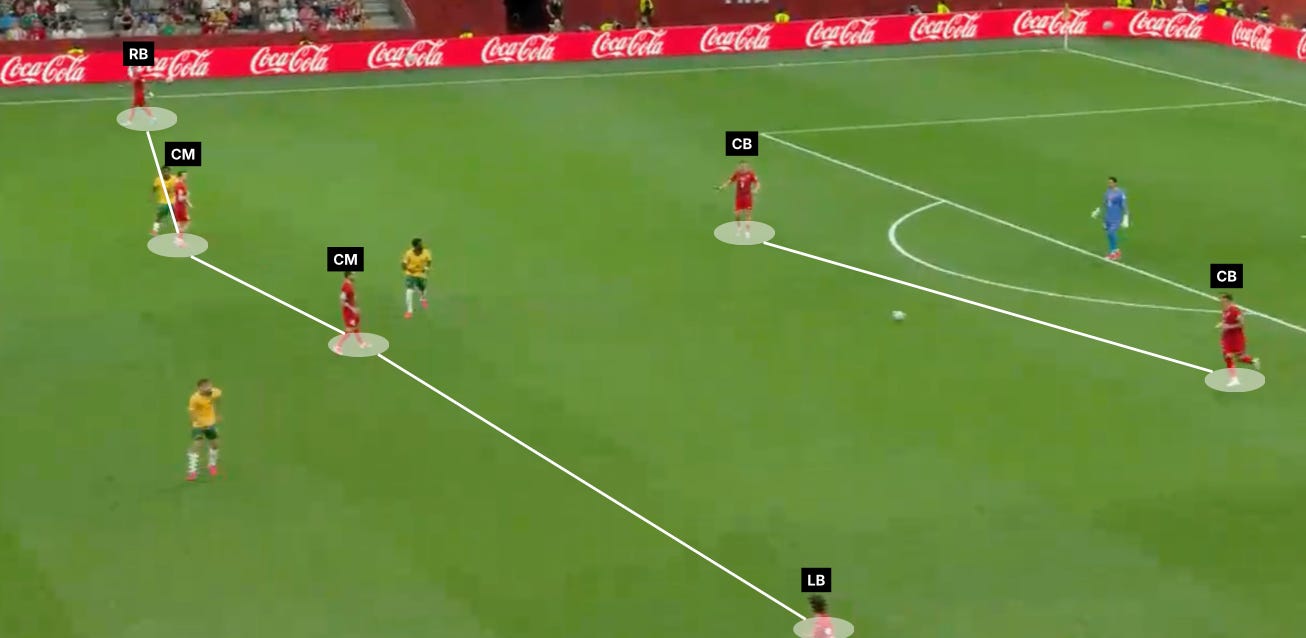
Turkey progressed a decent distance in this manner, effectively walking into Australia’s deep block, without either midfielder even trying to drop deep to get the ball and actually drive forward. The pivot was far too static, giving Australia time to regroup and, frankly, know what Turkey were going to do next.
Even when one midfielder (here, Çalhanoğlu) dropped deep to try and make something happen, Çelik, as the right winger, was not someone who can create separation consistently, nor is he in a good enough position to even try.
Consequently, Turkey aren’t able to progress play either through or around Australia with sufficient speed:
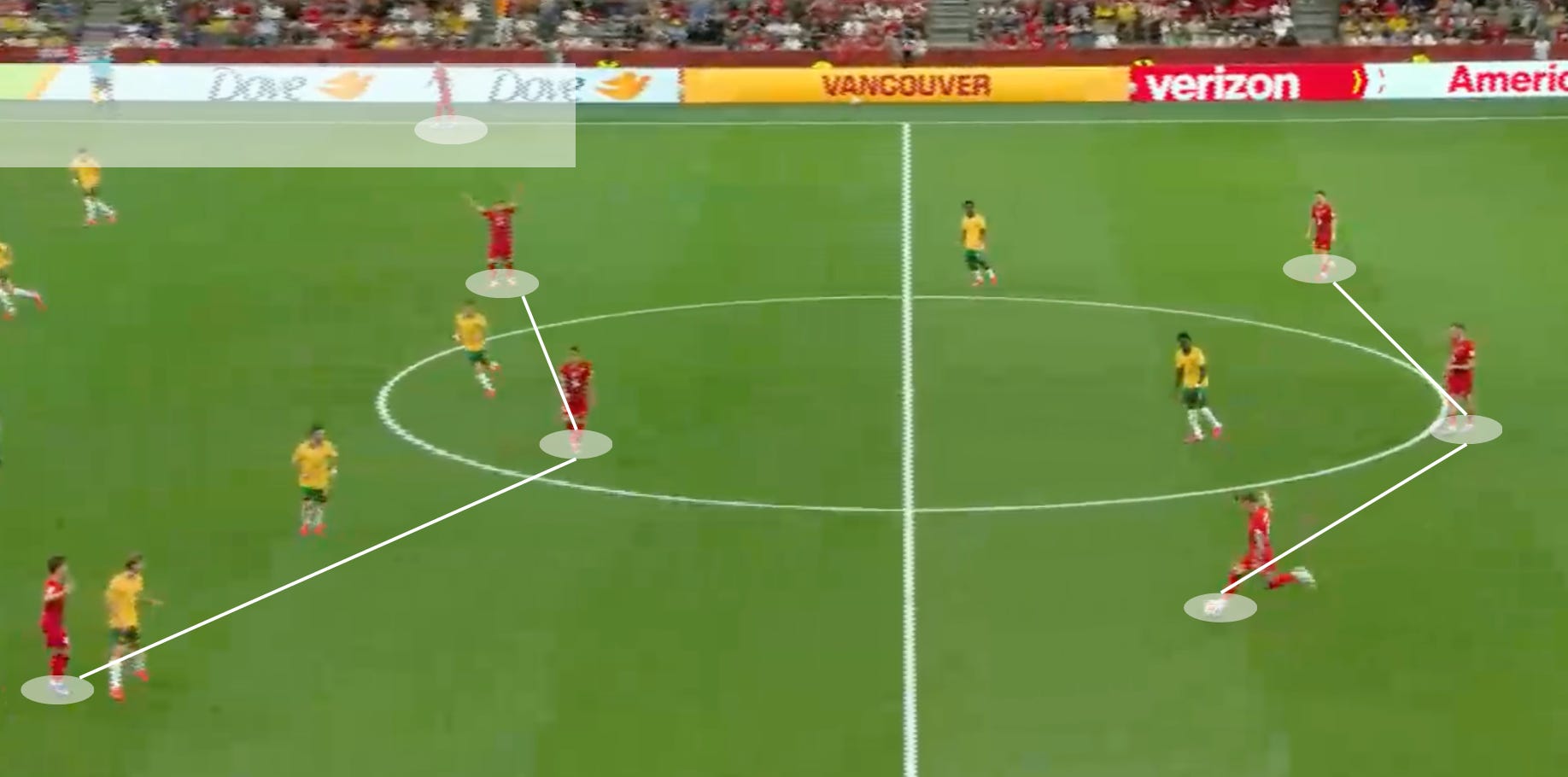
...which then meant their players weren't able to make it up the pitch with sufficient speed to counter-attack either. Like here:
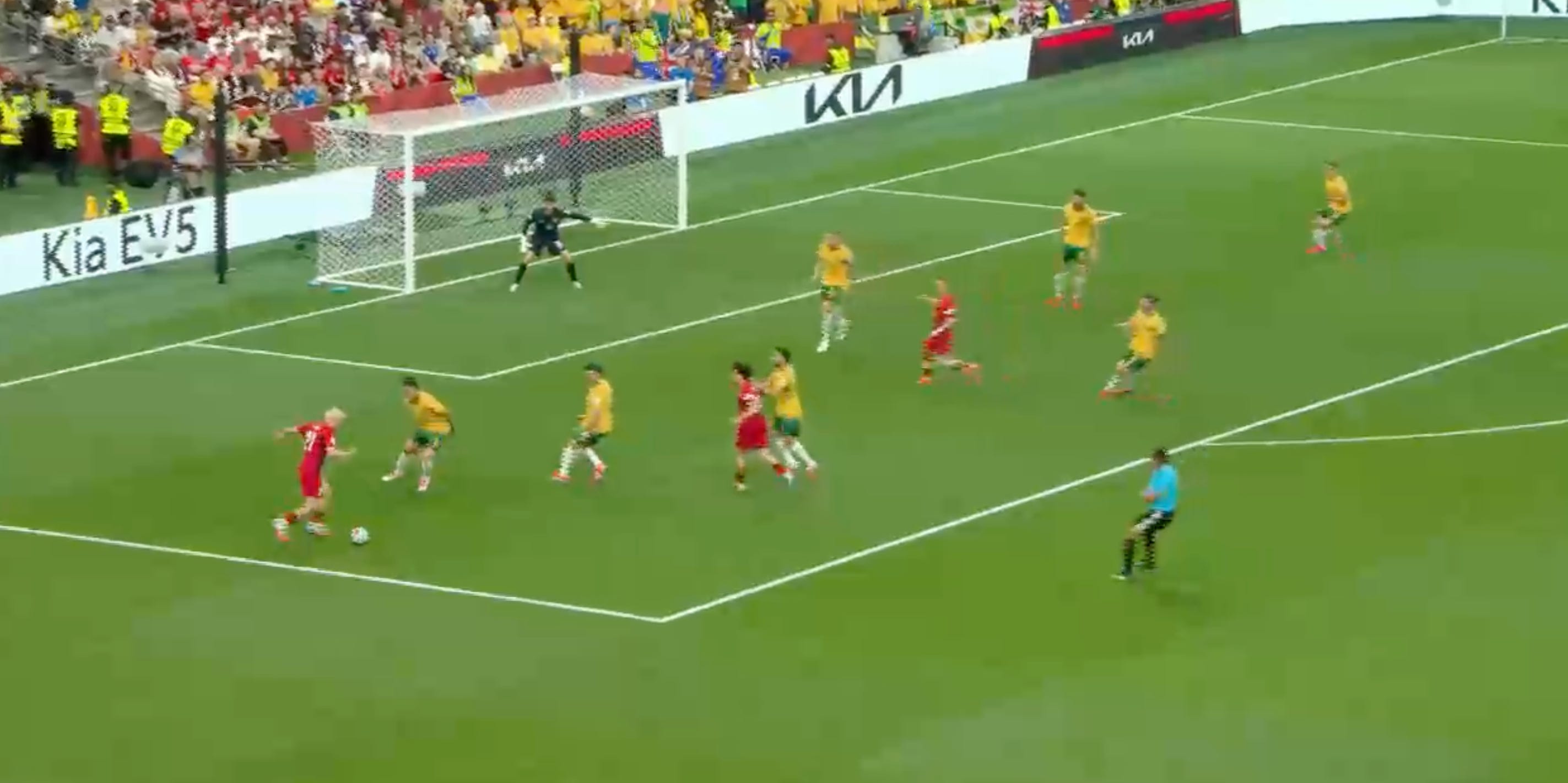
Kadıoğlu laid the ball off to Yıldız and continued his forward run. Yıldız recognises that he has no room to run onto, so he cuts back and floats a cross in. But there is absolutely no one crashing the back post, which is one of the most fundamental things a team can employ in attack.
Now, going back to the final third, this means Turkey's players had a very limited range of solutions to the many problems they faced.
Having your most direct winger (Yıldız) out injured doesn't help matters here either, so you REALLY don't want your [backup] winger receiving the ball here, with zero support nearby:
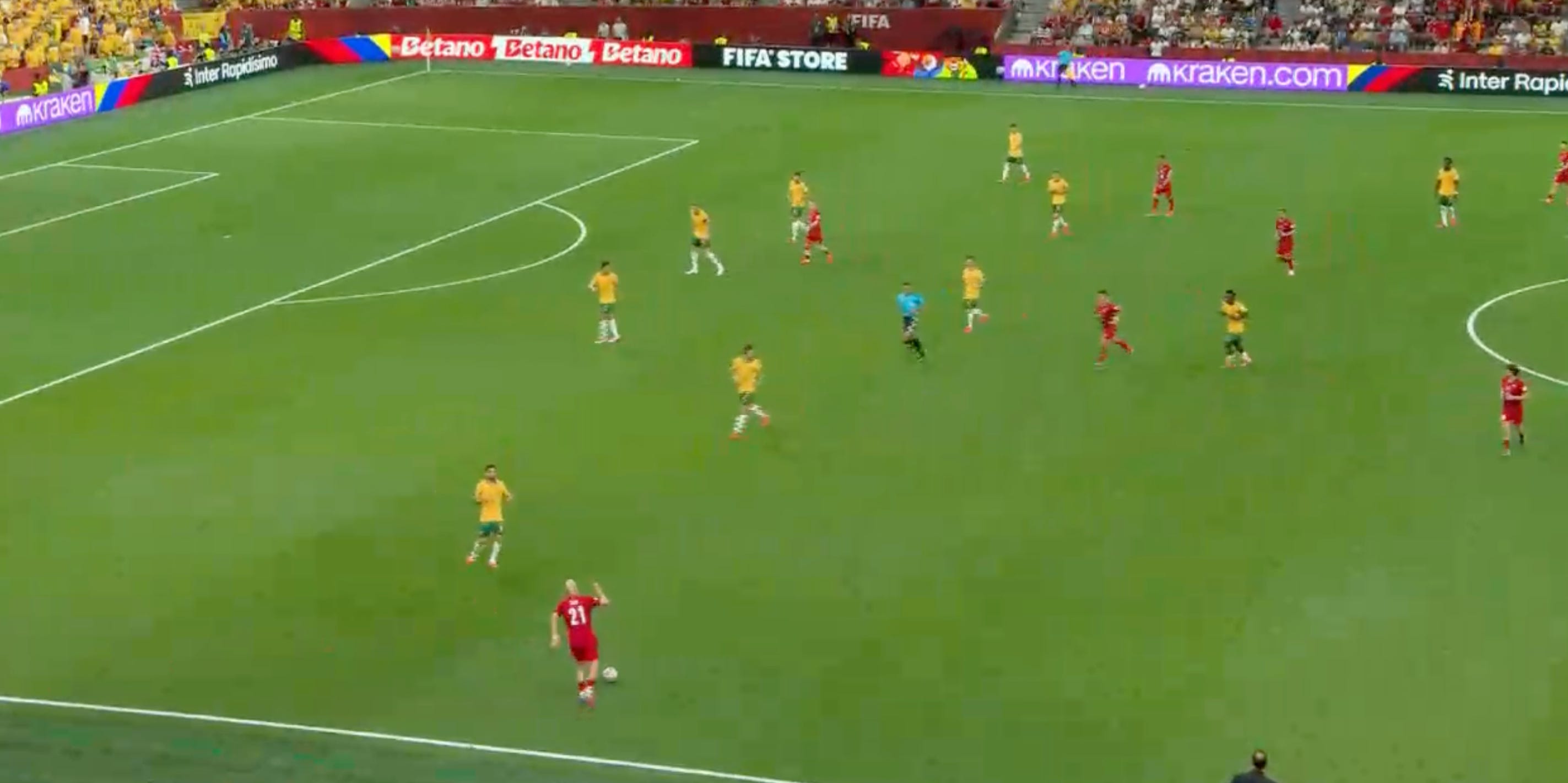
And not being able to have good combination play leads to frustration on the players' side:


Kökçü and Urgency
A lot of the critique I’ve given here boils down to Turkey’s midfield becoming too cramped. So, I simply cannot understand why Vincenzo Montella subbed Yılmaz off for Yıldız at half-time.
Turkey needed Yıldız, so bringing him on makes sense. But when you’re struggling to break through Australia’s block with sheer numbers, as opposed to the ball, surely it makes more sense to move Yılmaz over to the right wing and sub Kökçü off instead..?
Thankfully, this was corrected 17 minutes later, as Kökçü came off for Yunus Akgün, who came on as the right winger.
And Akgün actually tried to make runs in behind:
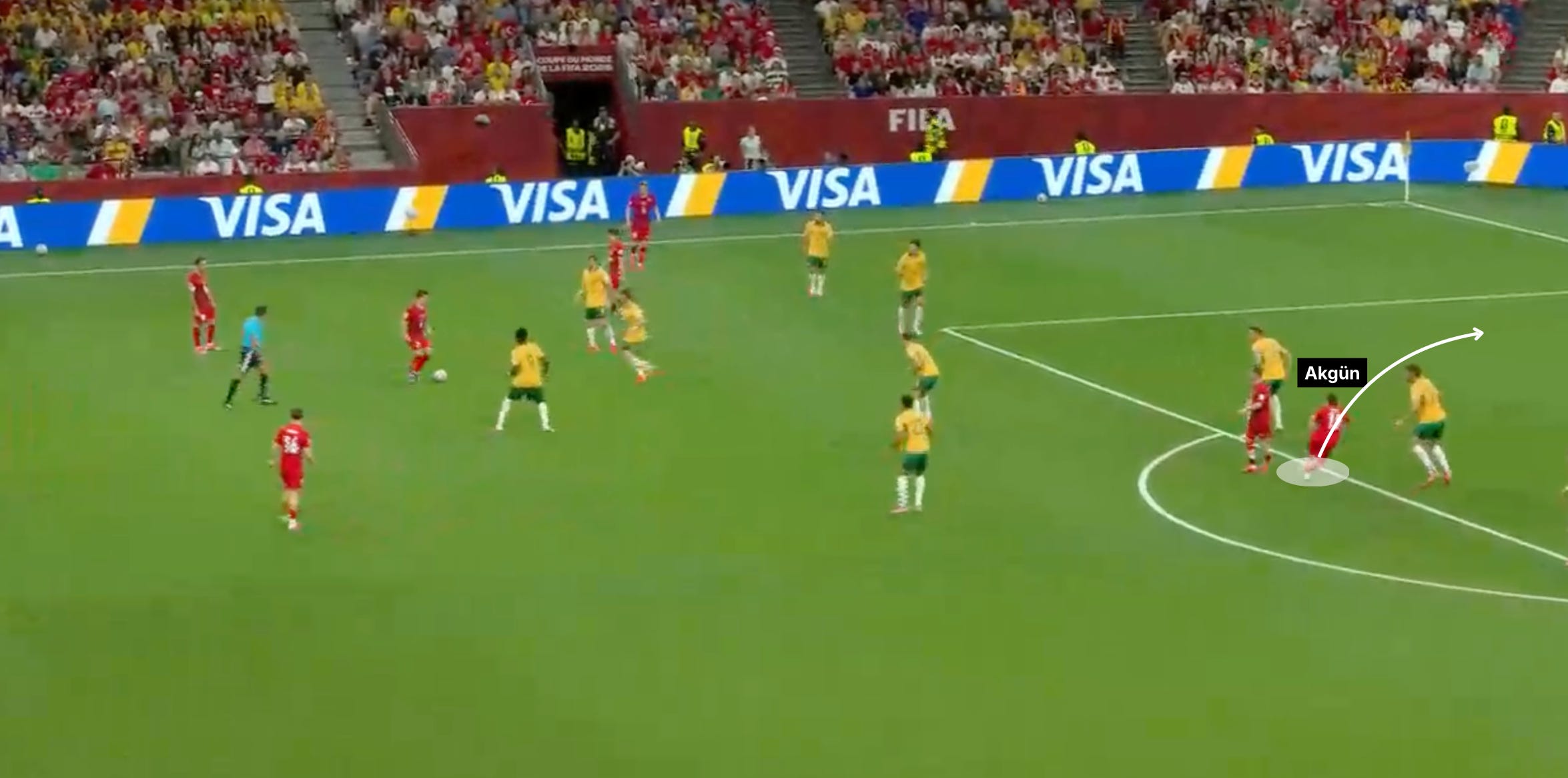
Him, Yıldız, and the urgency stemming from Turkey's need to score generally took their play up a notch. Kadıoğlu's combinations on the left immediately improved, with him helping pin Australia's RCB, Alessandro Circati, back, such that Yıldız was 1v1 with Jacob Italiano, from where he could drive toward the byline.
A Lack of Defensive Organisation
I’d earlier mentioned how pressing Turkey aggressively in the first phase can effectively take them out of the game, and I stand by that.
Turkey’s four attackers were 5’8” (Aktürkoğlu), 6’1” (Yılmaz), 5’9” (Kökçü), and 5’9” (Güler).
Australia’s five defenders, meanwhile, were 6’0” (Bos), 6’4” (Burgess), 6’6” (Souttar), 6’3” (Circati), and 5’10” (Italiano).
So when Turkey were pressed and Uğurcan Çakır had the ball at his feet, he’d often resort to hoofing it forward, into an area where his players were towered over by the opposition.
What I will give Turkey credit for, though, is that they usually had two or three men near the ball, ready to collect the knockdown should they win the header. Of course, winning the header was the difficult part, but should Turkey do so, they had more than enough support in advanced areas to make something happen.
The issue is that this “hoofing” problem extends to pressing them in the second phase too.
So, if you press Turkey’s CBs aggressively enough such that they’re forced out to the touchline, they’re going to have to hoof the ball long. Once they do, Australia effectively regain possession, from where they can counter. And look at the space they have to counter into:
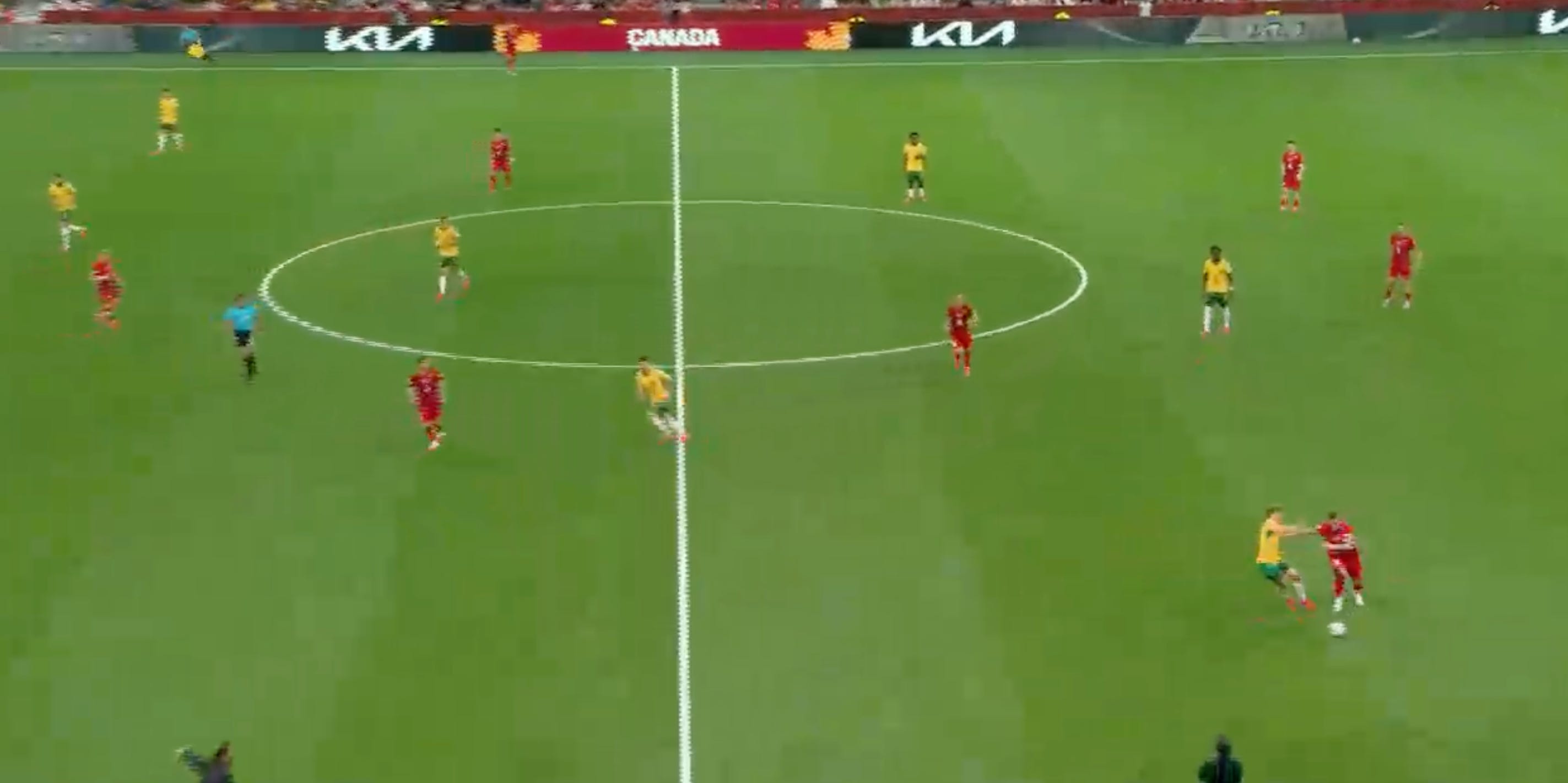
Furthermore, Turkey were themselves very gettable in transition. My previously mentioned point about the midfield getting clogged by similar players wanting to occupy similar zones extends to the defence too.
So, when the midfielders press together, without any real intensity or variety, it’s just so easy to slice them apart with one pass, at which point you’re free to run at Abdülkerim Bardakcı and Merih Demiral:


There’s also some general confusion in the press, and that’s what cost Turkey their second goal.
Kadıoğlu has two players he can press here. He goes after the player on the touchline, while the entirety of Turkey’s midfield is lined up in no-man’s land:
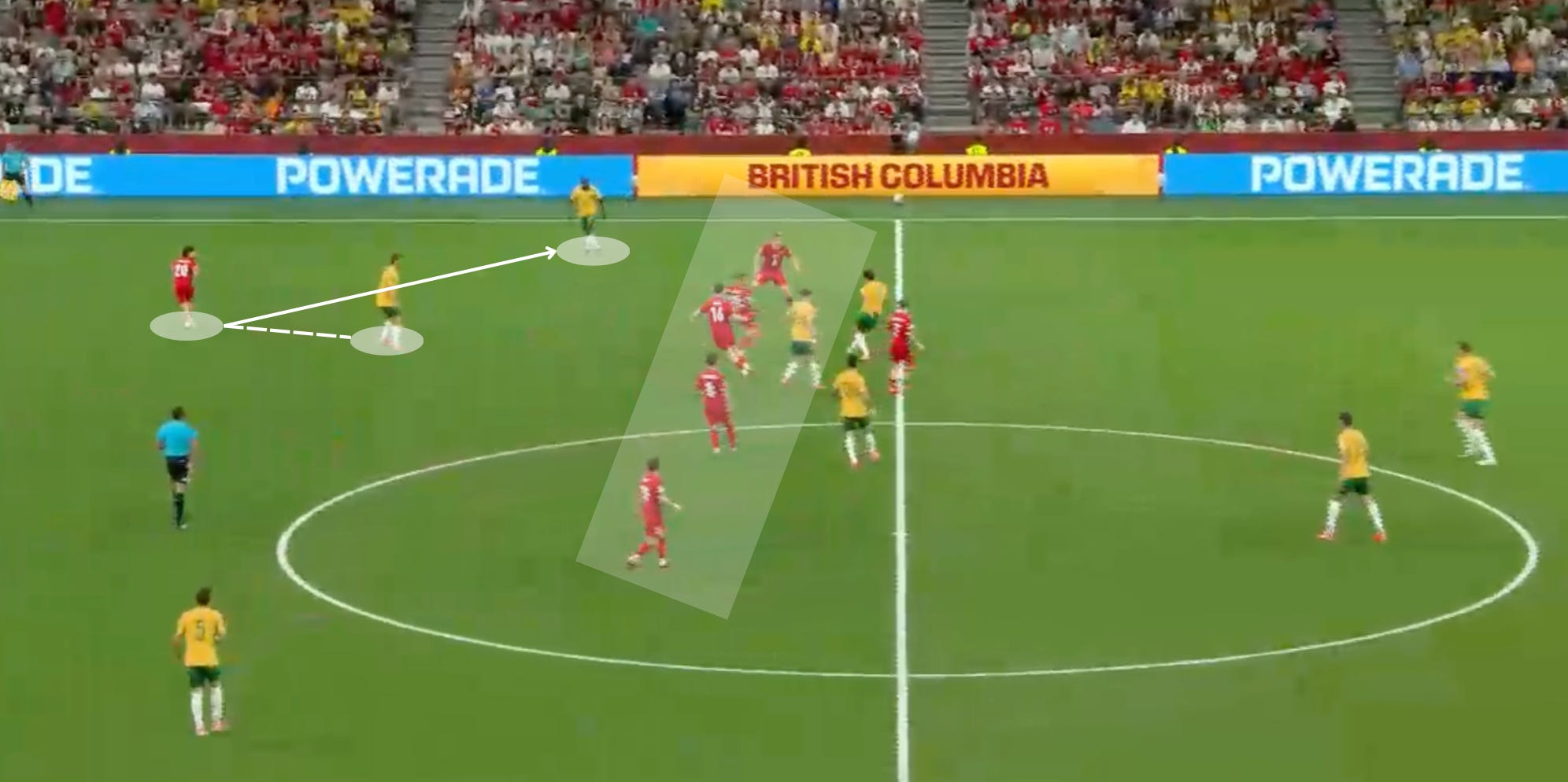
The player Kadıoğlu didn’t go after ended up scoring. You can’t blame him here at all, really; too much was being asked of him defensively.
What this does show, however, is that there are some basic issues of distance and cohesion in Turkey’s defensive shape, and something Montella must fix as soon as possible. The USA will carve through it. Mauricio Pochettino makes his players fit, and they run, and run, and run, whilst Turkey... don’t.
What’s Next for Turkey?
Turkey are pretty lucky to be facing Paraguay next as opposed to the USA, but there are some challenges they’re bound to face along the way.
Whilst Paraguay’s 4-1 loss to the USA may say otherwise, they ultimately have a really good defence. They stayed compact during the World Cup qualifiers, conceding only 10 goals in 18 games. Paraguay do have a big weakness in transition, though, given they HAVE to overcommit to attacks, as they don’t sustain enough possession to control games.
Hence, this is a good opportunity for Turkey to work on their transition play, as well as their ability to break down a deep block. They’re also going to be up against some hero ball in transition, so it’s important for the midfield to stay compact.
Ultimately, Turkey’s biggest challenge will come vs the USA, who are, at the moment, exactly Turkey’s kryptonite given how they press. Nevertheless, the game vs Paraguay is a must-win, should the Turks have any hope of progressing from the group.
All things considered, I’d like to see a lineup like this:


With X hopefully being Can Uzun, but, alas.
The main change I’d like to see is for Kökçü to be replaced by Yılmaz or Akgün. I do think Kökçü is a generally decent player; it’s just that this side needed incisiveness through runners, and that’s better left to wingers.
Thank you for reading. I hope you enjoyed. If you did, please consider subscribing (it’s free):
And sharing this with a friend:
And, most importantly, take care, and have a great week ahead!
If you’re interested, here’s some more of my work:


Great analysis 👏 Enjoyed reading. Fully agree with your suggested lineup, hope Uzun gets enough time.